|

|
|
NEW MUSICAL EXPRESS -
AUGUST 1, 1970

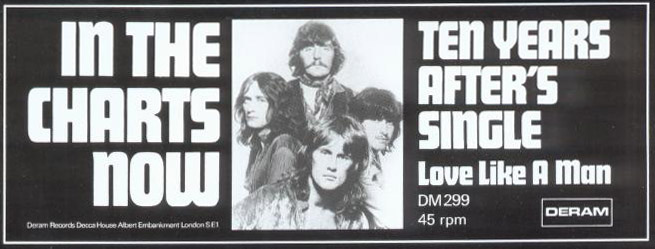
(Love Like A Man)
Chick Churchill has suddenly learned to come to terms with
the pressures of his environment. He now appears to be far
happier and more contented than I have ever seen him look
before.
I wondered if this was perhaps due to the fact that Ten Years
After are on the NME charts with "Love Like A Man."
To be honest, Chick wasn't aware of his newly acquired status
until I broke the glad tidings to him. The reason for this was
that he had just flown into London for a brief stop-over
half-way through TYA's lengthy, strenuous coast-to-coast tour
of the American continent.
Actually, Chick was more concerned with the fact that he had
forsaken the perils of the dreaded nicotine habit, though he
admitted rather sheepishly that he'd accidentally fallen off
the "juice wagon" the previous evening. This was
forgivable, as it was his first lapse in all of twelve months.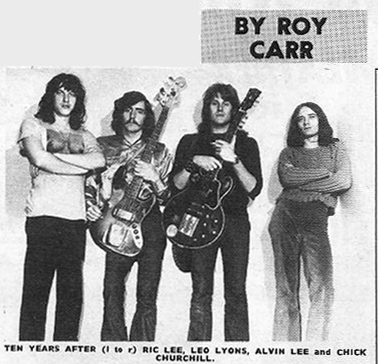
POP STAR?
Following jokes about him being a "pop-star." Chick
was quite frank when he confided with a shrug of his straight
frame that he couldn't relate as to what a hit single meant to
Ten Years After. "As this was originally an album cut, we
haven't got a follow-up prepared," he admitted. I suppose
you could say that groups like TYA don't really need singles,
as their policy is directed more towards the album market.
However, I'm sure that it gives them a great sense of
achievement and personal satisfaction when they make in-roads
into the realm of ballads and bubblegum.
Prior to its release , "Love Like A Man" presented
Ten Years After with many problems as Chick made pains to
point out. "Originally it was a track off our "Cricklewood
Green" album, but the record company said that with tight
editing it could be a good single. "We agreed to let them
do it on the understanding that we could use an extended
"live" version of the same song, which we had cut at
the Fillmore, on the flip side." In fact this record made
phonographic history in that the A-side was at the standard
speed of 45 r.p.m. while the B-side was cut at 33 r.p.m to
accommodate the lengthy concert version. "Naturally, it's
the Fillmore cut that I enjoy most of all," Chick
admitted, who then quickly points out: "I also like the
original version on the album." With a big smile, he drew
attention to the fact that there are now three different
versions of the song available by the group.
Though perhaps the most lucrative, the summer is not always
the best time of year to tour the States, specially with its
ever changing patterns of behaviour and values. "The
recent Atlanta Music Festival created much press copy, but not
for the music. TYA were one of the many attractions on it and
Chick told me about it. "The Festival scene in the States
is getting very strange. There seems to be a movement that
says that people shouldn't pay admission to see a rock
concert. They should all be free because all the groups really
belong to the people."
It goes without saying that is a most ludicrous philosophy and
one that can only cause trouble.
Continuing, Chick explained: "From what I can gather,
only 50,000 actually paid at the Atlanta Festival. About a
QUARTER OF A MILLION got in for free.
SPIKED!
"On top of that, it seems as though all the drinks
backstage had been spiked with acid, with the result that they
had to fly quite a number of people to the hospital by
helicopters. "The spiking of the drinks was a most
irresponsible thing to do because some people were very ill.
And with the place being crowded, they completely freaked."
British groups returning from across the Atlantic are nearly
always full of alarming stories about the increasing hassles
of working in the States. "I just can't put my finger on
it, but it's all getting a bit uptight. Perhaps it could be
something of an anti-reaction towards Woodstock, but I'm not
sure," he went on. Enquiring about the aftermath of TYA's
rather splendid presentation in the filmed documentary of
Woodstock. Chick informed me: "It has given the group a
great deal of respect everywhere we've appeared in the States,"
Due to return to the States the next day to resume the group's
cross-country trek, Chick confessed: "The novelty of the
States is wearing off. I'm not knocking the place, because
it's a beautiful country. It's just that I feel that the
Americans can't fully realize the turmoil and violence that
they are living in." Obviously Chick can, and for a
second his smile completely vanished.
|
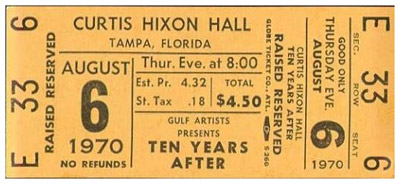
Ten Years After Tour
Schedule For 1970 - August
August 6, 1970 – At
The Curtis Hixon Hall in Tampa, Florida
August 7, 1970 – At
The Goose Lake Park Festival, in Jackson, Michigan
August 8, 1970 – Ten
Years After play at The Strawberry Fields Festival in
Moncton N.B.
August 30, 1970 –
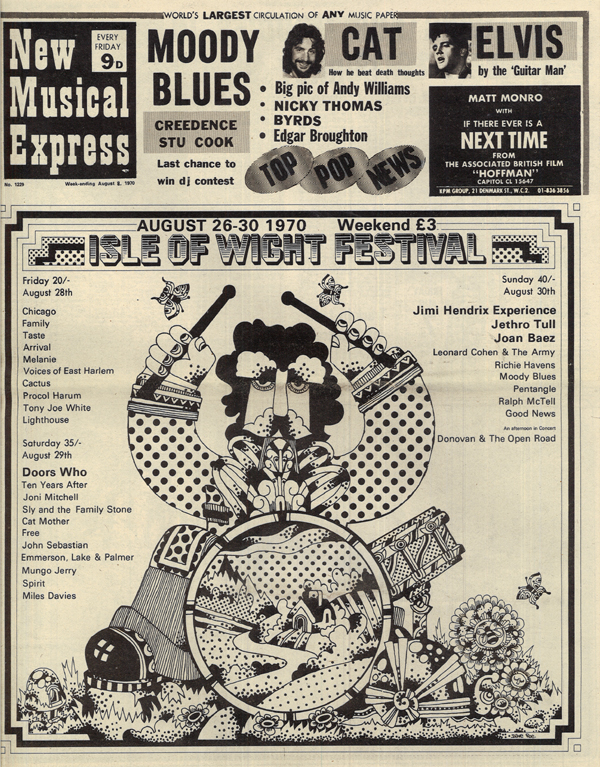
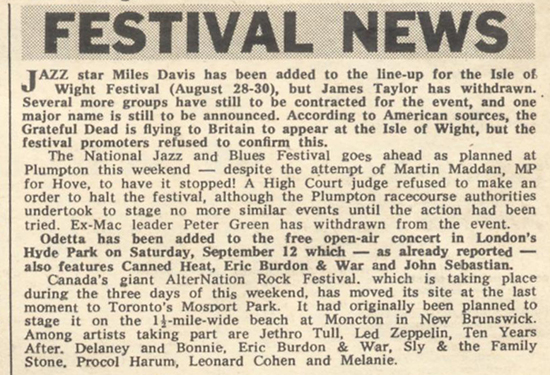
Ten Years After perform at the Isle Of Wight Festival at
Afton Downs, England.
|
|
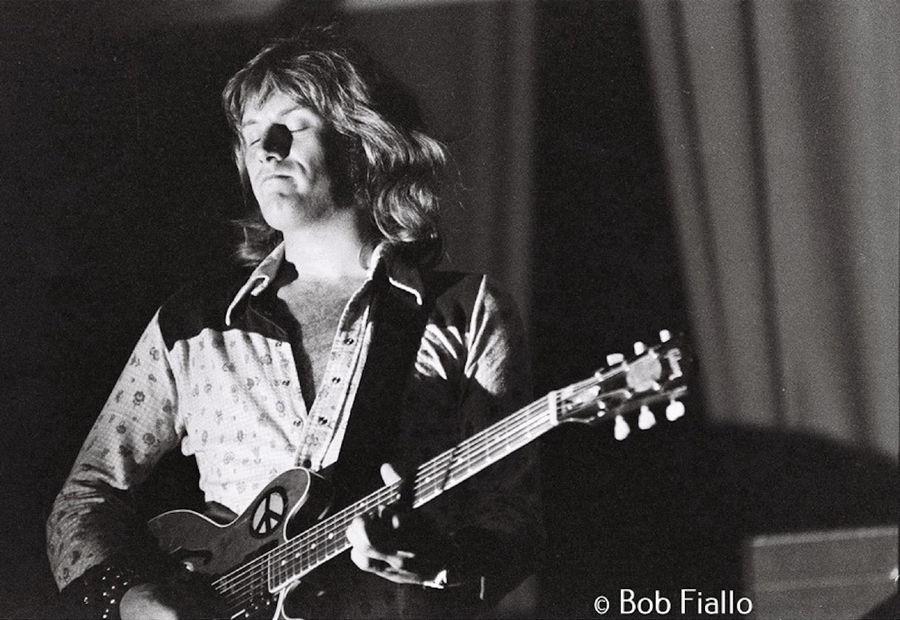
August 6, 1970 -
Curtis Hixon Hall, Tampa, Florida - Photo: Bob Fiallo
|
August 1970 - Musik
Express Magazine
NME - August 8, 1970
|
August 7 - 8 - 9,
1970
Goose Lake International Music Festival,
Goose
Lake Park
with
Ten Years After -
August 7, 1970
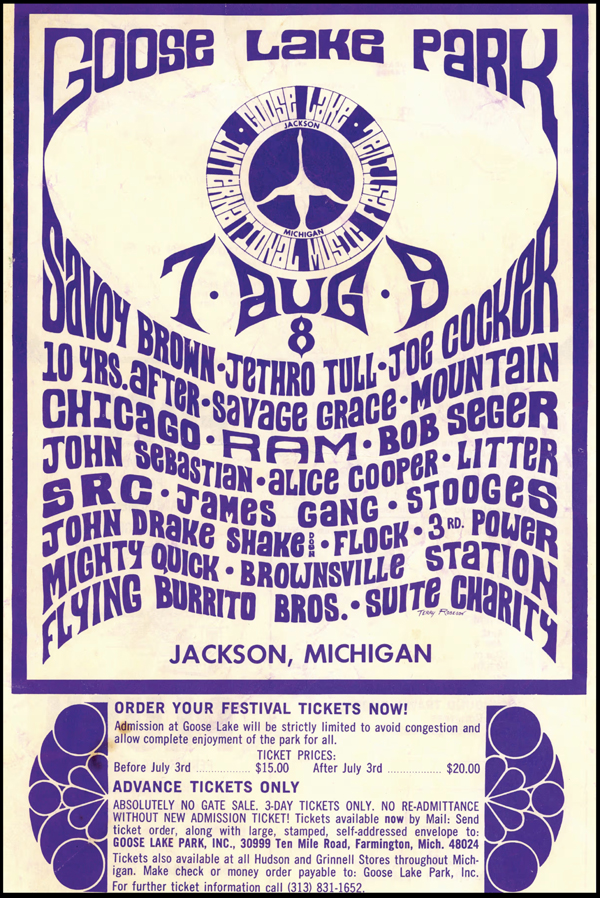
The
event was an outdoor rock festival that was held from August
7th through the 9th 1970, located in the Leoni
Township of Jackson, Michigan. The festival was strongly
opposed by the local residents, who failed to prevent its
occurrence, despite attempts at litigation.
Approximately
70,000 advance tickets were sold, but contemporary press
estimates report that as
many as 200,000 people actually
attended. The festival was characterized by the widespread use
and exchange of hard drugs. The local authorities chose not to
intervene in the open drug use for fear of starting a riot and
causing a violent scene. It was bad enough that the festival
attendees were forbidden from leaving the grounds once they
entered. The entire area was surrounded by a razor sharp wire
fence, that was under constant police patrol, including
persistent helicopter surveillance.
There
is 8mm film footage of this concert, but not with a lot of
music in it. There is,
Ten
Years After performing “Sweet Little Sixteen” along with
The Stooges doing their song “1970” and playing together
live for the last time. Leslie West and Mountain doing their
new hit song from a few months before, called “Mississippi
Queen” written by Corky Laing, along with some local Ann
Arbor bands performing.
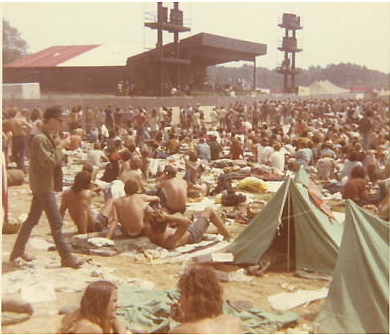
 This
(basically) home-movie film is a time capsule from 1970 and
the hippies from that period. The influential line-up included
Jethro Tull - Ten Years After and John Sebastian, the latter
two fresh from their Woodstock appearances the previous summer.
Local talent included Bob Seger, Mitch Ryder and the Detroit
Wheels, Frost and the MC5 supporting the “White Panthers”
and John Sinclair. This
(basically) home-movie film is a time capsule from 1970 and
the hippies from that period. The influential line-up included
Jethro Tull - Ten Years After and John Sebastian, the latter
two fresh from their Woodstock appearances the previous summer.
Local talent included Bob Seger, Mitch Ryder and the Detroit
Wheels, Frost and the MC5 supporting the “White Panthers”
and John Sinclair.
Just to keep the record straight, Alice Cooper –
Joe Cocker and Savoy Brown were listed on the hand bill to
attend this gig, they didn’t come. MC5 and Rod Stewart were
added at the last minute as replacements.
According
to reports, 13,000 Kilos of marijuana were digested at the
three day festival.
The
headlines in the local newspaper reported, “125,000 and
still coming”. The reporter also stated: “Goose Lake
Park’s Rock Festival is no country fair, or worlds fair –
It’s a young person’s fair”.
John
Sinclair was one time manager of the band “MC5” and also
leader of, “The White Panthers Party”, which was a
militantly anti-racist counter – cultural group of white
socialists who were seeking to assist the “Black Panthers”
in the Civil Rights Movement. He was also a distinguished poet
as well as the president of the Cinema Guild.
As
a final detail: After this concert took place, the local
residents passed a law that forbid any concert of this type
ever taking place at Goose Lake Park or surrounding areas
again.
|
The Goose Lake
International Music Festival – Friday August 7th
through Sunday the 9th
Friday
August 7th Featured Acts Are:
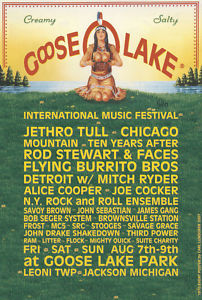
The Mighty
Quick, John Drake’s Shakedown, SRC, The New York Rock
and Roll Ensemble, The Flying Burrito Brothers, John
Sebastian, The MC5, Chicago, Rod Stewart and The Faces
and Ten Years After.
Saturday
August 8th Featured Talent:
Third Power,
Brownsville Station, The Litter, Tee-Garden and Van
Winkle, The Stooges and Mountain.
Sunday
August 9th Featured Talent:
Suite Charity,
Tee-Garden and Van Winkle, Mitch Ryder and The Detroit
Wheels, Bob Seger, The Frost, The Flock, Savage Grace,
The James Gang and Jethro Tull.
Originally scheduled to appear, being listed on
posters, flyers and on tee-shirts, but were no-shows:
Joe Cocker, Alice Cooper, Ram and Savoy Brown
|
|
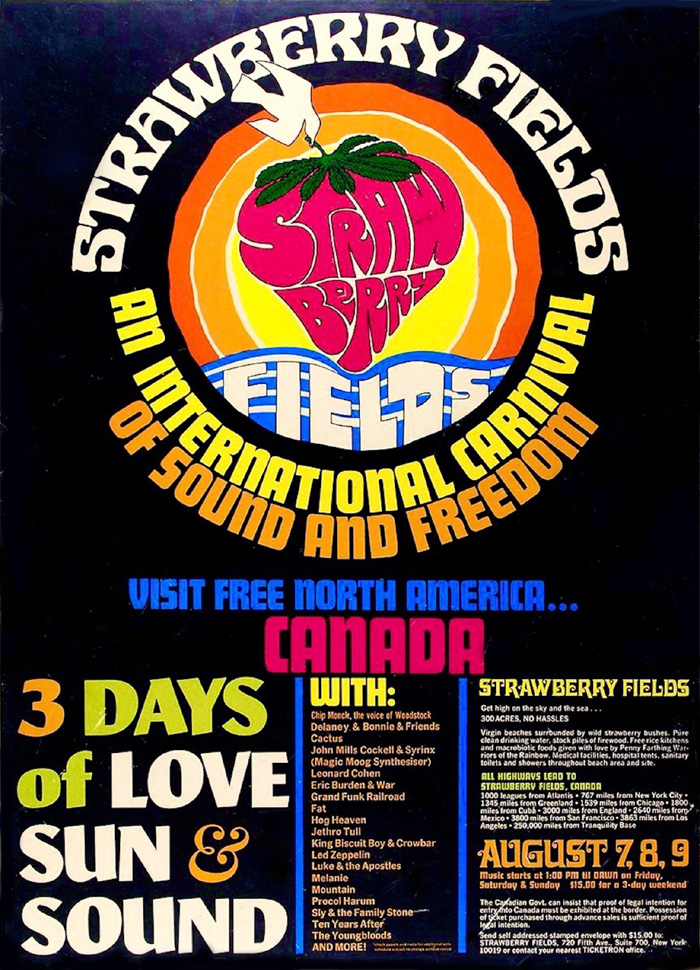
August 7 - 8 -
9, 1970
Strawberry Fields Festival
Poster
Mosport Park, Bowmanville,
Ontario, Canada

|
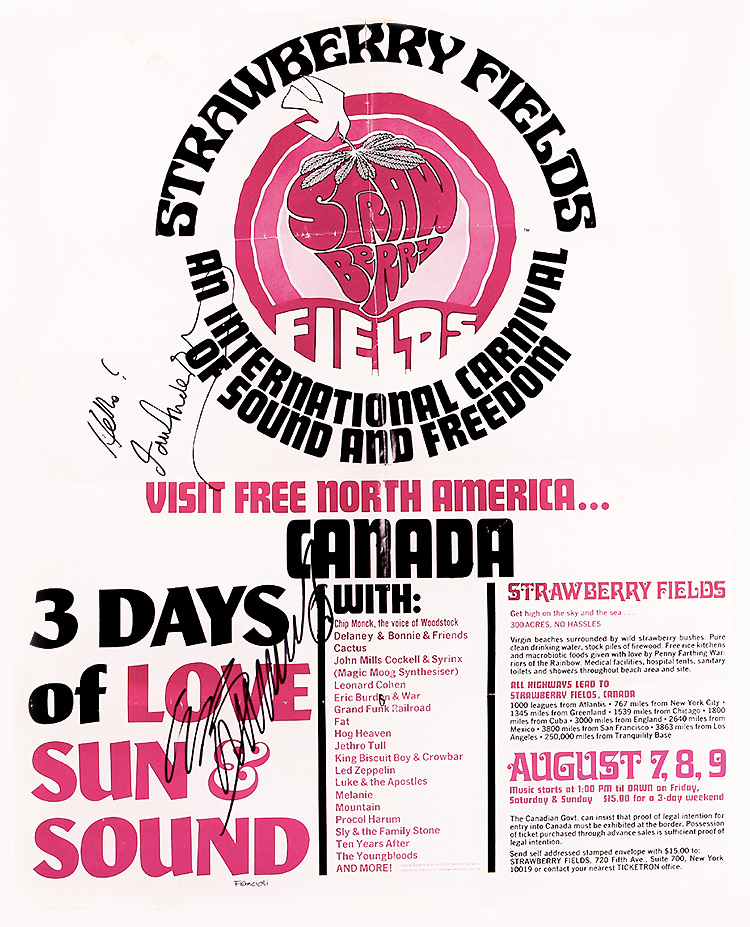
August 7 - 8 - 9, 1970
- Strawberry Fields Poster, signed by Ian Anderson
|
TEN YEARS AFTER:
Strawberry
Fields Pop Festival 1970
Moncton,
Canada
Featuring
Music Artists:
Led
Zeppelin – Janis Joplin – Ten Years After – Sly and the
Family Stone – Grand Funk Railroad – Leslie West and
Mountain – Leonard Cohen – Jethro Tull ….
It
took place at the Mosport Park Raceway in Bowman, Ontario,
Canada – which is located one hundred kilometres east of
Toronto. It’s reported that between 450,000 and 500,00 were
in attendance, and the festival took place on August 7-10 1970
just one year after the Woodstock Festival. A three day ticket
cost $15.00.
It
was originally intended to be held by John Brower with John
Lennon and Yoko Ono to host the “Toronto Peace Festival”
but their permits were denied. The Canadian Security Service
began spying on John and Yoko after they announced the plans
to host this festival.
The
“Strawberry Fields Festival” was promoted heavily in the
United States as a three day rock music festival – “Love
– Sun and Sound”. The concert was emceed by the one and
only Chip Monck who was also the host of Woodstock 1969.
Other
Artists on the bill Included:
Jose
Feliciano, Delaney / Bonnie and Friends (Eric Clapton), The
Young Bloods, Melanie, Hog Heaven,
Freedom Express, Leigh Ashford, Fat Chance, Cactus, Syrinx, Crowbar, King Biscuit Boy
Luke and the Apostles,
Lighthouse, Alice Cooper, Eric Burdon and War
It should also be noted that - Led Zeppelin and Leonard Cohen –
were no shows at this event.
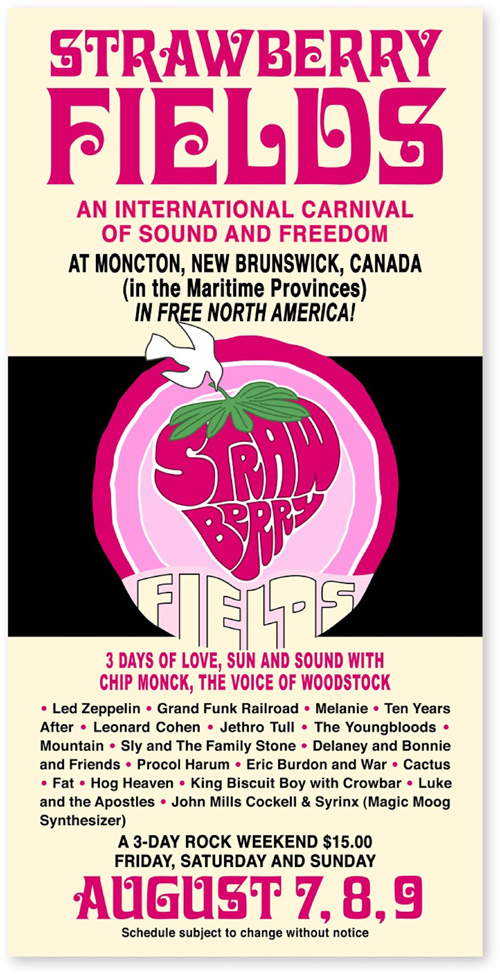
Strawberry Fields Festival, Moncton Maritime Province, New
Brunswick, Canada
|
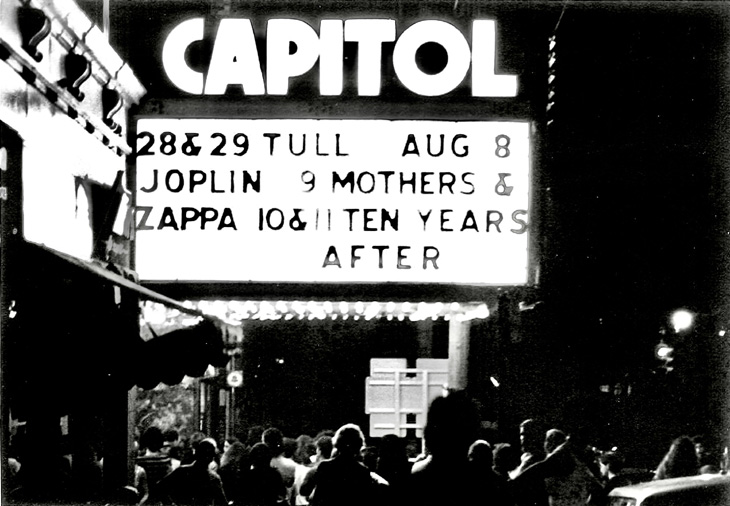
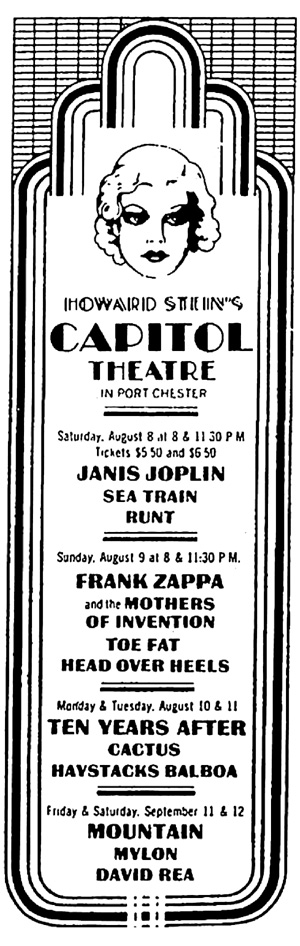
August
10 & 11, 1970 - Capitol Theater, Port Chester, New
York
|
Evening Post and News – Wednesday August 12, 1970
On the Square – Alvin and Company Are
Top City Dollar Earners … Rock Goes A Million.
Led Zeppelin and the Rolling Stones
are probably the only two bands that would currently outsell
them. If Nottingham’s financial wizards ever got together to
work out who or what are the city’s biggest dollar earners, some
of the answers would probably cause a raised eyebrow or two.
Because, right up there at the top of the list, rubbing
shoulders with the city’s industrial giants would be for
outrageously long haired and even more outrageously dressed
young men guaranteed to bring a shudder to the gnomes of
Nottingham. The four young men are known jointly as Ten Years
After. And if that doesn’t mean anything to you it illustrates
my point exactly.
Ten Years After is a rock music band
which has enjoyed only moderate success in this country –
nothing to cause more than a faint financial fluctuation on the
city’s ledgers.
But start taking the band’s
American
profits into account and some of Nottingham’s export giants are
rocked and rolled right to the bottom of the list. The band’s
four LP’s alone have rung up millions of dollars on the American
cash registers. Alvin Lee and Company – as he’s generally
regarded as the man owning the the fastest guitar playing
fingers in the business
of serious rock music are among the
three or four British bands guaranteed to draw capacity crowds
where ever they play in America.
Festivals. They’ve been featured at
all the big rock festivals including Woodstock, on the film
version of which they receive a significantly large portion of
time, and are constantly in demand for one night stand tours of
the States. Poor Old Alvin is even in the unfortunate position
of having to instruct his agents that he doesn’t want a separate
limousine from the rest of the band, in which to travel from
town to town during tours. Such is fame.
Before the days of wine and roses,
Alvin Lee and Chick Churchill from Nottingham and
Leo Lyons and Ric Lee from Mansfield, the band’s original
line up, could be found at local hops in Sutton, in Ashfield as
the Jaybirds. Next step was Mansfield, Palals, Nottingham,
London, America – and whatever’s next is anybody’s guess.
|
|
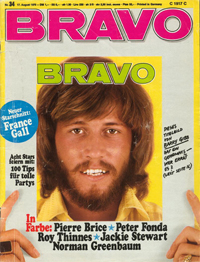
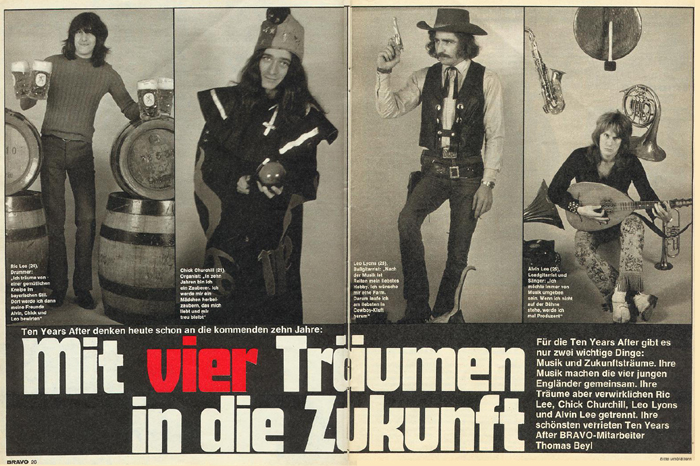
BRAVO No. 34 - 17 August 1970
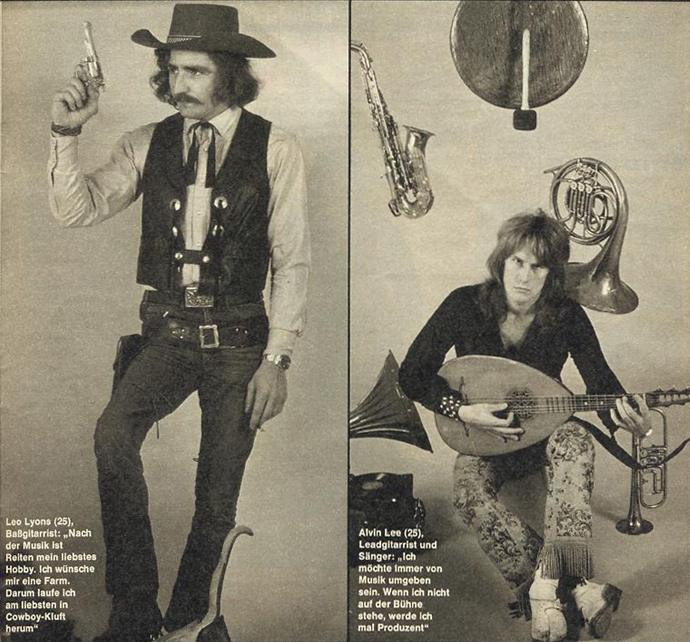
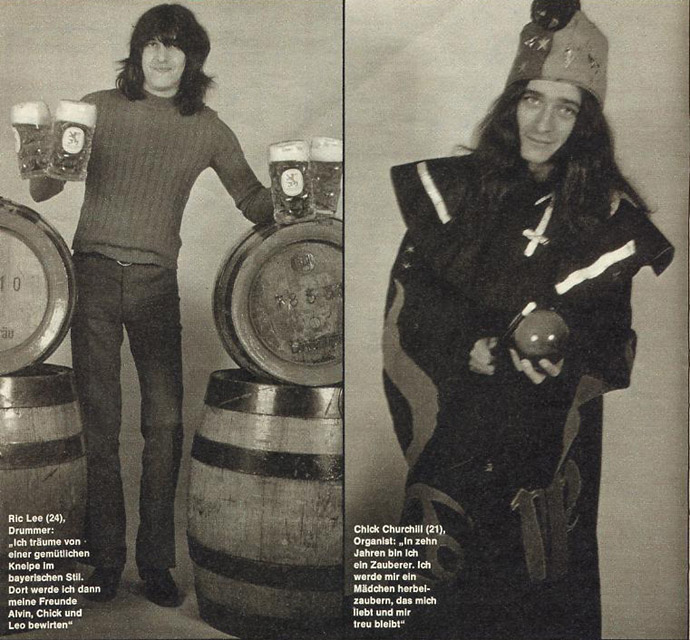
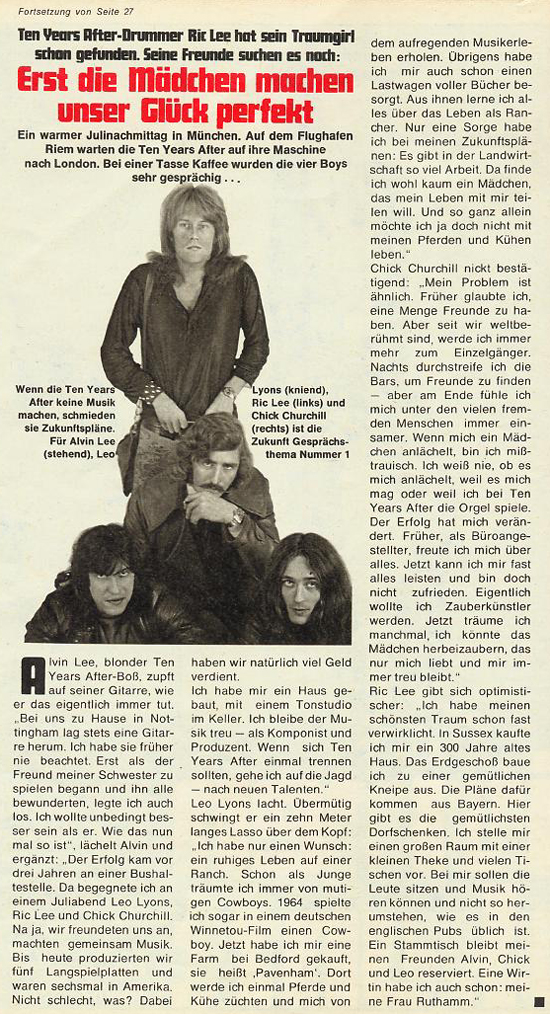
|
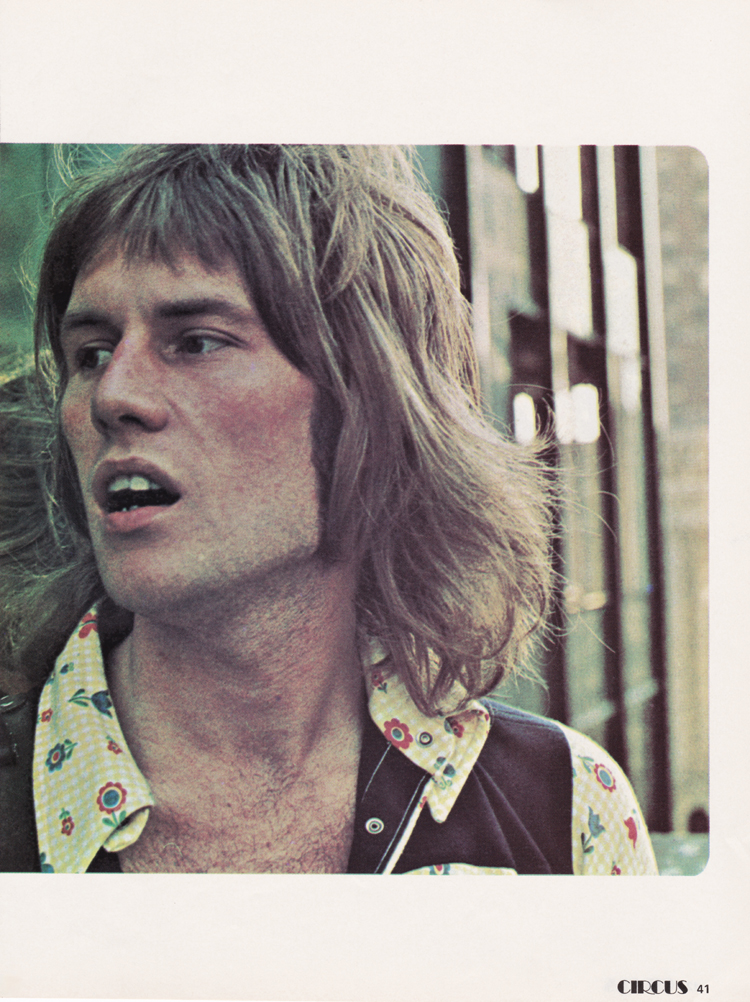
September 1970
- Circus Magazine USA
Photos: Jerry
Tobias
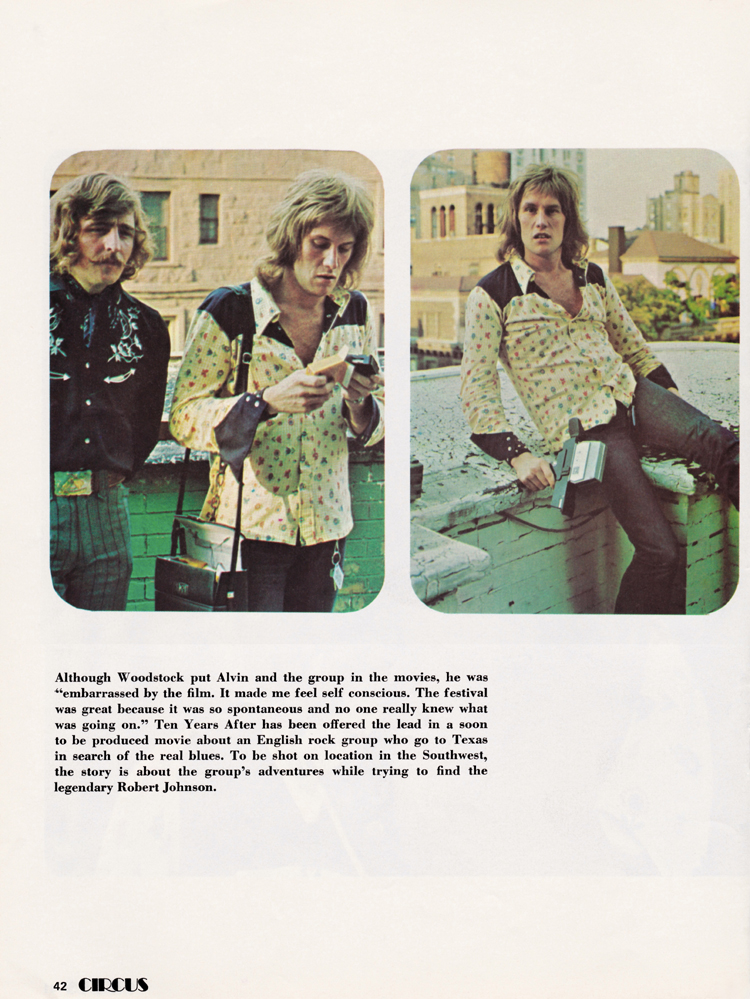
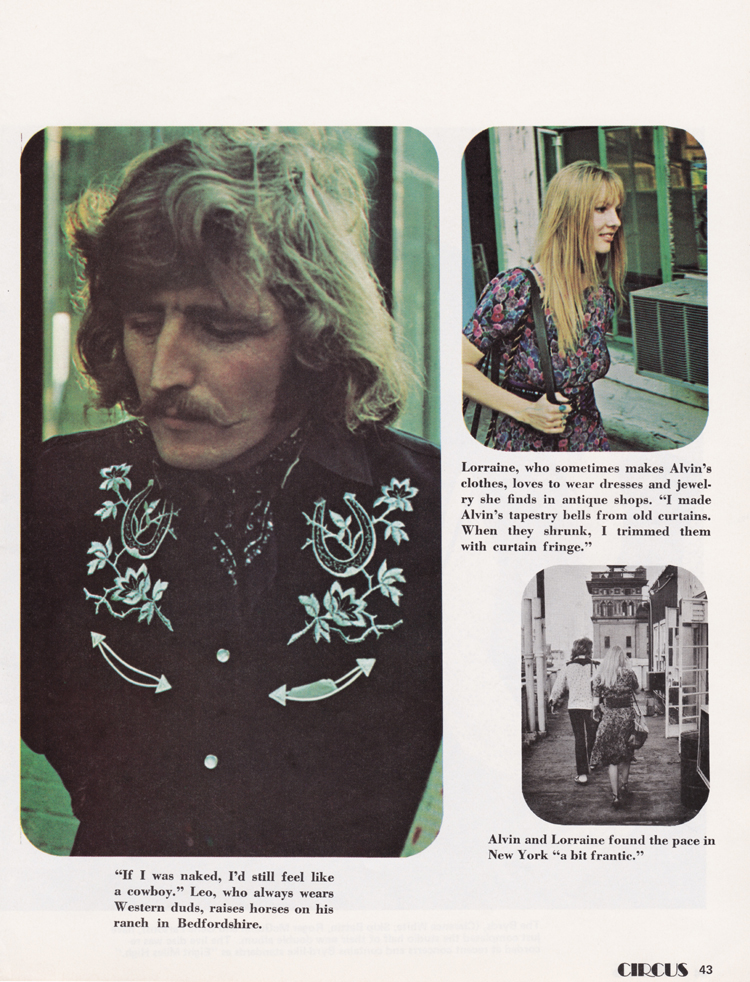
|
BERLIN
SUPER CONCERT 70
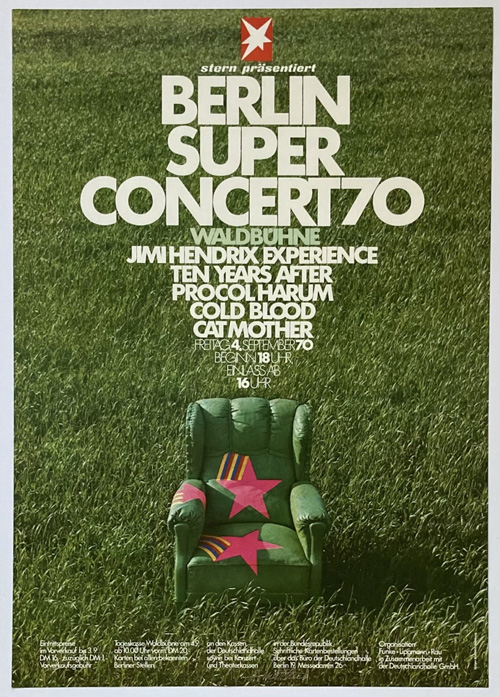
At Deutschland
Halle Berlin, Germany
Held September 4,
1970 – The festival was headlined by Jimi Hendrix and
featured, Ten Years After, Cold Blood, Cat Mother, Canned
Heat and Procol Harum.
Jimi Hendrix
Experience were the headliners of the event and played
their signature “Sunshine Of Your
Love” and “Purple Haze” which of course whipped the
audience into a real frenzy, and then the bootlegged Roman
Candles started going off everywhere…bouncing off of the
rafters, into the crowd, off the crowd and onto the stage.
Amazingly, the Deutschland Halle didn’t catch on fire and
burn to the ground. It’s a wonder!
This was also the
second to last show that Jimi Hendrix would perform at.
After this Jimi did the Open Air Love and Peace Festival
in Fehmarn, Germany. He died on September 18, 1970.
Canned Heat
But, the first
casualty happened the day before this event, with the
sudden death of Alan “Blind Owl” Wilson on September 3,
1970. Alan was co-founding Canned Heat member along with
Bob “The Bear” Hite. Alan played harmonica, guitar,
vocalist and song writer.
Canned Heat had a
huge loyal following in the late 1960’s and early 1970’s.
They could always be counted on to deliver a “Heated
Performance” of extremely cool heavy attitude blues rock.
Their two best known songs, “Going Up The Country” and “On
The Road Again” had every nook and cranny of the huge
Deutschland Halle arena rocking heavy.
Procol
Harum – Performed their “Progressive Symphonic” rock
style set. Including their biggest hit from 1967 “A Whiter
Shade Of Pale”. All I can remember at this concert however
was “Oh, my god…it’s Procol Harum”.
Note: Cat Mother and Cold Blood did not appear,
instead Birth Control.
This festival was supposed to be an outdoor festival at
"Waldbühne", but because of bad weather it took place at
the Deutschland Halle.
|
|
Ten Years After Tour
Schedule
September - 1970
September 4, 1970 – Deutschland Halle
in Berlin, Germany. This event was also
promoted as the “Super Concert 70”. Also on the bill with
Ten Years After were, Jimi Hendrix, Procol Harum, Canned
Heat, Cat Mother, and Murphy Bland.
September 5, 1970 –
Hamburg, Germany
|
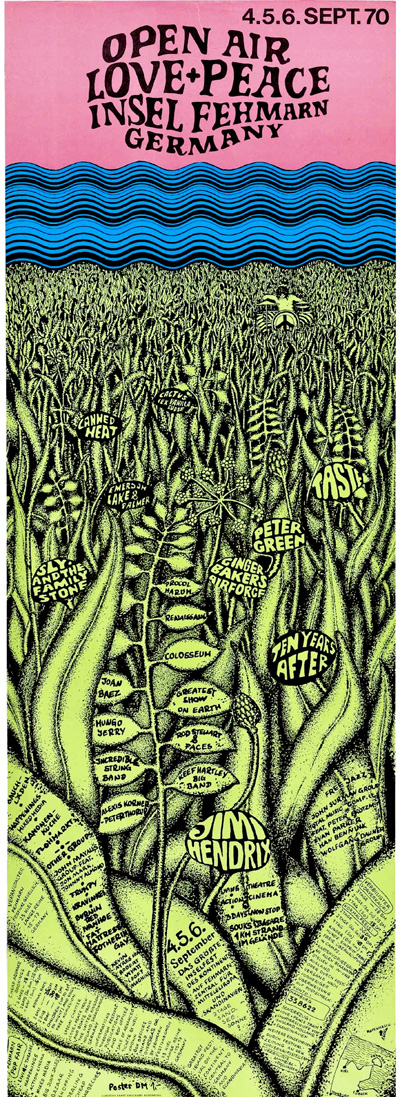
September 6, 1970 –
At The “Love and Peace Festival” at the Isle Of Fehmarn,
Germany.
Ten Years After were
due to perform at this festival, but due to severe thunder
storms and high winds, that incidentally tore the entire
stage apart, to the ground, it was impossible for the band
to play at all.
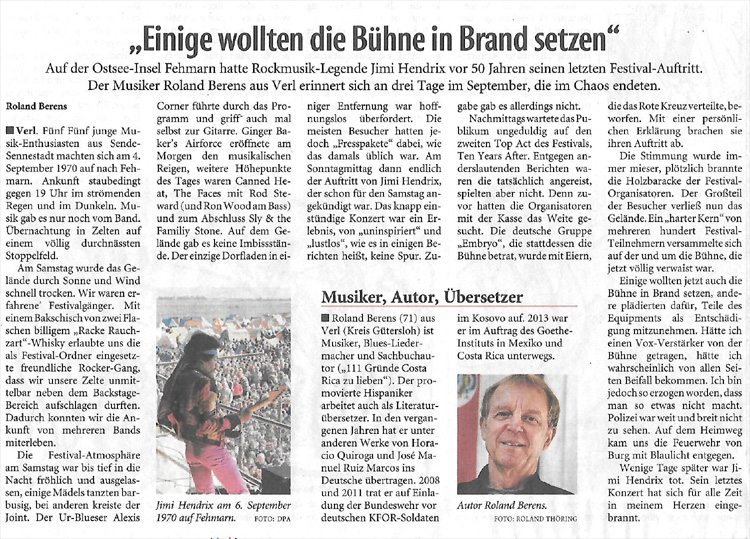
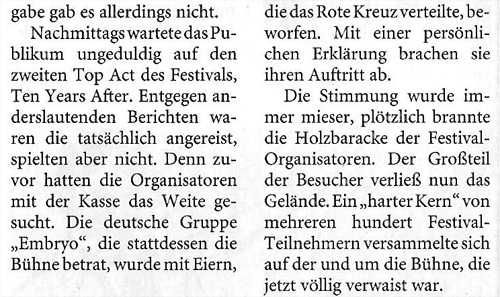
Herforder Kreisblatt,
September 2020
|
|
|
The Love and Peace
Festival, Fehmarn – September 4th through the 6th 1970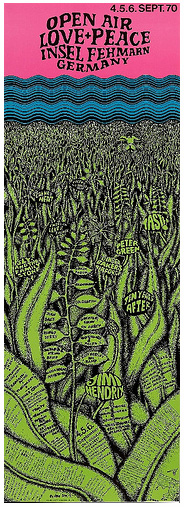
In 1970 three young
Germans had a dream. Helmut Ferdinand 33 was an Engineer,
Christian Berthold 28 was an Inn-Keeper and Tim Sievers 30
was a student, planned a European equivalent of the all
American Woodstock Festival that took place the year
before. They were also inspired by the Isle of Wight
Festival as they liked the idea of having it on an island.
Which quickly led to the realization of the Isle of
Fuhrman, a well connected island located between Germany
and Denmark. They were hoping to entice the artists playing
at the,
Isle of Wight to
come over and play their festival as well. The date for
this new festival was set for September 4-6th.
The idea was to feature 30 to 40 bands that also included
Top International
Talent. But what they got instead was closer to a nightmare
than a heavenly situation. They got the heavy torrential
rains of Woodstock, only this time lasting all three days,
the rain more on than off. It was also colder in September
than the August weekend of Woodstock. They got the Altamont
version of the Hells Angles Pseudo Security Force, heavily
armed, ignorant and brutal as always, causing problem
everywhere they went. As if this wasn’t bad enough, they
also got the ugly side of the Isle of Wight experience to
boot. Although it must be pointed out, that the audience
tolerated incredible hardships for those three days and are
to be commended. Many bands who were promoted on posters
and flyers to perform there either cancelled or showed up,
but because of all the chaos had to leave to fulfil other
commitments. These were: Ten Years After (showed up but
never played) Cactus, who never returned phone calls, or
showed up. Colosseum never made it there, car trouble.
Taste (Rory Gallagher) never showed or cancelled as the
band broke up right after the Isle of Wight concert.
Renaissance – cancelled. The best thing to happen here, was
that Jimi Hendrix did show, did stay over-night and did
play the next afternoon, as the sun finally came out and
lightened everyone’s soul, spirit and overall attitude.
To learn more, I
found this excellent website, to which I highly recommend
it:
www.fehmarnfestival1970.com
|
|
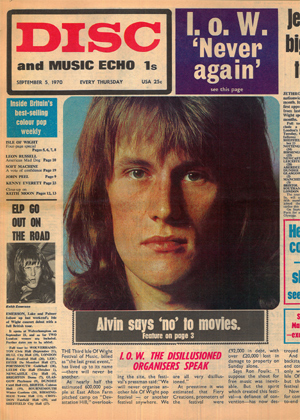
DISC and
MUSIC ECHO - September 5, 1970
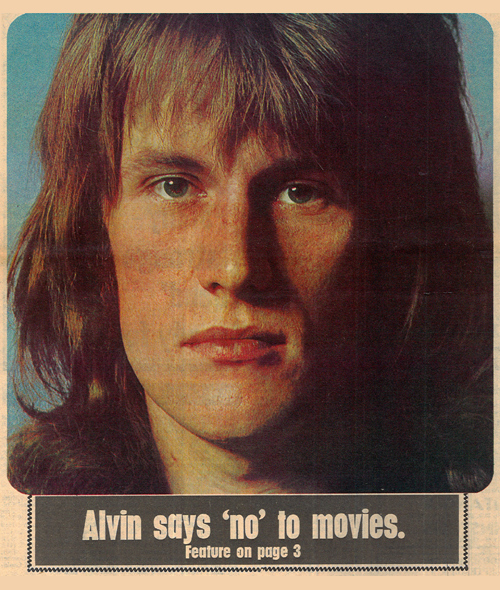
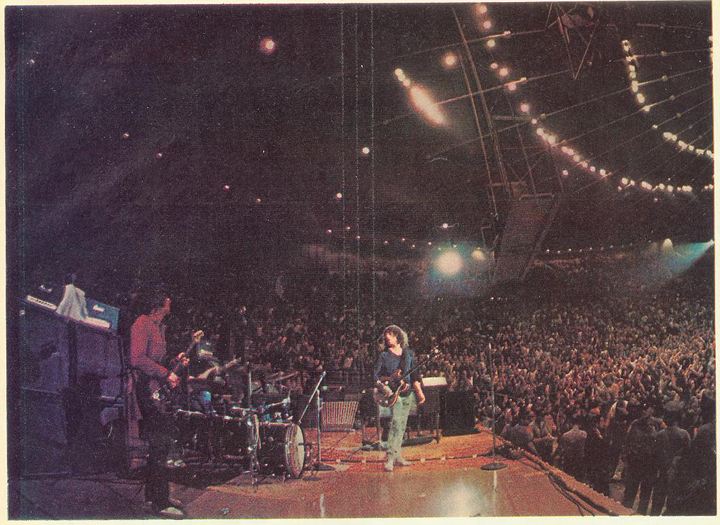
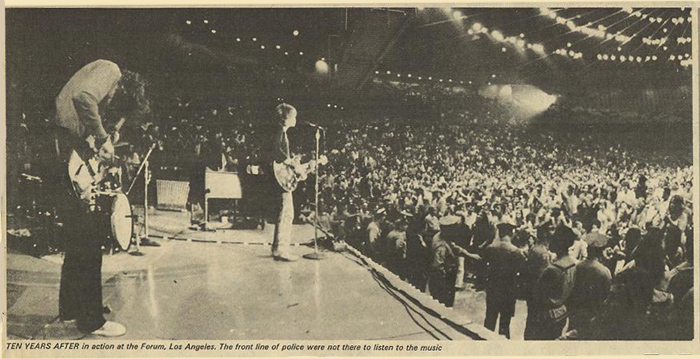
TEN
YEARS AFTER in action at the Forum, Los
Angeles. The front line of police were not
there to listen to the music
Alvin
Lee’s present is catching up with him. Lead
singer and guitarist with Ten Years After and
amateur cine-photographer, experimenter with
electronic sounds, songwriter and producer of
demo-discs for Ten Years After’s songs, the
equipment and possessions that these involve
are encroaching on the living space of his
London W1 mews flat. “I’m moving to a
house in Berkshire. I need somewhere to relax.
American tours and things and things get a bit
hectic and I need a bit of open space and
fresh air when I get back to Britain. “I’m
having the top floor converted into a studio
and all the equipment re-wired”. Alvin’s
involvement with movies and sounds are
something he keeps apart from his work with
Ten Years After. “They’re sort of
glorified home movies. I carried cameras
around and shot a lot of film while we were in
the States, but I don’t have time to do much
with them. I just get a load of cuts and stick
them together, and put some weird noises on
the soundtrack, which amuses my friends and
relatives. I don’t think of it as a
commercial thing. “I like to make
surrealistic sounds rather than that actual
soundtracks, like if someone is talking I
don’t have lip synchronization, just an
echoing mumble going on to give it an unreal
feel. All my films are unreal because they are
mostly taken in America which is unreal for a
start !”
On
the subject of films, Ten Years After’s part
in “Woodstock” has increased the Alvin Lee
cult in America, and Alvin has received film
offers, all of which he has turned down.
“I’ve had two actual scripts. I get the
feeling that the powers that be think: “Here
are people who are well-known, and if we put
them in a film, we’ll get people to come and
see it”. “They all seem to revolve round
British hands in America. A cross between
“Woodstock” and “Easy Rider.” I think
it’s very commercial box office stuff, but
as I am not an actor in the first place, I
feel I can turn such things down.
“They
say I could change things round a bit to suit
myself. But although it would be good fun to
appear in a film, I think it would be bad to
play a musician, because then people would
think it was me, not just me playing a part.
“I’m a bit embarrassed to say "Yes, I would
like to appear in a movie,” I’m not sure
about it. I have always been interested in
behind the camera.
If
I was involved, I would like to be
artistically involved rather than come on and
say some lines, then walk off."
Mr.
Lee is apparently genuinely embarrassed about
another subject as well. Hit singles. And
before talking on the subject he steps over
the sitar and a pile of albums to find the
menthol tipped cigarettes he smokes lost in
the lower strata of a pile of “Man, Myth and
Magic” magazines.
“We
have a hit single with a number we think is
really atrocious. But who are we to judge if
people want to buy it, we’re not going to
stop them. We don’t really think it’s
representative of what we’re trying to do
because it was taken from our album, and they
took the solo out and released it. It means
nothing to us. It might as well have had
another name on it.
“The
idea of editing album tracks stems from
America where you have FM and AM radio. FM
plays albums and AM plays singles, and its
very difficult to break into the AM circuit
with just albums, so they cut the numbers down
to give them to AM as advertisements. “So we
have more or less had a hit single with a
trailer for our album”.
“I’m
not really embarrassed about it, because
anyone who is intelligent will realize
what’s happened to it, you will notice we
haven’t been on “Top Of The Pops”
plugging it, or anything”. Alvin doesn’t
consider TV as a medium for Ten Years
After’s
kind of music. “TV watchers want to
be entertained. We’re not entertainers, we
don’t actually do anything. We may be
entertaining but we’re not entertainers.
“I think people who do have things to gain
from TV might plug their records on it, but
our mission is not to sell records, but to
create what we are proud of in records. We
just hope they sell and leave it up to peoples
discretion”.
When
pushed on the subject of “Top Of The Pops”
he does admit: “They asked us to do it. They
asked us a couple of times actually. I don’t
I don’t know if I should say this, but we
have gone out of our way not to do it. When I
watch it I find it insulting – it’s
nothing at all to do with music. I feel that
it’s presented to a market that doesn’t
really exist – a market of about eight years
ago. “I think the answer would be a film, if
you could make your own and give it to them,
but there again, we don’t really want the
medium. We don’t want to be nasty about it,
but we could live without it, and I’m sure
they could get by without us, so we should all
be happy.
Back
on his favourite subject, Ten Years After and
their music, Alvin relaxes in the huge
armchair in the one-time stables and servant
quarters that served the “Big House,” but
a suggestion that Ten Years After might be
planning their progress in music brings
expansive hand movements: “We
never plan anything. We prefer to just let it
happen naturally. There is a temptation to
think: “Oh well, we should progress towards
this, because this is becoming trendy,” but
if you do, you lose any kind of identification
with what you are doing yourself.
“The
commercial success which we are having is very
flattering and very nice, but we haven’t
aimed for it. If anything we have tried to
discourage it. I mean, we have never blatantly
sold ourselves, or played what we thought
people wanted to hear. “We have just played
what we believed. Now that it is successful
we’re not going to change it because people
say we’ve gone commercial. We starved for
eight years playing what we believed in”.
And the songs he writes don’t come easy.
“I usually have to sit for about four hours
in a sort of vacancy waiting for some sort of
inspiration, and it doesn’t always come,
even after four hours. “It is an atmosphere
which is usually the first thing that hits me.
Then the rhythm or the beat. Then a chord
sequence, either putting words to it that
I’ve written before (I’m always jotting
down odd words) or write something special for
it”.
Then
comes his penchant for electronics. He makes a
demo disc and takes it to the rest of the
band. “I just take it to them and see what
everybody likes. Everybody throws in ideas and
someone might say, “It could be good if it
had this feel to it”. And maybe we all agree,
or disagree. So out of many songs, hopefully
we are going to find ten or twelve that we all
like.
“But
often the songs turn out totally different
from the originals I’ve written.
“We
have two verses and a middle eight, then some
solos to bring out the musical ability of the
band. Often this takes off into something else.
If this happens it’s really good because you
are actually creating first hand and not
planning”. With the success goes money, and
money, says Alvin, is not a fulfilment in
itself.
“Playing
to 18,000 in the USA, we felt we lost rapport
with the audience, and were
offering ourselves
as superstars instead of people.
“We
tried playing smaller places, but all that
happens is the place gets completely packed,
and people who get turned away cause trouble.
“Los
Angeles I didn’t like. There’s a civil war
between young people and police there. The
police are so heavy handed. They don’t
believe in suffering anything. “I don’t
know why they have a line of policemen at the
front of concerts. If the police freak out and
start clubbing people, that’s when the
trouble starts.
“I’ve
never known a crowd that actually physically
wants to get the band. Like the Royal
Albert Hall, that’s cool. The crowd are all
just there digging it and come down the front.
A few leap onstage and start freaking out. The
roadies just usher them off, they go and
there’s no trouble….that’s cool” !
By Gavin Petrie
|
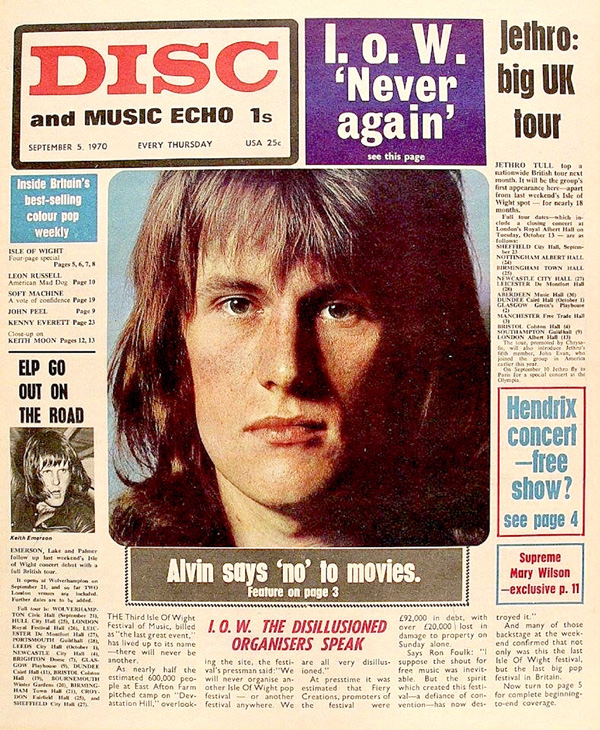
September 5, 1970 - Disc
And Music Echo - Front Page
|
MELODY
MAKER, September 5, 1970 ... the melody maker
interview ...
|
 |
FOR A CULT
FIGURE, Alvin Lee Has
A Curiously Flat Image. Sure He Looks Photogenic.
But Then So
Do Ten Thousand Other Rock Singers. And, Agreed, He Has A
Fast Guitar Technique, But So What? What The Hell Is The
Use Of Being Called The Fastest Guitar In The West Anyway?
All The Same, He Must
Have Got The Super-Star Tag, Somehow. I Mean He Has Made
Minimal T.V. Appearances, Had Only One Hit Single, And Was
Included In Just A Five Minute Clip In The "Woodstock"
Film. On Top Of That, The Guy Hardly Ever Plays In England!
He Must Have A Whole Lot Of Something Going For Him.
|
In Person He Is A Mild Mannered,
Belaying The Grimacing, Pouting Figure In "Woodstock."
He Seems To Have No Positive
Ambitions About Politics, The Contemporary Situation Or
Life In General. He Is The Epitome Of The Ordinary Guy In
The Street Who Has Made It: A Pop Singer Who Has Grafted His
Way To The Top, Just As The Bank Clerk, Becomes The Bank Manager. His One Conceit
Is His Guitar Prowess, And Who Can Deny He Has Good
Technique? After All, He Is Paid For Playing Guitar, Not
Shooting His Mouth Off.
He Lives In A Small Mews,
Cottage, Which Used To Be A Stable, At The Back Of London’s Baker Street. He Was
Thrown Out Of His Last Place, In Belgravia, Because Neighbours Thought He And His
Friends Were Drug-Crazed-Hippies. That’s The Price One Pays For Being A Pop Star, I
Suppose. The Small Down-Stairs Room Reflects The Interest And Outlook Of It’s
Occupant. A Sitar Is Propped In The Corner By The Stairs,
An Electric Piano Stands Like A
Child’s Toy Against One Wall, And An Amplified Acoustic Lies Flat On Its Back In
The Centre Of The Floor. A Quick Look Through The Record
Collection Housed In A Long Shelf Establishes The Fact That
The Owner’s Taste Are Largely Confined To
Rock. All The Ten Years After Albums Are There.
It’s A Revealing Room. In A
Notebook Lying Open On A Pouffe Are Written Words Of A New
Song, The First Verse Goes: "Gonna Run, Runnin From The
City, Gonna Run, Runnin To The Country, Gonna Run, Runnin
From The City, Got To Ease My Aching Mind (Oh Yeah)" – And The Last One
Reads: "Gonna Run, Runnin From The Ego, Gonna Run, Find Out Where The Free Go…."
Alvin Lee Walks In Dressed Completely In Maroon.
You Look At Him Carefully. He Has
Hollow Cheek-Bones, Which In Less Successful Years Gave Him The Appearance Of
A Tubercular Victim. That Was A Long Time Ago, Though When Ten Years After Was
Just Another Cute Name For A Group. And When A Residency At The Marquee Meant
Steady Work In God Knows How Many Months.
It’s A Long Way From Nottingham
Now…
(The Alvin Lee - Melody Maker - Interview).
Question:
First Off, A Lot Is Made About
Your Guitar Speed: That You Are Fast To The Detriment Of
Feel And Emotion. What Do You Think About This Whole
Question?
Answer - Alvin Lee:
Who Says This? Some Guys Say You
Can Always Tell A Good Guitarist Because He Doesn’t Look At The
Fret-Board, And A Good Drum Solo Is One Where The High-Hat Goes All The Way
Through. You Can Only Answer Criticism If The Criticism Is Valid, And I Don’t Think It
Is. I Could Play A Lot Faster If I Wanted To Blind People With Speed. Perhaps I Do Play
Faster Than Some, But I Just Play my Style. I Could Play In
Another Way If I Wanted, But I’m Going Somewhere Else
Myself You Know, I Use Speed As An Effect, A Kind Of
Crescendo. If I Want To Bring Something Up I Use Set
Phrases, But Perhaps To Some People, It
Doesn’t Sound Like A Kind Of Feeling. It’s Not Like B.B. King, Where He Slurrs The
Notes; That’s Another Trip. A Guitarist To Me, Is Not How Good He Is, Because The Top
30 Guitarist Can All Play Like Each Other, If They So
Wished. It’s Just A Matter Of The Style They Prefer. And
You Either Agree With Their Preference, Or You Don’t. But It
Doesn’t Make Them A Bad Guitarist, If You Don’t Like The Style They Prefer.
Question:
Can You Pick Out Any Contemporary Guitarist You Admire?
Answer - Alvin Lee:
I Don’t
Listen That Much. When I Do Listen, I Listen To People Like George Benson And Such. You Know,
Rock To Me Is Something I Play The Way I Feel It, And I’m Not Interested In The
Way Other People Feel It. I Suppose It Sounds Weird, But I Play Rock The Way I Like To
Hear It. So In That Sense I Suppose I Could Say, I’m My Favorite Rock Guitarist,
And In That Sense I Suppose Every Rock Guitarist Is Their Favorite Guitarist.
Question:
Let’s Put It Like This. Which Guitarist Have Influenced
You, If Not Now, At Least When You Were Growing
Up.
Answer – Alvin Lee:
First Off,
Scottie Moore, Elvis Presley’s Guitarist. Chet Atkins, I
Got Into A Finger Style Thing. Then I
Went Into A Bit Of Classical. Merle Travis. Then I Got Into Charlie Christan And Barney
Kessel, And Yes Les Paul. I Went Down To His Studio In New York, It Was Really
Incredible. We Had A Little Blow, It Was Good Fun. He’s Very Clean, And He Plays
With A Lot Of Swing. He Really Is Neat.
Melody Maker:
Not Unlike You In A
Way. You Don’t Use Feedback, For Instance.
Answer – Alvin Lee:
No, No Boxes
Or Anything Like That. I Haven’t Got Anything Against Feedback, But All Gimmicks Like
Fuzz, Wah-Wah And Such, You Can Get The Sound By By Buying The Equipment; They Are
Not Very Individualist. Anybody Using A Wah-Wah Pedal Has Got To Be Exceedingly
Lucky To Find Something New He Can Do On A Wah-Wah, Because It Makes All
Guitars Sound The Same.
Question:
How Far Is Jazz A Big
Influence On You?
Answer – Alvin Lee:
It’s Not A
Big Influence, I Like The Feel Of Jazz; I Don’t Like The
Jazz Tradition, I Don’t Like The
Philosophies, The Attitude, Of Jazz People At All. They Are Inwards Looking People,
Jazz People, They Look In All The Time.
Question:
How Is It Then, That You Played With
Woody Herman?
Answer – Alvin Lee:
We Didn’t.
Somebody Fixed It Up, But We Didn’t Do It. The Only Reason
We Were Going To Do It, Was That We Had Recorded
"Woodchopper’s Ball," And The Only Reason It Was,
"Woodchoppers Ball" Was Because Of The First Verse And The Last Verse, It Was Just A Jam
With A Tune Vaguely Resembling "Woodchoppers Ball"
To Start It Off With…And We Were
Going To Do Carnegie Hall With Woody Herman And Do "Woodchopper’s Ball"
Together, And I Happened To Mention To The Powers, That What We Did Was Nothing Like
The Original, So We Dropped The Idea. The Only Kind Of Jazz
I Play Is Mock-Jazz---It Has A Jazz Feel, A Jazz Tone. I
Like A Jazz Tone Sometimes---More Mellow Sounds---But
Really I Am Still Playing The Same Style Of Guitar.
Question:
What Therefore, Do You Feel About These Apparent Fusions
Between Jazz And Rock? Do You Think They Ever
Succeed?
Answer – Alvin Lee:
Not To My
Taste They Don’t, Because The Only Kind Of Fusions I Have Heard Are Like A Watered –
Down – Brass Section. I Don’t Think It Is Either Jazz Or Rock, It’s A Middle Of
The Road Between The Two, A Fusion Of Lesser Jazz and
Lesser Rock. The Thing I Like About Jazz Is The Feel and
The Freedom."
Question:
If
Jazz – Rock Is Out, In Which Musical Direction Are Ten
Years After Going?
Answer – Alvin Lee:
Mmmm, It Is
Difficult To Say. If You Evaluate Where You Are Going You Tend To Jump To
Conclusions, Which Is Bad. We Just Let It Happen, Really.
We Won’t Know What The Next Lp Is
Like Until We Have Got It Down. That Is The Way We Have
Always Done It. Like, An Album Comes Out The Way We Feel At
The Time We Make It. Sometimes It Comes
Out Of A Whim, Other Times It Just Comes Out Naturally.
Sometimes We Experiment A Bit And
Say, Let’s Lean This Track A Little More Towards This Or The Other."
Question:
There Will Be No Future Changes In Lineup Then, Such As The Addition Of Brass?
Answer – Alvin Lee:
Personally, I
Don’t Like Anything Over A Four Piece. For The Sake Of
Music It Is Nice, But Creating Music Is Another Trip Again.
We Are Not Really Into Creating Music, We’re Musicians
Working Out. Do You See The Difference? Like Say, You Have A Brass Section, Or
Reeds And Things, That Limits What You Can Do. You Know, Brass And Reeds Have To
Riff, So You Are Tied Down To A Riff. The Way It Is Now, We
Can Just Start Something Off On Stage, And If We Don’t Like
It, We Can Just Change It Round Completely. Nobody Knows
That They Have To Do Something Particularly.
Question:
You Started Off In Nottingham Didn’t You? What Was Your
First Group?
Answer – Alvin Lee:
The First
Band I Was Ever With Was A Weird Affair, Called Vince Marshall And The Square
Caps. I Played Rhythm And I Would Be About 12. It Was A Very Amateur Affair –
Well, It Was And It Wasn’t. This Guy Had A Very Freaky Mind. He Was Planning It Like A
Show, And We All Had Different Numbers. He Just Advertised In The Papers For
Everyone To Meet Him In Lyons Café In Nottingham. He Was In There, And He Waited An
Hour, So That Those Who Weren’t Very Keen Would Go, And He Said He Would
Keep The Rest. It Ended Up With Two Drummers, Five Guitar Players, No Bass
Player, An Electric Accordionist And A Country And Western Banjo Player. We Rehearsed About
Three Times A Week For Six Months, Did One Gig And Broke Up And That Was The End Of
Marshall and The Square Caps.
We Played All Souls Church Hall,
And We All Had Little Plywood Stands To Stand On Because It
Was His Idea Of Professionalism, And This Guy Vince
Marshall, Conducted And Sang One Number Out Of Key.
But I learnt A Lot Off The Guitarist There Who Played
Lead, And I Picked His Brains And
Got To Know Quite A Bit. Up Till Then I Had Been Playing Just On A Hobby Basis; I
Never Thought I Would Be Able To Get It Together On Stage. But That Broke Up, And
When I Was 13 I Phoned Another Band, Called Alan Upton And The Jailbreakers.
We Played Sort Of Rock ‘n’ Roll Because He Played Piano And Liked Jerry Lee Lewis,
And By This Time I Was Into Scottie Moore And All Those
Rock Guitarist. I Played Lead With That, And I Got A Proper
Electric Guitar For My Birthday – A Guyatone, Crystal
Pick-Ups, A Weird Thing. But We Had Some Fun, It Was An Experience.
We Used To
Play At A Cinema, At Sandiacre, The Palace Cinema. We Used To Play In-Between The
Films. I’ve Still Got One Of The Things In a Scrapbook
Somewhere Where We Are On With
Brigitte Bardot, And I Was Also Learning A-Lot Around That Time About Amplifiers
Ang Things. When That Finally Broke Up, We Were Playing At A Lot Of Pubs And Low
Places, You Know."
Question:
That Was Still At 13 Was It?
Answer – Alvin Lee:
Yeah. I Did
That Probably, For About A Year, Then I Did Nothing Again For A Year, Then I Left
School, When I Had Almost Turned 16. I Got Out As soon
As I Could, I Decided What I
Wanted To Do, And I Was Wasting My Time At School."
Question:
Which
Was What? To Be A Musician?
Answer – Alvin Lee:
Yeah!
Somehow, Someway. I Did Not Really Think About It In Those
Days, I Just Thought, Oh, I’ll Do It. And Er, I Left School
And Got A Job In A Factory For About A Month, Which Didn’t Seem
To Go Down To Well. But My Folks Said, If You Want To Get A
Band Together And Work Like That, You Had Better Leave Your
Job. Which Was Very Cool Indeed."
Question:
What
Does Your Old Man Do?
Answer – Alvin Lee:
He Was A Bulider, They Were Not Very Well Off At All, But You Know A
Lot Of Parents Would Have Demanded Their Three Pounds A
Week Board. They Were A Bit Cooler Than That,
And They Encouraged Me All Along. So I Left This Job And I Answered This Ad In A
Nottingham Paper, For A Band Based In Mansfield, Called The
Atomites, And Leo Lyons Our Bass Player Was In There – He’s
Just A Few Months Older Than I Am, And We Met, And Were
Into, Like Well, We Were Playing Shadows Music To Get Gigs.
And I Knew This Singer From Nottingham Blond Hair And A
Very Early Freak, Who Used To Do Well On The Pub Circuit –
Ivan Jay Was His Name. So We Roped Him Into It, And Changed
The Name To Ivan Jay And The Jaycats. We Tried Various
Combinations For Awhile, And Then Came Up To London; I
Would Be About 17 Then.We Came Up To London For About
Six Months, And Lived In Finsbury Park, And Nearly Starved
To Death."
Question:
Did You Have A Manager
Then?
Answer – Alvin Lee:
No, Leo Was
The Manager. He Used To Call Himself Mr. Lyons. It Was Very Funny Because He Used
To Ring Up The Pub Owners The Next Day And Say, How Were They, Were They Great?
All This Spiel. He Was Pretty Good. But Down Here In
London, We Hardly Got Any Work At All. We Came Down Here To
Get Work, But The Only Work We Ever Got Was Up North. We
Did A Few American Air-Force Bases, But We Were A Bit Proud. Like We
Had Been Getting 15 Quid A Gig In Nottingham, And They
Would Offer Us Eight Quid Down Here. I Think, Though, We
Had Some Sort Of An Original Style…Oh, I Don’t Know, It Was
Like The Early Cliff Richard Stuff, "Nine Times Out Of Ten"
And Stuff Like That, The Ravier Ones, And Some Of The Old
Ones, And Some Of The Elvis Ones. Anyway, We Didn’t Do Very
Well, So We Went Back To Nottingham, And The Singer Ivan Jay, Stayed
In London. He Didn’t Do Anything, And That Was The Last We Heard Of Him. We Got
Another Singer When We Went Back To Nottingham, Called
Farren Christie. We Worked With Him For Awhile, And We Were
Doing Alright, Like Travelling Around To Places
Like Rugby. It Was A Bit Of A Giggle.
Anyway, We Went Over To Germany As The
Jaybirds, With A Rhythm Guitarist We Got From Rugby, And Hamburg Was Very Interesting.
I Learnt A Lot There.
Cliff Bennett
Was In Hamburg
With Nicky Hopkins On Piano and
Strawbeffy Watson On Guitar; Tony Sheridan Was There.
A Lot Of Good Musicians Were
Kicking Around On The Scene – Albert Lee Was Playing Down
The Road In A Club On The Reeperbahn, The Top Ten, A Very
Seamy Place In Hamburg. The Big Three Were
There, A Lot Of Liverpool People There. Everybody Was Talking About The Beatles, But
They Hadn’t Done Anything, Then We Saw Photographs In
Windows Of Them In All The Leather Gear, And There Were A
Lot Of Stories About John Lennon. Hamburg Made Us A
Lot More Professional, Because We Were Playing To An Attentive Audience, Which Is
More Than We Were Doing Before, And When We Got Back To
England, We Really Pulled It Together, Like The Band Got
Into Playing Its Own Stuff, Doing An R and B Thing. So
We Tried London Again, Moved To A Slightly Better Part Of
Finsbury Park, But Failed A Second Time, With The Result
That We Went Back To Nottingham, Where We Began To Do
Pretty Well; We Were Getting 40 Quid On A Saturday Night,
And Doing Co-Op Halls And All That."

Question:
This Must Have Been The Time Family Was Coming Up As Well?
Answer – Alvin Lee:
Oh, We Used
To Play With Them From Leicester, When They Were Called
"The Farinas" And Even Before Then. Roger Chapman Used To
Wear A Leather Hat And An Overcoat And Do "On The
Boardwalk" And Things. He Was Good As Well, A Sort Of
Smoothie Type. He Used To Do Standards And Things – Quite
Incredible. Anyway Back In Nottingham, The Drummer With Us
Left – Dave Quickmire – And Ric Lee Was Playing In A Group
Called "The Mansfields" And Doing Everly Brothers Type
Things And Buddy Holly Numbers, And He Was About The Only
Drummer We Ever Heard, Who Could Do The Bass Drum Best,
Which Was Bum-Ba-Bum, Instead Of Bum-Bum-Bum….He Was
Reluctant To Join At First, But Somehow, We Talked Him Into
It; And We Were Doing Chuck Berry Stuff Still, And He Was Never
Into It As Much, As The Other Drummer, And We Wondered At
Times, If He Was Going To Be As Good As The Other. (Dave
Quickmire Was Replaced By Ric Lee – Ric Was Reccomended By
Dave To Replace Him).
Then Of All Things, For A Joke –
We Auditioned For, "Saturday Night And Sunday Morning" – At
The Prince Of Wales, And They Were Interested In A
Nottingham Band. A Bit More Authenticity, As It
Were – To Play In The Wings, And Do A Pub Scene, And That
Was All Right For Half an Hour’s Work; It Was 30 Quid A
Week.
Question:
Did You Ever Think At Any Time, During This Period, That
You Weren’t Going To Make It?
Answer – Alvin Lee:
I Always
Thought We Were Somehow.
Question:
You Can Read
Music?
Answer – Alvin Lee:
Er, Just The
Chords…We Used To Do All The Really Corny Standards, And A
Few Spanish Things, And We Get A Free Meal and 24 Quid A
Week, Which Was Pretty Good, But The
Only Gigs We Were Getting Were In Wales and They Were
Terrible. You Know, We Could Still Get The Backing Jobs,
And Do The Odd Session, But Everybody Was Down-Hearted
Indeed. This Was About The Time I Started Thinking Perhaps
It Is Not Going To Work At All."
Queston:
You
Were Very Disillusioned At This Point?
Answer – Alvin Lee:
Exceedingly
So.
Question:
Did You Ever Think Of Packing The Whole Thing In?
Answer – Alvin Lee:
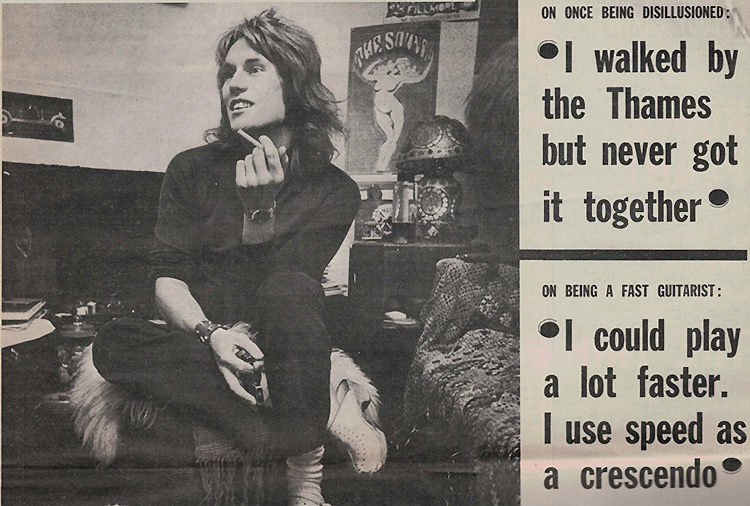
Well I
Walked Along By The Thames A Few Times, But I Never Got
That Together (Laughter). But It Was Really Grim, Because
We Could See How It Had Been For The Last Six Years, And It
Had Everything Pointing In That Direction For The Next Six
Years If Not Worse. At This Point We Decided We Were Going
To Stop Playing, What We Thought We Should, To Get Paid,
And It All, Play What We Wanted Like, We Had Always Jammed
Jazz Together And Done A Bit Of Blues And Stuff, And At
Some Clubs We Used To Do A Gig At 10:00 To 11:00 Of Stuff
Which Was In Vogue To Get The Bread (Money) And Then Go And Do What We Liked.
I Would Get About Five People Who Were Really Into It, And
That Used To Give Us More Pleasure Than Anything."
Question:
So This Was The Turning Point In Your Career?
Answer – Alvin Lee: "Yeah".
Question:
What Were You Called During This Period? The Jaybirds?
Answer – Alvin Lee:
No, We
Dropped The "S" Off To Be A Bit More Trendy, And We Were
The "Jay Bird". Then We Changed To The "BluesTrip" And We
Did The Marquee Under The Name Of The "Bluesyard" And
Nobody Liked Us; John Gee Didn’t Like Us, And I Still Think To This Day, He
Doesn’t Know We Were The BluesYard. But During This Period
We Were Really Together, And The Epitome Of Everything That
Was Not Commercial. If It Looked As If The Audience Were
Liking It, We Would Not Do It. We Were The Opposite Of
Being Commercial, We Wanted To Play What We Liked."
Question:
It Was A Bit Masochistic?
Answer – Alvin Lee:
Yes It Was,
We Really Wanted People To Hate Us. We Were Still Pretty
Pissed Off With The Whole Musical Scene. Then We Decided
That People Did Make Bread Out Of Jazz And Blues, And There
Was A Band Around Called, "Cock A Hoop" Who Were Getting 20 Quid A Night,
Which Was Cool…And Their Manager Was Chris Wright And Like We Told
Him, That We Were Much Better Than Cock A Hoop, And We Could Blow Them Off Any-Day.
We Were Much Better Musicians And All That Bull, And We Did An Audition For Him
For Ten Quid In Manchester – I Think We Made About Four
Shillings Each For The Time We Had Taken Out For The Petrol
Money, And Split It At The End. A Few Places
Thought We Were Very Good, The Hip Places, Where The
Promoter Was Interested In The Music And Not Just Getting
The Money From The Kids."
Question:
Were You Writing A Lot?
Answer – Alvin Lee:
No, I Just
Used To Mess Around and Jam Things. Anyway, We Talked Chris Wright Into Moving Down To
London, Which Was A Good Move, And We Got The Name Of "Ten Years After" – Leo
Lyons Picked It Out Of Almost 100 Names, Which We Narrowed
Down To 20 We Liked. We Got Ten Years After Out Of The
Radio Times, We Liked The Name Because It Didn’t Pin Us
Down Musically, Didn’t Mean Anything, It Was Very Abstract. And Then We Got A
Residency At The Marquee, Which Did Quite Well. We Grew From Strength To Strength
As They Say, And We Got The Jazz Festival Thing, What Is It At Windsor, The 7Th
Jazz Festival At The Time – And We Went Down Well There.
That Was Followed By An Audition
A Decca Records With A Producer Named….I’ve Forgotten His
Name, He’ll Be Glad About That, Because They Turned Us
Down, And Then Three Months Later They Approached Us (To
Sign A Contract) Which Appealed To Our Sense Of Humour."
Question:
By This Time The Name Was Getting Around?
Answer – Alvin Lee:
Yeah, That
Was Really Going Well. That’s Why They Approached Us. We Were Doing Good In London.
Like, We Were Playing Up North And Getting Thrown Out Of
Gigs. One Guy Sais, "It’s Bands Like You That Are Ruining
The Ball-Room Business"! Another Guy Said, "I Like What You
Are Trying To Do, But If I Let You Go On Again, The Kids
Will Tear The Place Down." We Had Quite A Few Places Like
That, We Would Rather Go Down Very Well Or Die A Horrible
Death; There Were No In-betweens in Those Days. We Still
Had This Masochistic Trip. We Weren’t Trying To Please
Anybody; If They Didn’t Like Us, We Didn’t
Like Them. And With That Policy, We Really Seemed To Get It
Together. We Put The First Album Out, Which Did OK, And
Then We Had Heard That It Had Done Well In A Place Called
America, Which We Had Never Not Even Thought About. So We
Got A Telegram From Bill Graham Saying, If We Ever Got Over
There, He Would Back Us. So, We Got An American Tour
Together, And The Whole Thing Went Zoom."
Question:
Is There Any Particular Time When, Or Place Where, You Can
Say That You Made It? Was It The Marquee Residency?
Answer – Alvin Lee:
Right,
Because It Was The First Time We Had Played To People Who
Wanted To Listen, Rather To Anything Else. That Really
Inspired Us, Like After The First Few Gigs We Thought, Well
They Really Do Want To Listen To Us, So We Started Trying
Acoustic Numbers, Different Things, This And That, A Lot Of Experimation."
Question:
There Have Been Reports From The States That People Are
Trying To Isolate You
From The Rest Of The Group, Turn
You Into A Super-Star, And Make You Travel In Your Own
Limousine Separately From The Others. True?
Answer – Alvin Lee:
That’s A
Complete Fabrication. I Mean, I Do Get Super-Starred Up A
Bit Because I’m The Singer, The One The Light Goes On. But
There’s No Pressure In That Range At All. It’s Nice To Know
That People Want To Listen To Me, But Sometimes It Gets To
The Point Where It Is Beyond Listening. They Just, Some
Audiences, In The Less Cool Places Can’t Experience …It’s A
Very Diluted Form Of Beatlemania, I Suppose."
Question:
But It Will Never Be Alvin Lee And Ten Years After?
Answer – Alvin Lee:
No, I Mean,
If People Choose To Say That, Then This Is What Happens.
Some Say, Like Oh, Alvin Lee, Leader And Star Of Ten Years
After, Then Other People Say, Ah, Ego-Tripping Alvin Lee.
It’s Got Nothing To Do With Us – Me, Or Any Of The Others."
Question:
So What Do You Envisage (Envision) Doing In Three Or Four
Years Time? Will Ten Years After Still Exist?
Answer – Alvin Lee:
I Don’t
Know, I Don’t Care To Think About It. I Know That I Will
Always Be Playing Something, Somewhere, To Somebody, But
Who With? If The Band Ceases To Play Together, Then We Will
Just Have To See What Happens. We Have Never Aimed For
Anything Musically, You Know, We Have Never Said, Let’s Try
And Become Super-Stars And Do This. It’s Just Happened And
Its All Very Flattering, Nice And Rewarding. But It Would
Be A Failure For Us To Revert To Thinking, What Do People
Want Now? So, Musically We Will Take Ourselves As Far As We
Can Go. These Bands Who Make A Couple Of Albums And Then
Break Up Because They Can’t Go Any Further Usually Do So
Because Of Head Problems And Ego Trips Rather Than The
Music. But We Have Been Into (Through) All That And Come
Out Okay, So I Don’t Really See Any Problems."
Question:
How About The Problems Of The Musicial Scene In Britain?
Answer – Alvin Lee:
Well,
Technique Is Better, Musicians As Such Are Getting Better.
It’s Bound To Happen. When I Was
Learning To Play Guitar, The Popular Things To Kind Of
Learn From Were Very Basic Pop. You Had To Search Around To
Find Anybody Who Was Laying Down Anything More Musical. Now
Everybody From Miles Davis To Roland Kirk Is Heard Of By
Anybody Interested In Music At All. So You Have To Get A
Much Vaster (Larger) Scene To Pick Things Off From."
Question:
But, Surely It Is Hard For Rock To Go (Get) Beyond A
Certain Limit, Because Then It Does Not Become Rock
Anymore, Does It?
Answer – Alvin Lee:
If You Call
It What It Basically Is "Beat-Music"Then It Has Never Died
At All. Bassically, What Is Appealing To Most People About
Music Is A Beat. It Is Right To Get Away From Beats And
Basic Formats, And Some Have Done It, But …. I Like The Beat It Is Kind Of
Animal Instinct, And The More Intellectual Music Lovers
Usually Get Into The Reasons Why And Where It Is
Progressing, But It Is Still Basically Beat Music."
Question:
But How Far Can Rock Go Before It Becomes Something Else?
Answer – Alvin Lee:
I Don’t
Know. It Has Progressed A Long Way From The Rock Which Bill
Haley Was Playing. (Released In 1954) Yes, And Also In The Paripheral Interest That Are Connected With The Music.
Their Appears To Be A Drive At Present To Establish A Rock
Culture. When I Was A Teeny-Bopper Fan Of Elvis Presley, I
Used To Read These Magazines About How He Used To Comb His
Hair, And People Used To Write Letters To Him Like Saying,
My Mother Says I Shouldn’t Have My Hair Combed In A D.A.
and Have Long Side-Boards, What Do You Think? Now It Has
All Become Intellectualised, It Is On A Sociological Basis;
It Is Now A Way Of Actual Life Rather Than A Fantasy. The
Beatles Led A Lot Of These Sociological Changes (Hair and
Beatle Boots) – But Now There Are Attempts To Relate Rock
To Everything, Such As Politics And The Chicago Conspiracy
Trial. It Was Never Like This In The Days Of Elvis, And All
You Are Getting Really Is A Lot Of Different People’s
Theories. The More Intellectual Minds, The People Who
Create These Theories Have The More Intense The Whole Thing
Seems To Become."
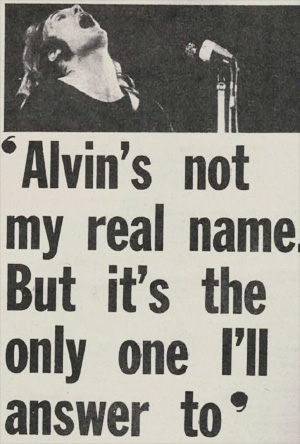
|
Question:
Is Your Name Really Alvin?
Answer – Alvin Lee:
No, I Left
The Other Name Behind In School. But It’s Irrelevant, You
Know.
Question:
Cedric?
Answer – Alvin Lee:
No, It Is Graham,
Actually It All Goes Back To The Old Days In Nottingham
With The Jail-Breakers, When We Got Round A Coffee Table
And Said, Let’s Get Some Groovy Names, Alvin Is The Only
Thing I Answer To Now.
(It Came From Alvin and
The Chipmunks = "Alvin" and Guitarist Albert Lee = "Lee" =
Alvin Lee).
|
 |
Question:
How Old Are You?
Answer – Alvin Lee:
25. 26 In
December. Sagittarius With Aquarius Rising, They Tell Me.
(Born December 19, 1944).
Question:
What Is Your Reaction To The Success Of The Single "Love
Like A Man"?
Answer – Alvin Lee:
I Don’t
Know. I’ve Always Been Shy Of Pop Parades, Because It’s
Such A Fickle Little Scene. The Drag Is That The Single
Isn’t Very Relative To Us. It Was Cut Off The Album, (Cricklewood
Green1970) The Solo Was Chopped Out, And It Was All For The
States As An Advert For The Album. I’d Like To Think That
The Reason It Was A Success Over Here Is That The B-Side
Was A Live Cut. We Didn’t Put The Live Cut On The B-Side In
The States, We Released A Track From Our Last Album, And It
Didn’t Do So Well Over There. We Did Once Record A Single
For The Actual Idea Of A Single, But We Scrapped The Whole
Thing Because We Thought It Was Too Unrelative To What We
Were Doing Musically. You Know, It Was Nice Soul, And It
Could Probably Have Got Into The Top Ten, But It Was Not Really
Anything To Do With What We Were Doing."
Question:
Why Haven’t You Appeared On Top Of The Pops To Promote Your
Single?
Answer - Alvin Lee:
We Have Made A Point Of Not DoingThat Because I Think That Is A Very, Very Poor
Programme. It’s Unprintable What I Think About It. It’s
Just A Conveyor Belt. We Have Been Approached, They Wanted
Us On, But We Can’t Represent Ourselves Miming Or Even
Playing Live To A Two Minute Number. All We Would Be Doing
Then Would Be Selling To The Nation, Something That Does
Not Exist. We Need At Least Eight Minutes To Do Something
That Is Relative To What We Play. And Even Then, Television
As A Music Medium I Do Not Like, Because It’s Not A Thing
You Concentrate On. It’s Not A Thing You Sit And Get Into,
It’s Like A Noise In A Corner."
Question:
What Do You Think Then,
About Pop Films? Woodstock, Obviously, Comes To Mind.
Answer – Alvin Lee:
Woodstock Is
Very Good, The Camera Techniques And Everything Are Very Fine. It’s A Very
Artisitic Film, And Being A Documentary It’s Very Valid. But Now Because Of The Success Of
Easy Rider And Woodstock, We Have Been Offered, I Have Been Offered A Film Part
In The States, Which Is Just Like A Commerical Hype. The Story Was That We We’re An
English Group (Band) In The States And We Go To Texas
Because We Hear That Robert
Johnson Is Alive, We Get Locked Up On A Drugs Charge, And
We Get Bailed Out By A Bird In A White Cadillac. It’s
Really Yuk! I Mean It’s Far Out, Filming Would Be Really
Interesting….But It’s Back To The Powers, The Commerical
Powers; The Studios Say All These Cats At Woodstock Are
Draws Now (Famous Now).
Like, If I Was To Be In A Film, False Modesty Aside, It
Would Probably Do A Certain Amount Of Business, Because The
Name’s There. So That’s Why We Get The Offers. But Unless
We Get Anything That Has Any Artistic Value At All, Forget
It. It’s Nice To Be In A Position Where You Can. To Turn
Around And Say, It’s A Load Of Rubbish, Go And Stuff It.
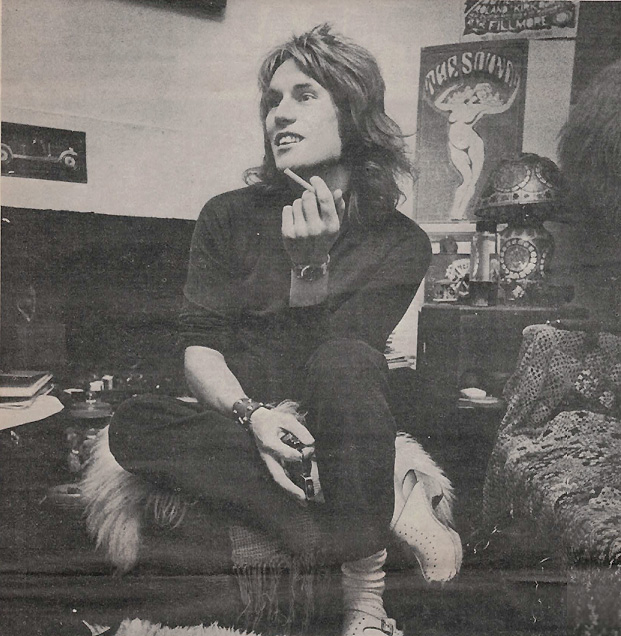
|
ALVIN at his London home |
Picture by
BARRIE WENTZELL |
|
September 27, 1970
- ROCK Magazine
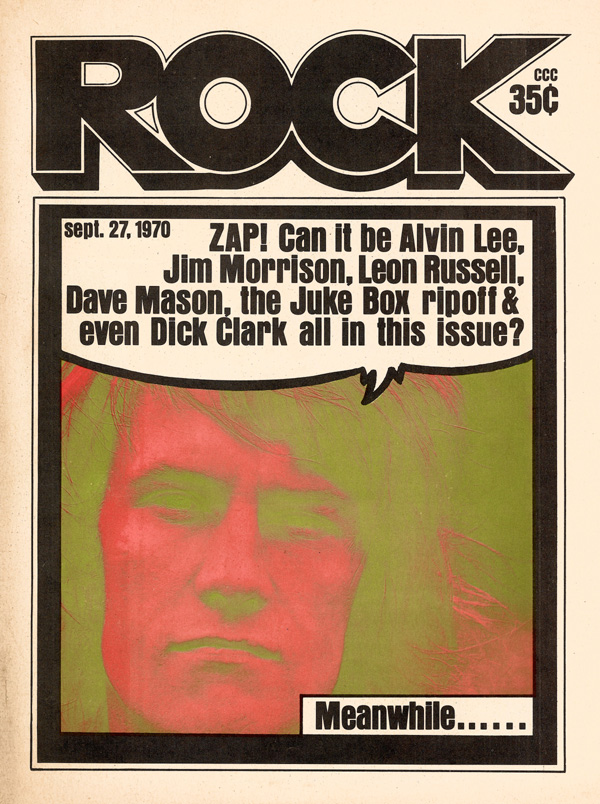
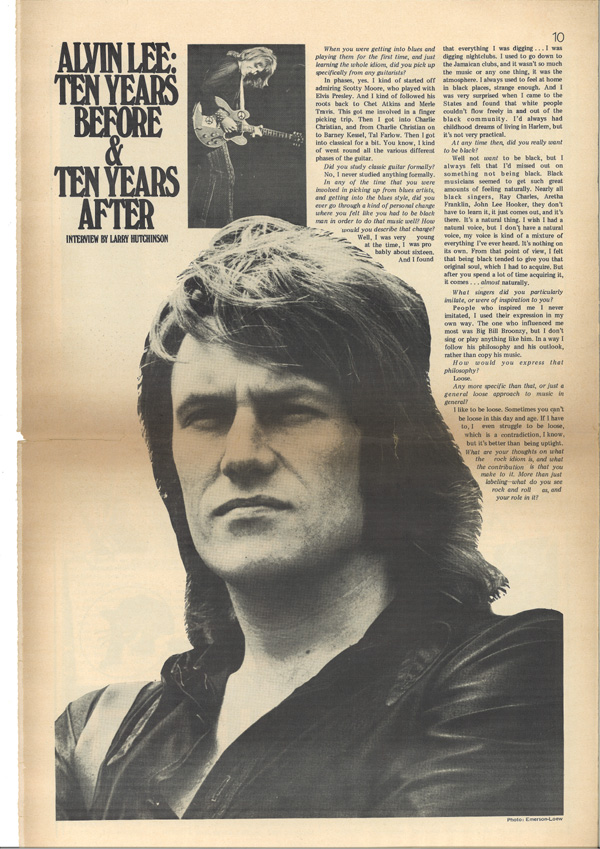
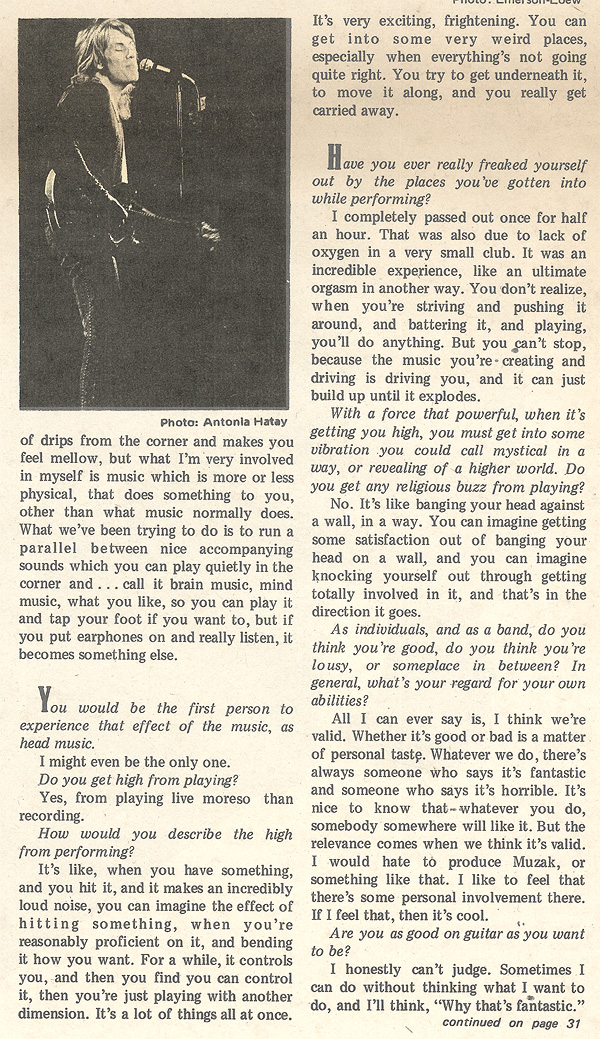
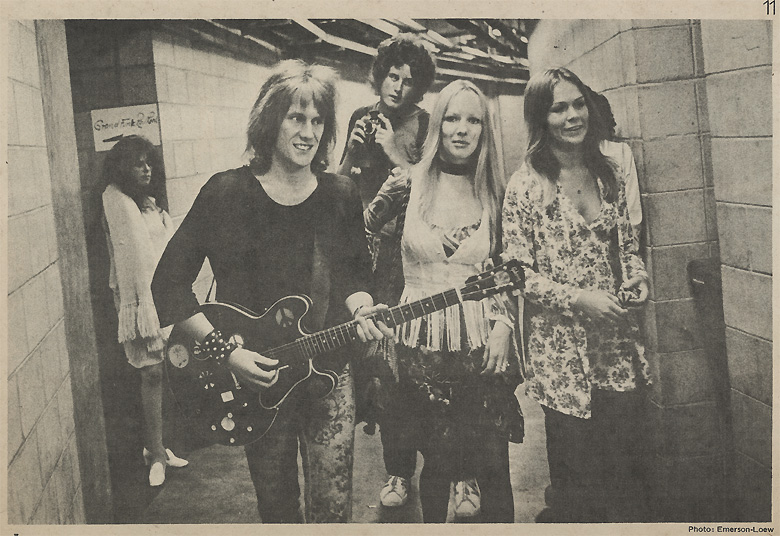
Photo: Emerson-Loew

me - Musik Express,
September / October
1970 - published in Germany and Switzerland
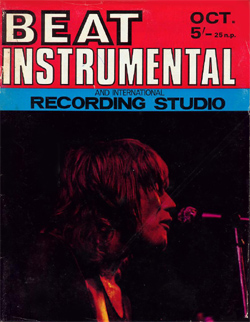
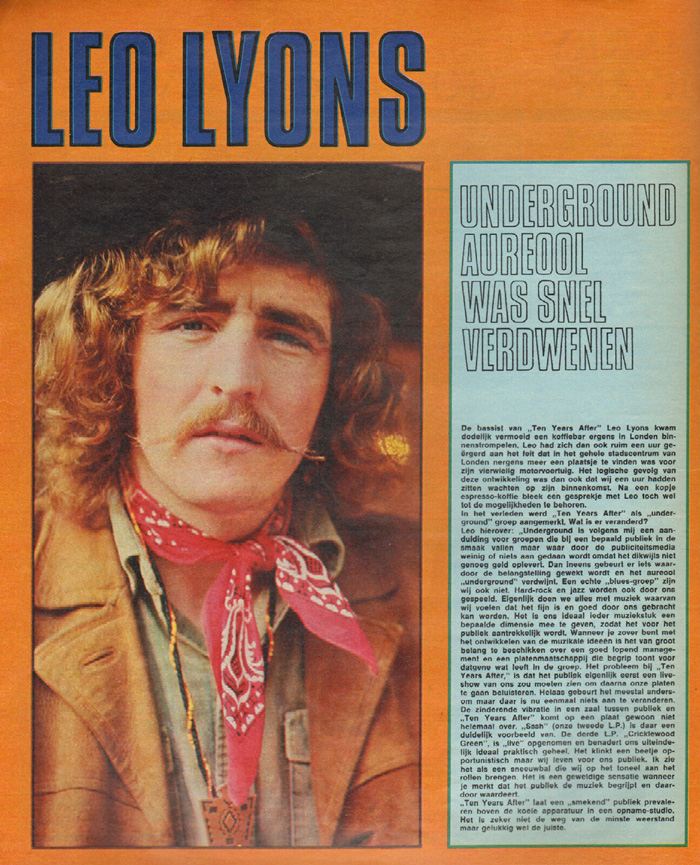
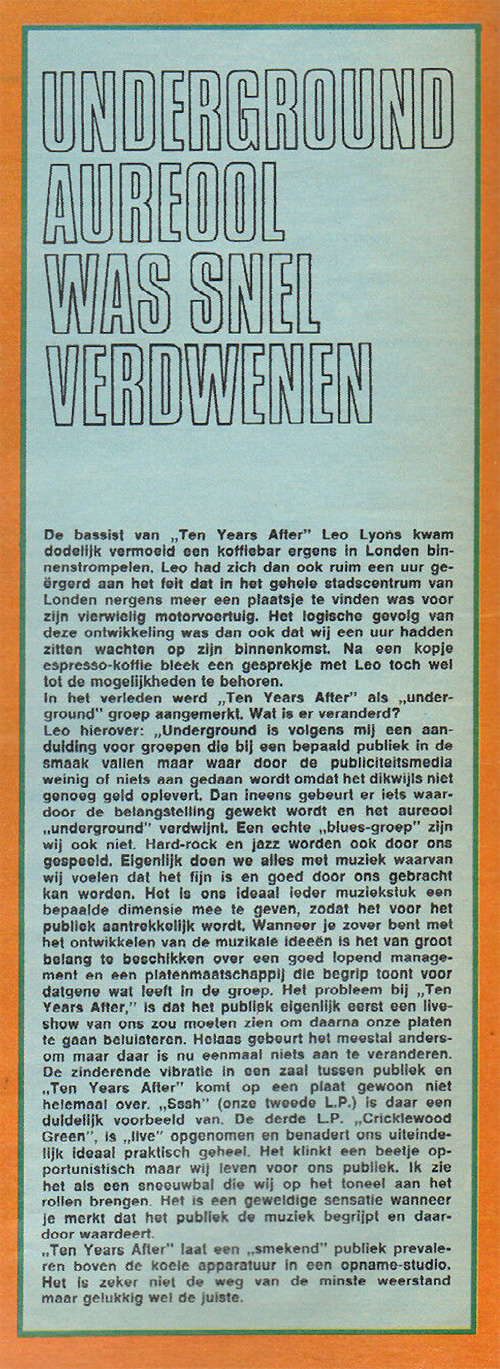
TEN
YEARS AFTER – INTERVIEW WITH LEO LYONS
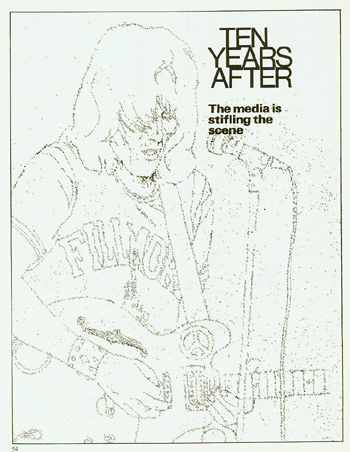
Beat
Instrumental - October 1970
The Media Is Stifling The Scene
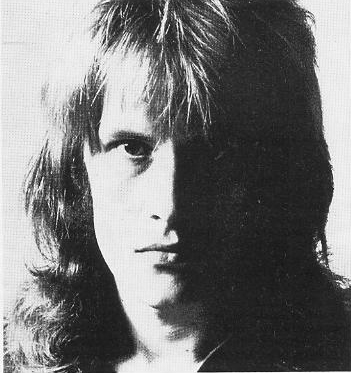
Ten
Years After had just returned from their seventh American tour
when we spoke to Leo Lyons in the groups London office.
Beat
Instrumental:
How
did it go over there?
Leo
Lyons:
It
was our hardest tour so far because we were playing in
baseball stadiums that were full to 15,000 or 20,000 and that
went on for over eight weeks. We’ve played these big
stadiums before but not so many at a time. In the past
they’ve been broken up by 8,000 or 9,000 seaters in between.
Beat
Instrumental:
How
do you feel stuck playing in the middle of a baseball field?
Can you get any reaction with the audience going under those
conditions?
Leo
Lyons:
Well,
you have problems getting in and out, with people crushing the
cars and so on, but once you’re on stage, provided the P.A.
is good, it goes very well.
U.S.
View
Beat
Instrumental:
How
do your American audience view the groups music?
Leo
Lyons:
They
are much more musical psychoanalysts over there. They buy a
record and analyse the personality of the people playing it,
rightly or wrongly. I believe myself that what I put down on
bass is an interpretation of my experiences. The Americans are
into that a lot whereas the English listen to music as music
and don’t go beyond. Americans probably do it to a fault and
read too much into it.
Beat
Instrumental:
Ten
Years After have had their share of knocking from various
quarters….
Leo
Lyons:
Yes,
once you get to a certain stage you’re bound to get knocked,
which is good in a way because it means you are worth knocking.
People go for Alvin because he plays too fast and so on. Well,
music is shaped by the environment of the artists. The Beach
Boys light music came out of the beach scene, dragsters and so
on, while the New York scene was more earthy, especially
Dylan. Because you can see what goes on there, the affluence
and the poverty. The way our lives have been, constantly
rushing around, comes out in our music. We can’t play slow
and relaxed because we don’t feel it. I get the impression
that some people think we play fast for the sake of it, which
isn’t true at all. It comes from our environment which is
fast and speedy. In December we’re going to take a while off
to catch up with what’s happened to us, and maybe the music
will change as a result.
Beat
Instrumental:
It’s
also been said that you have deserted your English fans.
Leo
Lyons:
It’s
difficult to explain this, but if we didn’t keep changing
our environment we would stagnate. If you don’t travel, face
different sorts of audiences and so on, you don’t progress.
Just
as you can be stuck in a job and become bored with your own
life, so a musician can get bored, and then of course people
get bored listening. So it’s necessary for us to go to
America and Europe, but we do intend to do a little more work
in England and play a few clubs.
Beat
Instrumental:
Why
don’t you work clubs now? Is it just the money factor?
Leo
Lyons:
In Los
Angeles we worked a 20,000 seater and 2,000 people couldn’t
get in. This led to trouble outside with the police using
tear-gas, and this sort of thing makes you wary of playing
small places. You owe it to the people, regardless of the
money, to let them see you, and it’s vital to have their
support.
Beat
Instrumental:
Now
you’ve worked away and achieved great success, what’s your
reason for carrying on playing as a band?
Leo
Lyons:
We’ve
never consciously thought career-wise. As far as live
appearances go, we have done everything now. We’re playing
the largest audiences it’s possible to play to. Where we can
progress, is in recording. We want to better ourselves in this
field. It’s important to play live and record. You can write
a three minute number, and you take it on the road and it
becomes a twenty minute one. So it’s an advantage to throw
ideas around and explore them before you go into the studio.
We spend less time recording than most people. We’ve tended
to go in and record enough material for an album and put it
out. The last album, Cricklewood Green was the first one we
rehearsed before we went in. Prior to that we’d always
rehearsed in the studio.
Beat
Instrumental:
How
does your material get written and worked out?
Leo
Lyons:
Alvin
writes most of the songs. He doesn’t tell me what to play,
and I don’t tell him what to sing. He writes the words and
then all four get together which can of course change his
concept of the thing. As for ideas for albums, they are often
things you pick up on tour. Perhaps you’ve been playing the
basis of a number over the years and it changes within that.
You
might get an idea for a new album from just four bars on one
night.
Beat
Instrumental:
Are
you working on a new album?
Leo
Lyons:
Alvin
has been writing some stuff, and we’re generally formulating
ideas. But albums are really a representation of what we feel
that particular day. We’re off to Germany after the Isle Of
Wight and then we start rehearsing for it.
Beat
Instrumental:
Do
you plan to record any more singles?
Leo
Lyons:
We’ve
had a hit single now and it hasn’t affected our policy. Our
U.S. company
wanted to put out a cut-down LP track as a dust cover for the
album, and they wanted to release it in England. It’s not
our policy to release singles as a rule, although we have put
out the occasional LP track in the past. So over here we put a
live recording on the B-Side and made it thirty three and a
third stereo release. We thought it would be bought for the
B-Side, mainly by people who buy our albums. We were knocked
out when it got in the charts, we had no idea it would be a
hit, and we’re not looking for a follow up.
Nearly
Starved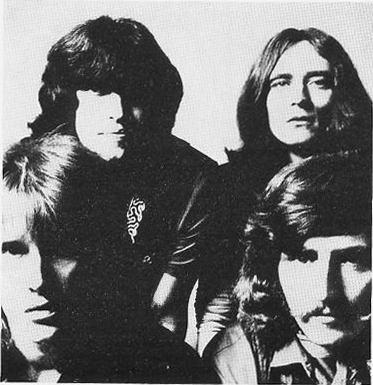
Beat
Instrumental:
Why
do you think the group has become so big over the years?
Leo
Lyons:
Our
successful formula has been doing what we want to do. Once you
start wondering what audiences want to hear you lose direction
I think. Before the band started up, we were all earning
pretty good money playing around Nottinghamshire with various
bands. But we started Ten Years After to play what we wanted
to play. It didn’t seem a particularly bright move at the
time because we were making money by musically conforming. No
one wanted to know and we nearly starved. People would pay us
to play as backing group because we were fairly competent
musicians so we took it. After all, it wasn’t so bad, you
could eat and it was playing. Then we decided to do what we
wanted or go under, but be truthful to ourselves whatever
happened….and we did go under. Out of 500 people at a gig,
five would stand up the front digging it and the other 495
wouldn’t like it. Promoters thought our music was horrible.
Beat
Instrumental:
But
you started to build up a following….
Leo
Lyons:
Yes,
we found the Marquee audience, or some of them, tended to like
it. We found we could work a blues club in Manchester where
they dug it, but we couldn’t play in a ballroom 100 yards
down the road. Promoters who liked it then stuck with us and
put us on again because they liked the music, even though we
weren’t a draw. The Marquee did that. We worked away and got
to the stage where we would work a Top Rank Ballroom which
would have been certain death at one time. It snowballed and
we went on to play Europe, America, and eventually the entire
world. This I suppose is the death of the underground. Once
that music became commercial it lost its underground nature,
but we haven’t lost the music. Commercial means something
that sells, it isn’t a sort of music.
Beat
Instrumental:
Sooner
or later, I suppose your popularity was inevitably begin to
dwindle. How long do you see yourselves continuing to play?
Leo
Lyons:
We
don’t have to carry on doing it now. We’ve enough money to
live on, but as long as we want to we will carry on. When we
started playing it was a love, but now it’s an addiction,
and I get very uptight if I don’t play. It’s a question of
having to play and I’ll continue to do so whether people
like it or not.
Stagnant
Scene
Beat
Instrumental:
Do
you think you’ll carry your present audience with you as you
and they get older ?
Leo
Lyons:
New
bands are bound to come in, I see them coming up now. But if
you can still relate to our music in ten years time, you will
like it. Older people still relate to Mantovani after all.
Beat
Instrumental:
How
do you think the music scene is developing now?
Leo
Lyons:
I
think it is largely stagnating at the moment, and I think the
press are partly to blame. They come along thinking “this is
the angle I’ll use” and if they can’t get it – it
isn’t a good interview. Sometimes journalists don’t
reflect what is going on. You can say that if there is nothing
new in the music scene now, it is partly a criticism of
journalists. They still say the same old things, a lot of
them. You know, about buying houses in the country and so on.
That’s just not relevant, because if everyone had the money,
they would all probably buy big houses and Rolls Royce’s.
It’s the motivation for playing the music that’ the
important thing.
At
the end of an interview once, I was asked about my house and
that was the whole story, when the article came out. I was
embarrassed by that, as if it was my whole motivation.
What’s the interest in that anyway?
Beat
Instrumental:
Surely,
British radio and television are just as guilty, if not more
so, of this sort of thing?
Leo
Lyons:
Yes,
the media of T.V. and radio are being wasted. Top of the Pops
has got nothing to do with the music scene and I don’t know
where Radio One come up with the stuff they play. Where I live
in Bedford the single is atrocious. Even a good record sounds
awful. We need stereo radio run by people with ideas that
aren’t middle of the road. Radio and T.V. are so far away
from what’s is happening and that’s what causes things to
stagnate. The music fan in England must be a good fan because
he doesn’t have the opportunity to hear records casually, he
has to go to a concert or buy a record. In the U.S. he’ll
hear a thing on the radio, which is good for bands and good
for the listener. I’ve bought eight or nine albums in
America that I heard on the radio, and no one’s ever heard
of them over here. I think the English pop fan deserves a pat
on the back for making an effort. Everything seems to be
against them.
Beat
Instrumental:
I
quite agree, but the BBC does have these needle time problems.
Leo
Lyons:
Yes,
it does have the needle time problems, but the attitude on pop
radio live sessions seems to be “Get it over with before the
pubs open”. Also their equipment is really dire and the
signal that comes out is bad. You can do five minute things on
the radio now, but they seem really long. It’s a negative
attitude to think “Oh well, it’s only going over a
transistor radio, it doesn’t matter”. I’ve got a
portable stereo radio that gives hi-fi reproduction when I’m
in the States, it’s just as good as a good record set up. I
bring it to England and it’s a row, a distorted noise, so I
switch off.
Beat
Instrumental:
How
does English radio (abysmal as it is) compare to the rest of
Europe’s though?
Leo
Lyons:
I
don’t know about radio, but in Germany and Sweden for
instance, music is covered excellently on television. We did a
German T.V. show and the producer had been to see us at a gig.
He was really interested in the music and he told us we had
half an hour to do just what we wanted to do, just like on
stage. We had 30 or 40 people come along and it came over
well. You see, the bloke was involved in the whole thing. He
had sympathy for it, which allowed it to come over. We
haven’t done a T.V. show in England. At one time this was
because they wouldn’t have us. Now it’s because we don’t
want to.
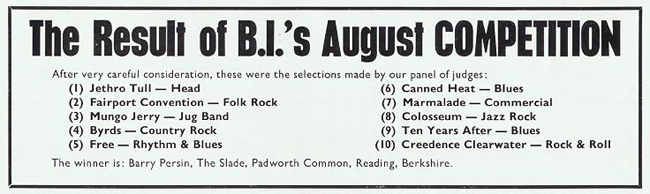
BEAT INSTRUMENTAL - October
1970
|
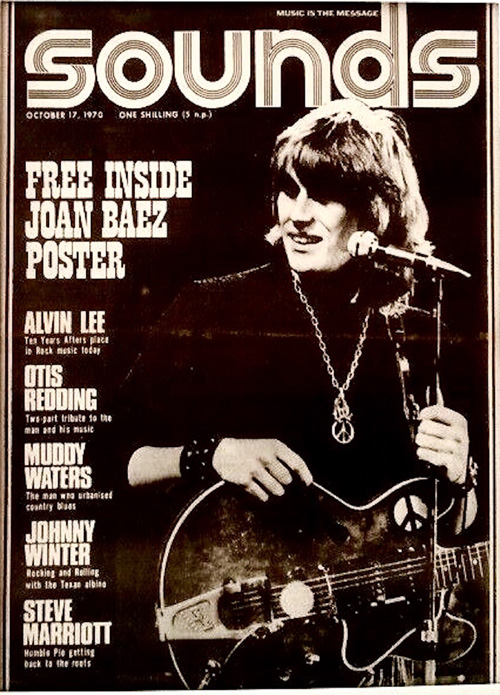
October 17, 1970 -
Sounds Magazine
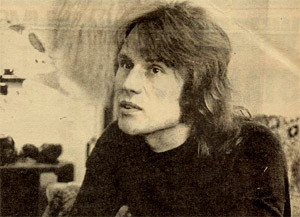
THE SOUNDS
October 17, 1970
Ten Years After have an unusual place in rock
idolatry; their live performances of supercharged
rock and roll have made them a monster group.
Woodstock has made them even bigger, and yet because
of their success they’re now at a crossroads.
They’ve arrived at the crossroads because their
strength, their success, is in their live
performance when they come together as a driving,
stomping outfit with a feel that they’ve never quite
come across with in the studio. But their strength
has also proved their weakness because having
reached so far they face the possibility of drowning
in their own success and being swamped by an
audience of screamers, an audience that they never
wanted.
Alvin talked about these problems and other things
to ROYSTON ELDRIDGE.
|
|
“Love Like A Man” was a best selling single—the
standard requirement for a group’s appearance on Top
Of The Pops yet TYA haven’t appeared to date. Why
not?
It’s mainly their lack of artistic integrity,
really, and television is a very weird medium for
our kind of music anyway. It’s very difficult to get
into music on a TV because of various
reasons—they’re prone to cutting things and making
it as short as possible. I’ve never done a session
there but I should imagine it’s in and out as soon
as you can. |
There’s no real point in us doing it anyway. The
thing’s a hit which we didn’t really want in the
first place, so what’s the point of plugging it
further. One day, maybe, if we can get it together
we might go on and play something which we are proud
of but it would just be a waste of time at the
moment.
The single was just put out as a trailer for the
album in the States but Jonathan King wanted it
released here and we agreed to it as long as we
could have the B side in stereo at thirty three and
a third and over eight minutes long. The A side I
personally think is a very un-valid thing, it’s not
representative of us at all with the solo being cut
out. When it comes back in after where the solo was
cut, it’s about twice as fast. It makes me shudder
every time I hear it.
When we turned down Top Of The Pops we were
accused of being superstars and everything but the
point is it’s not valid for us to do it. We don’t
want to reach the people that watch it and you must
admit it’s a pretty poor programme. The bands come
on, do their thing, and off.
It’s very watery entertainment , superfluous,
nothing real.
A television enables you to reach a certain market
which we’re not really ready for yet , I don’t think
we ever will be actually but definitely not at the
moment. The concerts draw full capacity anyway and
the albums sell much more than the singles have ever
done and as musicians that’s all we want…the
appreciation of people who listen.
Hit singles tend to bring in people—like the
Woodstock film has to a degree—who come to kind of
experience the event rather than listen to the music. We try to encourage the listeners rather then
those sort of teenyboppers.
Has the Woodstock festival and film appearance
affected the group in any way?
It’s affected the concerts in certain areas like New
Jersey where it’s got completely out of hand, you
know where it’s like a form of Beatlemania. I hate
the word but a lot of people are definitely coming
to see us because we’re topical or trendy or what
have you. They’re just coming for the event, we
played there and there were police barricades
outside, it was a joke. We try and discourage it as
much as we can—you know all those screamers—without
sounding totally ungrateful. It’s flattering in a
way but if we can’t hear ourselves then it’s not
really worth playing.
The group’s been together a long time now. How
does everybody feel at present?
Well we’ve been playing the same number for the last
couple of months and you tend to feel a bit machine
like and repetitive so we’ll be having a few
rehearsals and work on some new numbers which will
cheer everybody up a lot. We’re going to make
another album, we’ll have some rough rehearsals
first and throw a few numbers around, so we know
basically what we’ll be doing before we get into the
studio. Then we’re going to have a quick shoot
around the States—two weeks—and then we’ll have
quite a bit of time off for policy talks and
everything to work out where we go from here.
I think we’ve gone like so far, we’ve gone beyond
where we were actually hoping, so now we’ve got to
re-assess what we want to do and what direction we
want to go in. We’ve so many ideas at the moment.
It’s difficult to know which will be the best for
us. Everybody’s had lots of thoughts musically and
no chance to put them into any solid form.
We’ve got to decide whether we want to go on just
as we are because if we do it might get too out of
hand, we might get too teenyboppery. We’ve got to
discuss if we want to control it and if so, how we
can. It’s been suggested that we don’t do any small
clubs anymore which in a way is sad because they
always have a very good atmosphere. The question is
can we play at any small clubs again? If you get a
lot of people turned away at the door, which
happened in the States, you get trouble outside.
There’s not really the venues in England anyway.
There’s such a lot of difference between going down
well in the clubs and from stepping up to the Albert
Hall. There’s nothing between, say the Marquee, and
the Albert Hall and then that’s it.
Once you’ve played the Albert Hall it’s difficult to
go back to the Marquee and there’s nothing beyond
the Albert Hall really except for the festivals.
I miss the club dates in a way because that was half
rehearsal, half playing, sort of thing where we used
to experiment a lot. When you’re doing really
organised gigs you get rushed in backstage, quarter
of an hour before you’re on, and before you know it
you’re on, you’ve played and you’re rushed out
again.
Have you considered increasing the size or
instrumentation of Ten Years After?
Our musical interest in TYA is seeing what we can do
with what we have. The format is very loose the way
we play now and any more instruments –although it
might sound strange—would limit us because then you
start getting into set arrangements. As soon as
you’ve got a certain section playing this and a
certain section playing that, you loose any informal
thing that you may have. Now we can just play and if
we don’t like the way it is going, I can switch the
rhythm around and everyone picks up and we’re off
again somewhere else. Any more people than four and
you might get some problems.
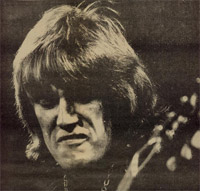
Do you feel that you’ve reached as far as you can
go with four people?
I think when you hear that it’s an excuse. Like King
Crimson reached as far as they could go in one album? I don’t believe
it, I believe bands break up
because of personal problems. I’m sure if we can
keep our heads together and keep a good relationship
on a personal level, the music will go on forever.
It gets to the point when you even surprise yourself
with what you’re doing. I don’t like forcing
progression, you let it progress naturally, but you
can be making and album and you’ll find yourself
onto something else which you don’t realise until
it’s done. There’s no limitation at all with four
people, probably even less with three.
You’re interested in electronics. Have you
considered getting into electronic music a little
more deeply?
It’s like a hobby thing which is creeping into the
albums a bit. I’ve got ideas for using it for
effects on stage but there again I’m not too sure
because electronics is my personal thing, it’s a
hobby, and if it gets to be part of the band, it
could ruin the hobby thing about it. Basically we
want to stay musical. We want to play music,
everyone has interest which are side trips but it’s
the music the TYA makes together that is Ten Years
After’s music, if you exert any one influence in any
one direction on it, it can change the group’s
direction and it’s wrong to interfere with something
that’s happening all on it’s own. TYA is a fusion of
four people and it just happens to work that way. If
it doesn’t well, it doesn’t, but if it does that’s
fine.
We prefer to let it happen and improvise rather than
guide it. We could say, guide it more towards jazz,
we could take it to jazz, we could take it anywhere,
but we prefer to let it have it’s own natural head
and see what happens to it.
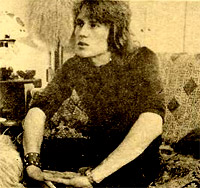
You’ve been singled out as the face, the
spokesman, of Ten Years After. Does it worry you at
all, this superstar image?
Only when I’m accused of doing something that I
haven’t done like ego-tripping or being a superstar
or something. A lot of it is just stories Rolling
Stone did a story about me having my own limousine;
it was completely untrue. In fact the actual thing
was that it was Ric and his wife travelling in
another limmo. I think the reason I’ve been singled
out is because I sing and it’s the singer who has
the spotlight on all the time. It wasn’t planned
that way and whether it’s good or bad I don’t
know.
What does get annoying, and what can happen to
anyone is that you get put up on a pedestal,
somebody puts you up there, and then other people
start knocking you off. I long ago realised that
whatever you do some people are going to like it and
some people aren’t. Some people write things which
they can’t possibly know about, the most common is
being accused of being on an ego trip. It’s really
weird because that’s the one thing that I have
always been aware of and tried to avoid.
It’s easy to get too flash and for the seven years
that I was struggling I always thought to myself if
I got anything together I would definitely not get
into one of those flash scenes. And I’ve always done
the opposite. I’ve always gone out of my way to be
non-egotistical.
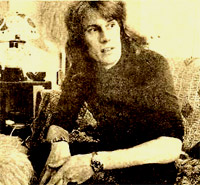 What about the criticism that you sacrifice taste
for speed in your guitar playing? What about the criticism that you sacrifice taste
for speed in your guitar playing?
I never know how to answer that, I just play the way
I want to play and I can see that in some people’s
eyes that might be true, but it’s not true to me. I
don’t play as fast as I could, I could play a lot
faster, I could be a lot showier, a lot flashier and
a lot more commercial. If I go too fast for some
people then that’s up to them to decide but to
actually say something like “he plays too fast”,
that’s a very weird thing to say. How do they put
themselves into a position to judge anything so
definitely. I’m going somewhere, my own style is
developing still, and I’m never going to be happy
with it. I know that, I’m always striving for
something more but I’ve never strived for speed
except for perhaps eight years ago when I used to do
speed scales and things but that was just to get
fluent.
When I’m playing I get kinda heated and then what I
play is more or less sub-conscious. I don’t think
“now I’m going to play this or I’m now going to play
that”, it just happens I don’t see any reason to
change it.
I think what is most valid is what is most real
and what’s most real comes out naturally. If I play
too fast for a lot of people’s taste and I therefore
slow down because I want to please them, then it
wouldn’t be real anymore.
The whole business is really funny anyway with all
the lights coming down on you and all those people
looking. I mean how can it be a normal event. I
can’t really relate to it, I just do it, I don’t
analyse it. If I thought to myself I’m walking out
onto a stage, bathed in floodlights, where ten
thousand people will be watching. I’d probably crack
up and never do it again.
Rock music is being used as a medium of political
protest with bands like MC5, Country Joe McDonald,
Grateful Dead and our own Edgar Broughton involved.
Does this present a difficulty in the States where
everyone seems to be on some political bandwagon?
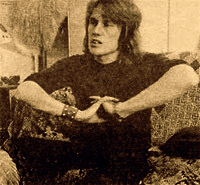
I don’t believe people can learn from other
people’s values. What’s right for me isn’t going to
be right for someone else. I’m not really interested
in politics enough to talk about it and even if I
was to use my popularity as a musician as a platform
for something else is a bit strange.
When we’re in the States people come into the
dressing room and ask you questions but you don’t
really talk. You just answer questions—“What do you
think of this? What do you think of that? What are
your views on this? – They obviously attach
importance to your views but I don’t. I don’t attach
importance to anyone’s views unless they’re actively
involved in it, and I’m not involved in anything
besides music—and I don’t think you reach anyone
who’s going to do anything about it anyway.
You’ve got a very wide selection of albums here.
Do you still listen to people like Broonzy and do
you take much notice of what other groups are doing?
No, if I listen to too many rock bands it’s
obviously going to influence me in the direction
which isn’t very good because we’ll start sounding
like someone else. Rock music to me is something
that I enjoy playing rather than listening to.
Music to me falls into something like fifty
different aspects: music for for listening to for
company, nice sounds in the corner like Crosby,
Stills, Nash and the Band which just make nice
noises to me. And then there’s the intense
stuff-jazz and the more progressive rock sounds that
get into heavy thing.
I still enjoy listening to the Beatles, I don’t
really know why, it’s just a matter of interest to
see what they’re up to. I listen to electronic music
as a means of escapism. I think that I probably
listen to it in the same way as someone who doesn’t
play an instrument listens to rock. They’re not
aware of the effects and how the instrument is being
played, it’s just a noise to them and electronic
music is just a noise to me.
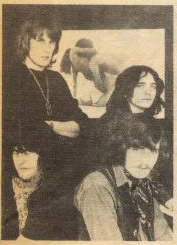 There’s been a revival of interest in rock and
roll. A lot of bands are going back to those roots.
Why do you think this is? There’s been a revival of interest in rock and
roll. A lot of bands are going back to those roots.
Why do you think this is?
There’s a tendency to go round in circles in music
and as a musician tends to progress much faster than
the people in the people who are listening, you tend
to outgrow the audience after awhile which tends to
make you feel less successful. I think this has
happened to the Beatles, they’ve gone on in
themselves but they’ve left the audience behind a
bit and then they try to go back and pick it up
where it was but then you lose your own interest in
it. I think it’s inevitable that it’ll happen at
some stage and if it does then I’m ready for it.
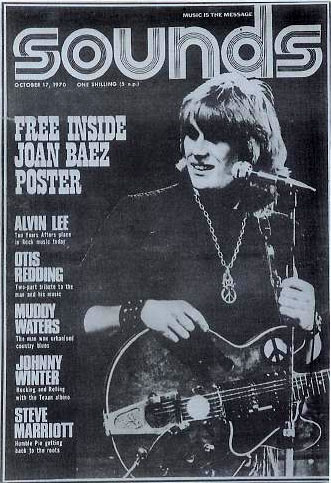
|
|
October 24, 1970 - New Musical
Express

Is This “Reduced?” – Last week’s New Musical
Express stated that Ten Years After were doing a short British
tour at reduced prices. After applying for a ticket at
Bournemouth Pavilion, I was told that prices were 18s each, 4s.
more than Black Sabbath the previous week. Having seen Ten Years
After for 12s. twice last year, it seems that prices are
spiralling out of all proportion. Guys just haven’t got the
bread to throw around at these prices. Greedy promoters will
kill off the club circuit by their own actions.
K.J. Woodford, Christchurch, Hants
|
November 1970 -
POPFOTO TEENBEAT
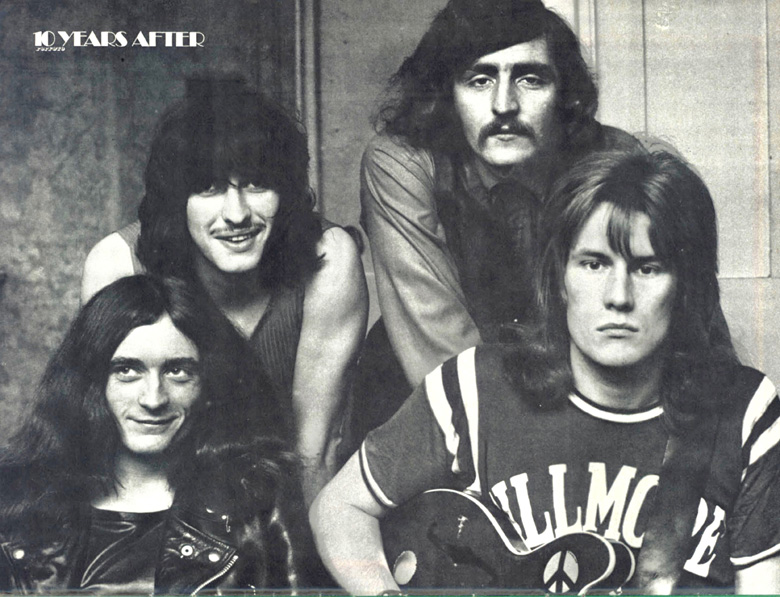
POPFOTO TEENBEAT
November 1970 - "Groupies" Movie, Poster

|
Ten Years After Tour
Schedule
October to December - 1970
October 27, 1970 –
At The Olympia Venue in Paris, France
November 1, 1970 –
At The Pavilion in Bournemouth, England
November 2, 1970 –
At The Civic Hall in Dunstable, England
November 3, 1970 –
At St. George’s Hall in Liverpool, England
November 12, 1970 –
At Winterland in San Francisco, California. This was the
beginning of Ten Years After’s eighth tour of the United
States.
November 13, 1970 –
Ten Years After at Madison Square Garden, New York City. This concert also
featured, Brethren and The Buddy Miles Band.
November 16, 1970 –
Ten Years After perform at the Memorial Auditorium in
Dallas, Texas
November 18, 1970 –
At The Sam Houston Coliseum, in Houston, Texas
November 19, 1970 –
At The Jailai Fonton in Miami, Flordia
November 20, 1970 –
At The Syndome in Chicago, Illinois
November 21, 1970 –
Ten Years After play at the Berkeley Community Centre in
Berkeley, California
November 22, 1970 –
At The Hic Arena in Seattle, Washington
November 25, 1970 –
At The Seattle Centre Arena in Seattle, Washington
November 26, 1970 –
Freedom Palace in Kansas City, Missouri
November 27, 1970 –
Ten Years After play at the historic “Warehouse” in New
Orleans, Louisiana
November 28, 1970 –
In San Jose, California
November 29, 1970
–
At The Sports Arena in San Diego, California
December 1, 1970 – Ten Years After perform at the Atlanta
Municipal Auditorium in Atlanta, Georgia |
November 1970 - POP Magazine, No. 11
published in Germany and
Switzerland
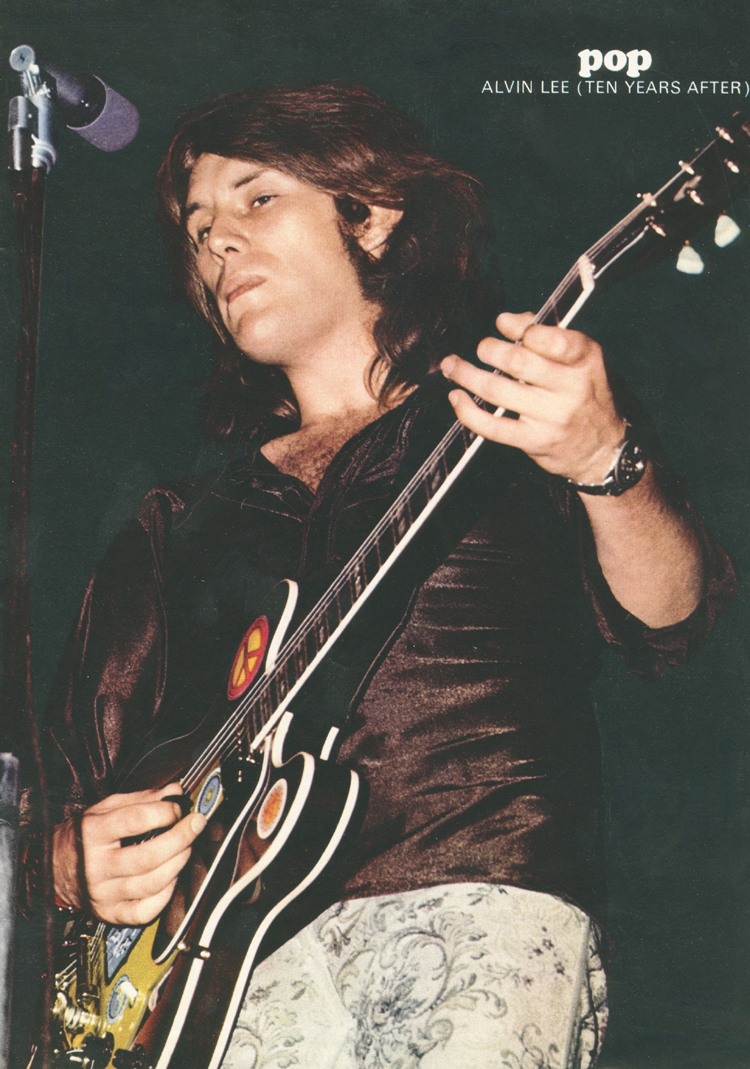
Alvin Lee with Gibson ES 345 Sunburst
Contribution
by Marcel Aeby
|
THE
ROCK PILE
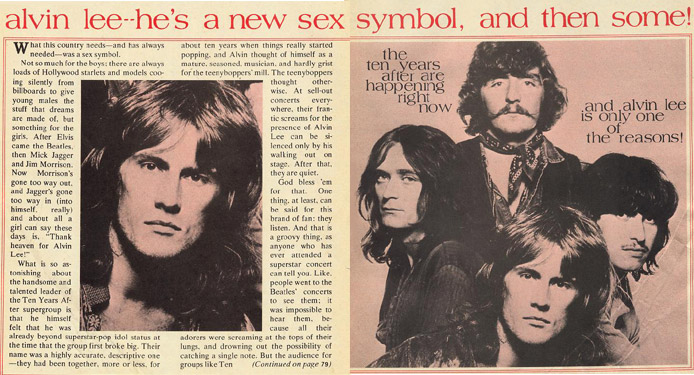
What
this country needs – and has always needed – was a sex
symbol. Not so much for the boys: there are always loads of
Hollywood starlets and models cooing silently from billboards
to give young males the stuff that dreams are made of, but
something for the girls. After Elvis came the Beatles, then
Mick Jagger and Jim Morrison. Now Morrisom’s gone too way
out, and Jagger’s gone too way in (into himself, really) and
about all a girl can say these days is, “Thank heaven for
Alvin Lee!”
What
is so astonishing about the handsome and talented leader of
Ten Years After
super-group is that he himself felt that he was already beyond
superstar – pop idol status at the time that the group first
broke big. Their name was a highly accurate, descriptive one
– they had been together, more or less, for about ten years
when things really started popping, and Alvin thought of
himself as a mature, seasoned, musician, and hardly grist for
the teeny-boppers´ mill. The teenyboppers thought otherwise.
At sell-out concerts everywhere, their frantic screams for the
presence of Alvin Lee can be silenced only by his walking out
on stage. After that they are quiet. God bless em´ for that.
One thing, at least, can be said for this brand of fan: they
listen. And that is a groovy thing, as anyone who has ever
attended a superstar concert can tell you. Like, people went
to the Beatles concerts to see them; it was impossible to hear
them, because all their adorers were screaming at the tops of
their lungs, and drowning out the possibility of catching a
single note. But the audience for groups like Ten Years After
has matured, not in age but in taste and respect for their
idols. They are no less adoring, but they dig the sounds that
the groups are laying down, and they come to listen as well as
look.
This
is very gratifying to Ten Years After, because they consider
themselves to be musicians first and idols after. They each
grew up in Nottingham, which for centuries was famous as the
hangout of the legendary Robin Hood, but now has a more
contemporary claim to fame in the form of the famous foursome.
They gigged around the area, first as a trio, then adding
Chick Churchill on organ to Leo Lyons on bass and Ric Lee on
drums.
Although
they are all natives of the same little English town, their
roots, as a band are fundamentally American. It was the big
beat of American -
rock – the Elvis Presley and Chuck Berry generation of sound
– that turned each of them on to opo music, although they
had all started playing their respective instruments long
before they ever met or thought of becoming professional
musicians. And it is the blues, in its purest form, that is
the greatest influence on them as a group today.
They
started making it big as a group right after the Beatles broke
the music scene wide open.
The
duality of the situation led to this, they would play the
first set of the gig in typical mod gear, velvets, ruffles and
the like, and do soft tunes that the girls in the audience
went crazy over. Then they would come back to do their second
set in rougher work clothes, and play the blues, and that
would get to the guys. So from the very beginning, they had
the best of both worlds going for them. And the best it was.
Alvin had been listening to authentic blues and jazz ever
since he was a child. Both of his parents were jazz buffs, and
later on, when someone mentioned the work of the late guitar
great Charlie Christian, Alvin was able to head home and go
through his old records and find just what he needed. This is
still another example of English musicians knowing more about
American music and musicians than Americans did. Alvin would
hang out in the clubs of Jamaicans living on the outskirts of
the city in order to dig the music. He listened, and he
learned, in the same respectful way that his fans are
listening to him today, and for some but not all of the same
reasons.
They
listen in part, because fans today are so much more
knowledgeable than they ever were before. Nobody who screamed
over Elvis in the old days ever stopped to think that his
gestures, his wiggles, even his songs were taken directly from
the soul singers like Chuck Berry, Bo Diddley, and Big Mama
Thornton, whom he watched and listened to so carefully. But
today’s fans know where the roots of the music are, because
artists like Alvin Lee have acknowledged their indebtedness
and inspiration.
The
other reason they listened is because there is a gorgeous man
up front worth screaming about. No question. Alvin Lee is a
face of today, and a mighty good one at that. He has that
famous something that no one has ever been able to define,
only identify, by ticking off the names of those who do have
whatever it is: Presley, McCartney, Morrison, Jagger, Sinatra
in the middle ages: maybe James Taylor in the soon. But right
now, it’s Alvin Lee country, and we all want passports!
|
|
November 7, 1970 - New
Musical Express

Live Concert – Ten Years After – Front Row
Reviews – By Roy Carr –
Without a doubt, Ten Years After have always
been a people’s band … playing to and for their audiences. Never
over or above their heads. Despite the fact that it seemed like
the start of the monsoon season, Ten Years After filled the
Civic Hall at Dunstable on Monday Night to the point of
overflowing. It was a most enjoyable night when Alvin, Chick,
Leo and Ric went back to the roots and created some nice crowd
reaction. Starting with the now familiar riff of … “Love Like A
Man,” they then presented some new material from their next
album, which included “I’m Coming On”. “Good Morning Little
Schoolgirl” brought forth cheers of approval and countless
bobbing heads”. “I’m Going Home” was the obvious show – stopper,
which had Chick a – top of his Hammond organ leading the
cheering, yelling, dancing crowd into a right old rave-up for
their encore of “Sweet Little Sixteen”. Those who did wish to
make Ten Years After the subject of their own petty controversy
should be left well alone to get on with their mindless rappings.
For me, I’d rather just go along like most people and hear some
good contemporary rock.
|
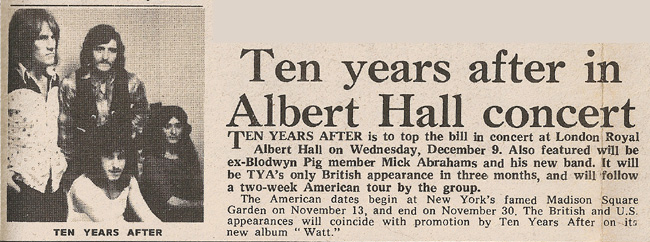
New Musical
Express November 7, 1970
November 13, 1970 -
Capitol Theatre, Madison Square Garden, New York City
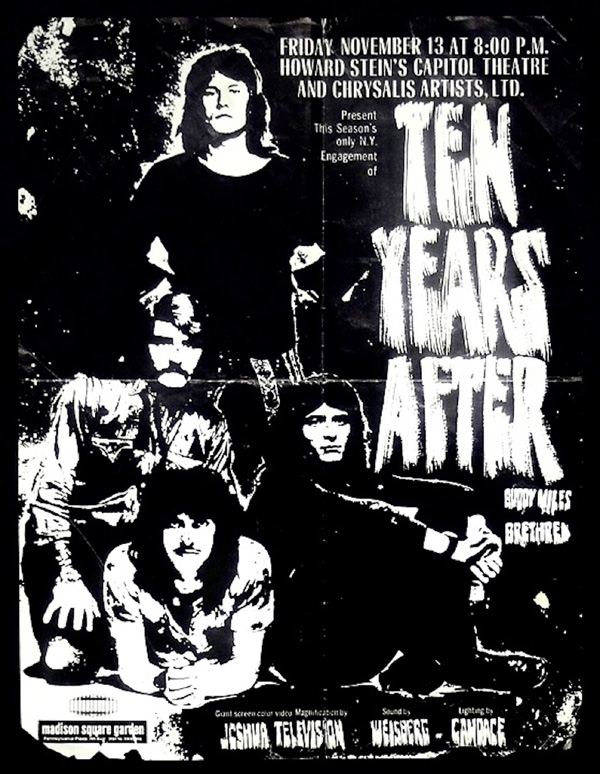
Concert Poster 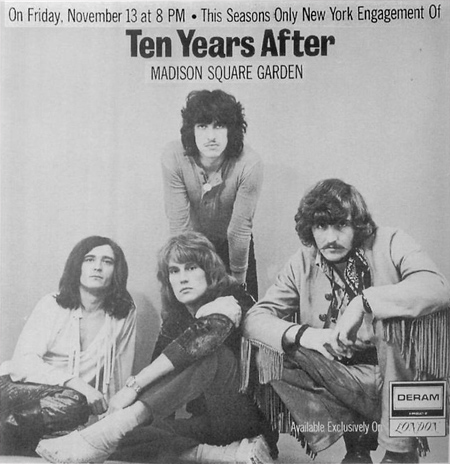
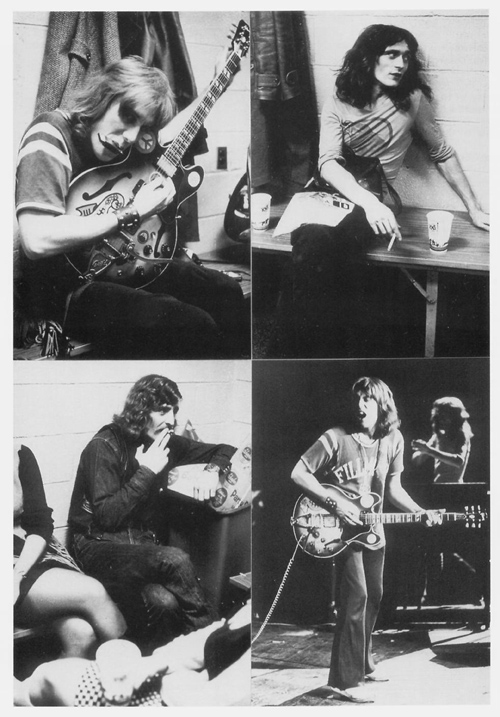

November 13, 1970
- Alvin Lee backstage with Gibson Sunburst, Madison Square
Garden, NYC,
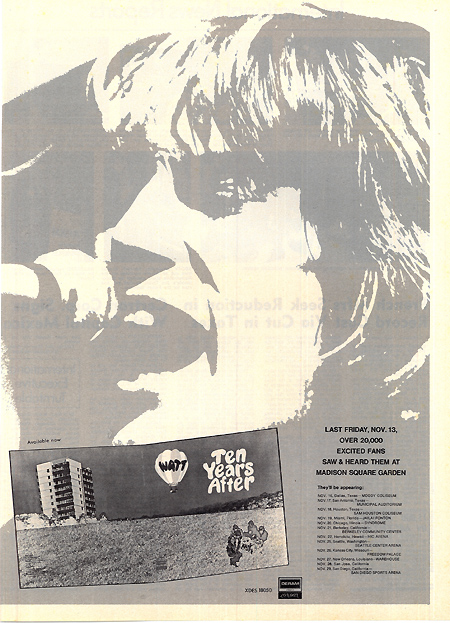
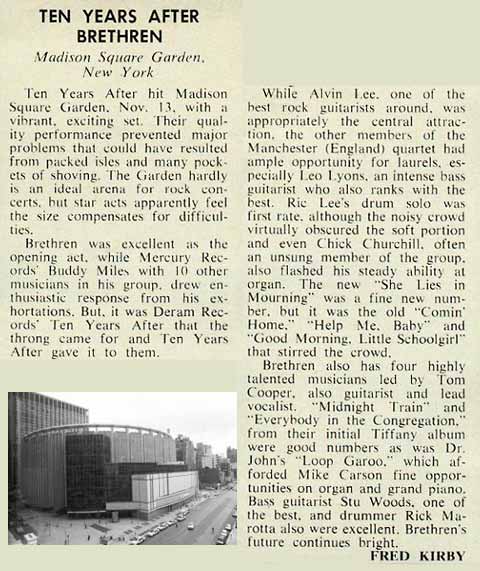
Billboard
Magazine - 28 November 1970
|
From Cash Box – 11/13/ 70
Ten Years After and The
Buddy Miles Express Concert
Madison Square Garden –
New York, N.Y.
Madison Square Garden
NYC. Judging from their November 13, 1970 Madison Square Garden
performance, two things became apparent: Firstly, that the new
material being prepared by Alvin Lee and Company for their
forthcoming “Watt” LP is far superior to their previous efforts,
and secondly, organist Chick Churchill serves little or no
function with the group during live concerts.
“I’m Coming On” and “She
Lies In The Morning” the two new cuts performed by Ten Years After are more
rock oriented as opposed to their traditional blues style that
so predominated their earlier albums. These two selections prove
that Alvin Lee is capable of leaving the blues roots behind and
able to venture forth into new musical realms.
A sudden relief !
Chick Churchill though,
poses somewhat of a problem. In the studio, he is effective, but
live, he contributes so little to the groups overall sound, that
I’ve often wondered why Ten Years After hadn’t performed as a
trio. Be that as it may, Ten Years After is a super group, and
in the tradition of super groups, the screaming audience wildly
applauded their every move, now that’s success !
Preceding Ten Years
After was The Buddy Miles Band. Miles, drummer now turned
vocalist, got the audience to its feet on several occasions with
his performances of “Them Changes” and Neil Young’s “Down By The
River” both taken from earlier LP’s. His band was tight at all
times, and played a short set of “get up and dance music”
The opening act,
Brethren seemed to be the most creative amongst all the
performers on the show, but I got the feeling that their music
was somehow lost somewhere within the huge Garden complex. In a
smaller hall, the audience would have given them the attention
they deserved.
By K.K.
|
|
November 14, 1970 New
Musical Express – New Music News
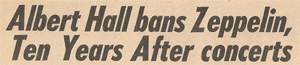
Led Zeppelin is virtually certain not to
appear in this country before 1971, and Ten Years After’s
projected concert at London Royal Albert Hall on December 9th
has been cancelled by the venue’s management as a result of
damage caused there during the group’s last appearance at the
hall. Zeppelin was to have undertaken four or five concerts at
major venues in late November or early December – including the
Albert Hall – but manager Peter Grant has
been unable to find halls willing to accept the group, because
so many are apprehensive about possible rioting.
Ten Years After last appeared at the Albert
Hall on December 15, 1969 – A number of seats were damaged by
fans, and the group has now been banned from appearing there. A
spokesman for the Albert Hall told the New Musical Express, that
application had been made to book the venue for the Ten Years
After concert on December 9th, but that the booking
had been rejected “because of the trouble which occurred the
last time the group was here”. A spokesman for Ten Years After’s
management said:
“More and more venues are refusing to book
rock groups, and it is becoming impossible to find large halls
to accommodate them. It is no use playing small clubs, because
many fans would be turned away, and those allowed in would be
extremely uncomfortable”.
|
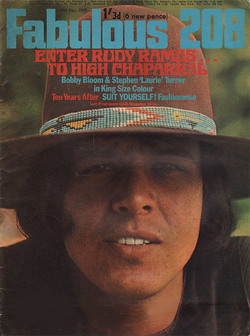
November 14, 1970
|
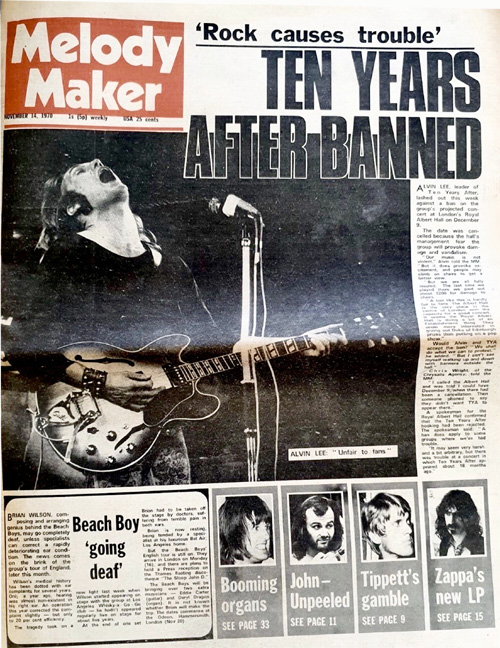
Melody
Maker – From November 14, 1970
“Rock
Causes Trouble” Ten Years After Banned From Playing
London’s Royal Albert Hall On December 9, 1970 – Alvin Lee
says “Unfair to Fans”
Alvin
Lee, leader of Ten Years After, lashed out this week against a
ban on the group’s projected concert at London’s Royal
Albert Hall on December 9th. The date was cancelled
because the hall’s management fear the group will provoke
damage and vandalism.
“Our
music is not violent,” Alvin told Melody Maker, “But it
does provoke excitement, and people may climb on chairs to get
a better view. “But we are all fully insured. The last time
we played there we paid out 200 £ for damage
to chairs. “A ban like this is hardly fair to fans. The
Albert Hall is the only place in the centre of London with the
capacity for a good concert. It seems the Royal Albert Hall is
doing a bit of an Establishment thing. They seem more
interested in giving out Duke of Edinburgh prizes, than
putting on a pop show.”
Would
Alvin and Ten Years After accept the ban? “We shall do what
we can to protest,” he added. “But I can’t see myself
walking up and down with banners outside the hall.”
Chris
Wright, of the Chrysalis Agency, told the Melody Maker, “I
called the Albert Hall, and was told I could have December 9th,
when there had been a cancellation. Then someone phoned to say
they didn’t want Ten Years After to appear there.”
A
spokesman for the Royal Albert Hall confirmed that the Ten
Years After booking had been rejected. The spokesman said:
“A ban does apply to some groups, where we’ve had trouble.
“It
may seem very harsh and a bit arbitrary, but there was trouble
at a concert in which Ten Years After appeared about eighteen
months ago.”
|
|
November 14, 1970 - Spectrum,
Philadelphia
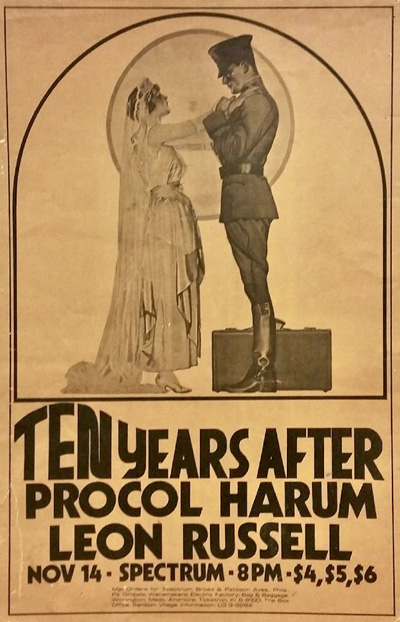
Concert Poster
Hard Rock Lives On At The Spectrum By
Jack Lloyd Of The Inquirer Staff.
Alvin Lee… Here From Britain. Acoustic
Guitars, Softer Sounds, Intricate Harmonies, Finesse… These Are
The Elements That Are Receiving A Steadily Increasing Amount of
Attention These Days. But Don’t Fret, Darlings, That Good Old
Fashioned Hard Rock Lives On. There Are Still More Than A Few
High Powered Amplifiers That Are Regarded With Tender Affection.
Case In Point: A Case In Point Was
Made At The Spectrum On Thursday Night During A Rock Concert
Headlined By "Ten Years After" One of The More Powerful Groups
That Periodically Makes The Economy-Minded Pilgrimage From
England To The Colonies. Also On Hand Were Another Brand of
British Marauders Called The "Mott The Hoople" and the Philadelphia Based
"Sweet Stavin Chain."
Low Key Vocals: Lee Is Hardly One of
The Best Rock Vocalist Around. The Sholiowness of His Tones Are
Especially Emphasized On The Low-Key Vocals That He Occasionally
Throws In To Slow Down The Proceedings. But On Those Good Old
Hard Rock Outburst That Are The Sum and Substance of The Group’s
Appeal. Lee Overcomes The Weakness of The Flesh With Sheer Brute
Force-A Raucous Vocal Breakthrough That Soars Out On The Back of
A Throbbing Rhythm Section and His Own Brilliant Guitar.
Rock Revivals: There Was Also An
Abundance of Hard-Hitting Rock Provided By The New Group Called
"Mott The Hoople" Which Is More Than Capable of Hitting Acid
Rock Plateaus But Really Doesn’t Stir Up The Folks Until The
Group Cuts Loose With Their Romping Rock and Roll Revivals of
Such "Classics" As "A Whole Lot of Shakin’ Going On." And When
You Hear The Response From Those In The Crowd, Who Were Barely
Able To Toddle In The Heyday of Jerry Lee Lewis and Little
Richard, You Suspect That Maybe Rock Had Its Grandest Hour Back
In Those Innocent 50’s.
Note: From Concert-Archives.org
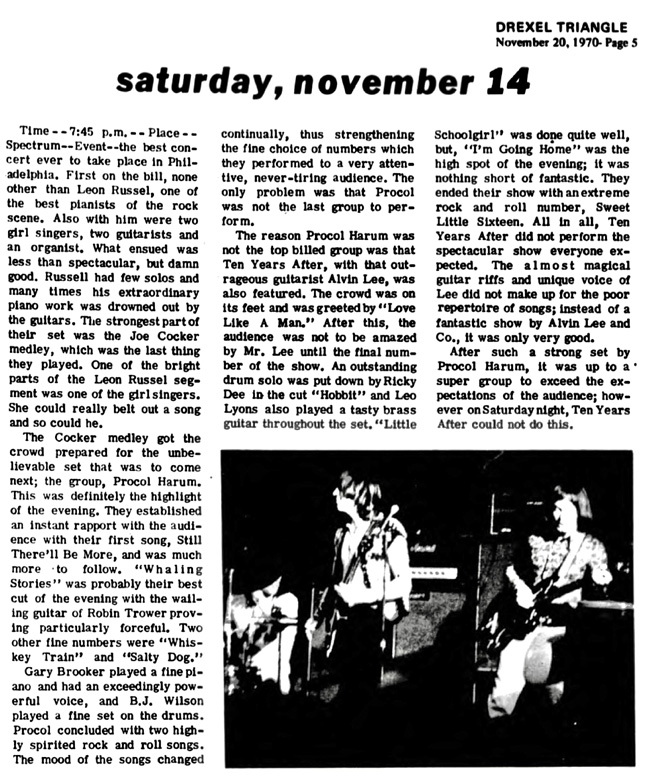
November 14, 1970 - The
Triangle - Concert Review
- Independent Student Newspaper,
Drexel University - |
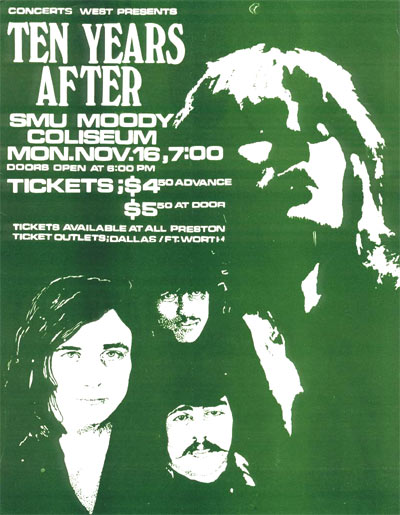
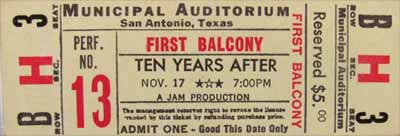
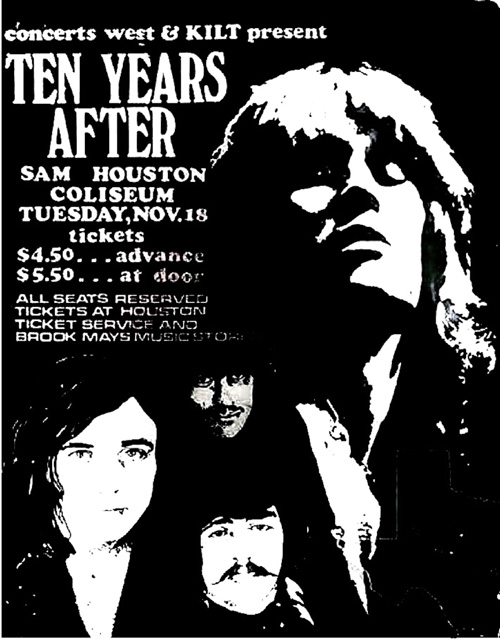
November 18, 1970 -
Sam Houston Coliseum, Houston, Texas
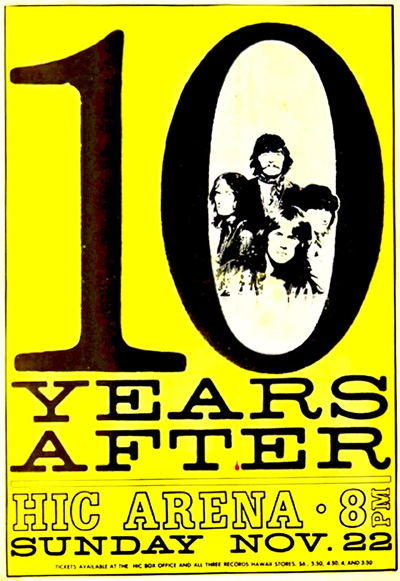
November 22, 1970 -
HIC Arena, Honolulu International Center
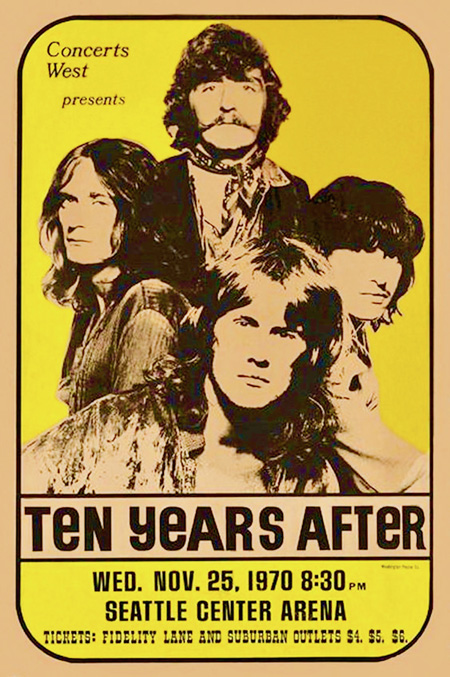
November 25, 1970 -
Seattle Center Arena
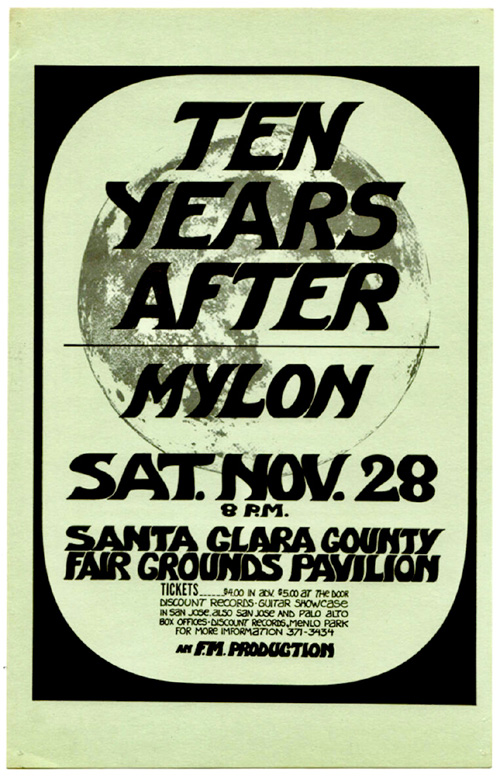
November 28, 1970 -
Santa Clara County Fair Grounds Pavilion, San Jose, California
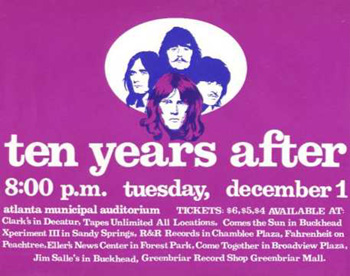
Ten
Years After – Tuesday December 1, 1970 – Atlanta Auditorium
“It was like I was
going through a door and into an alternate universe. I’m not sure
that I ever came back into this one after that experience. That was
a heavy scene."
1970
November 25 - Ciao2001 - No. 47 - Italy
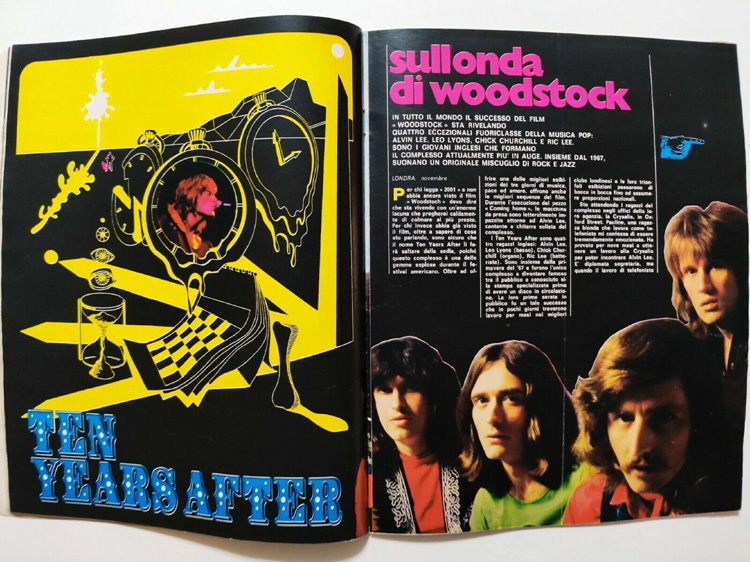
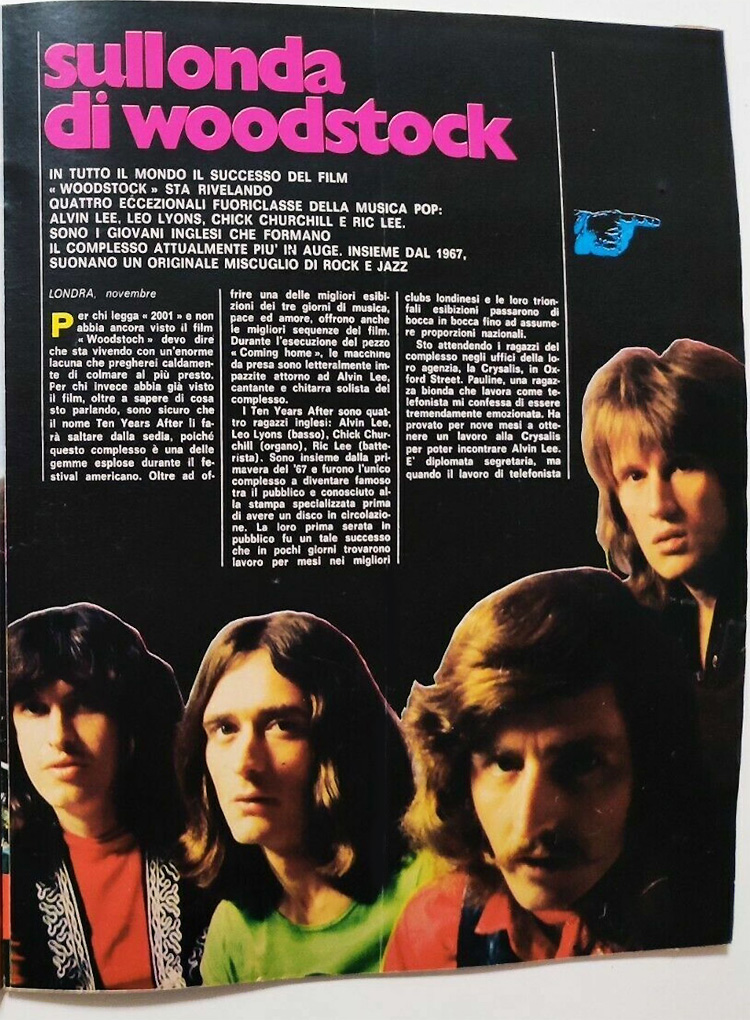
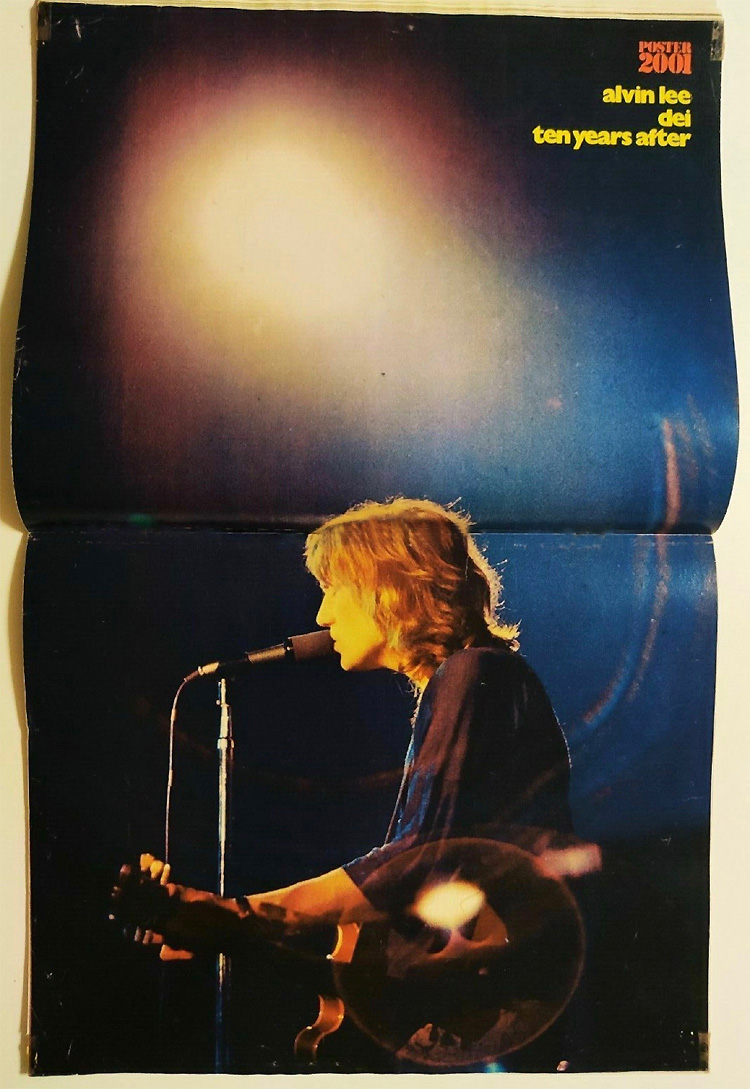
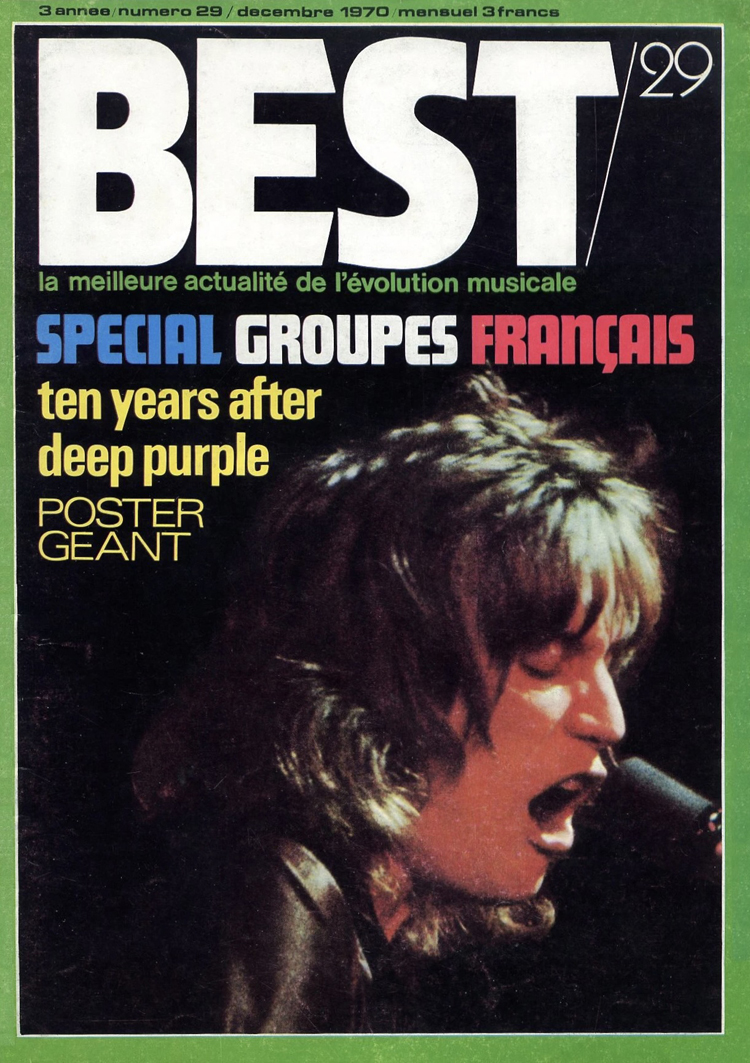
December 1970 - French
Magazine BEST
December 1970 -
Rock Folk Magazine, France
Page 44
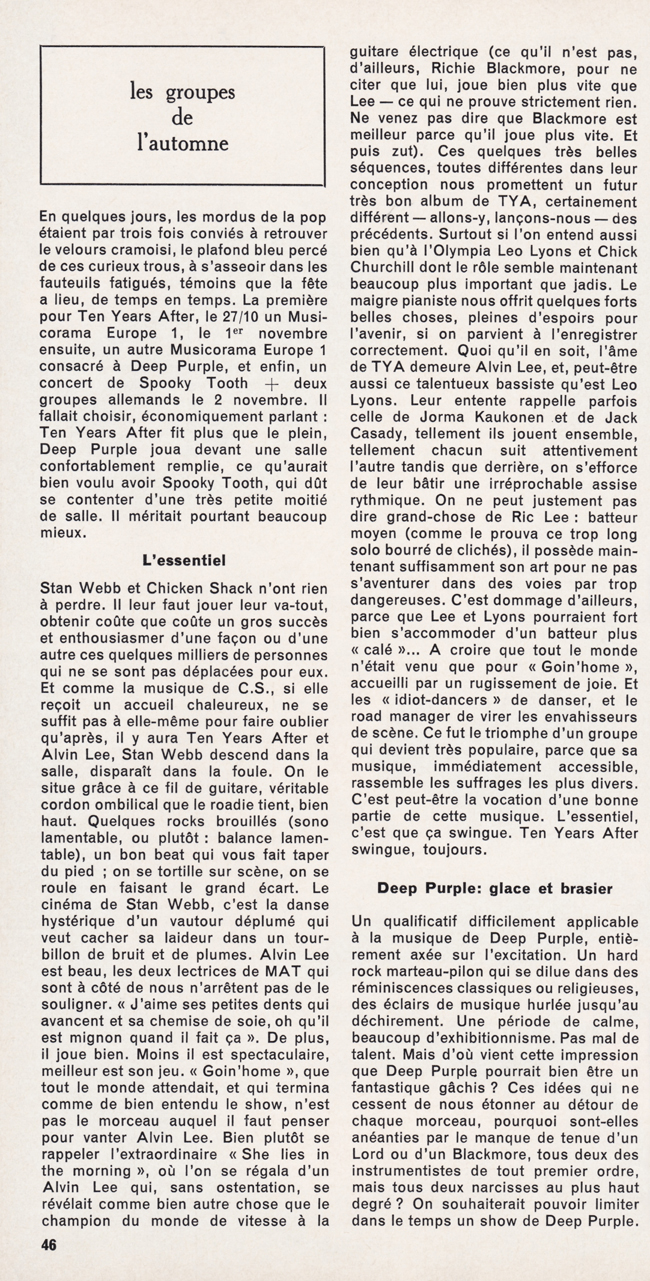
Page 46
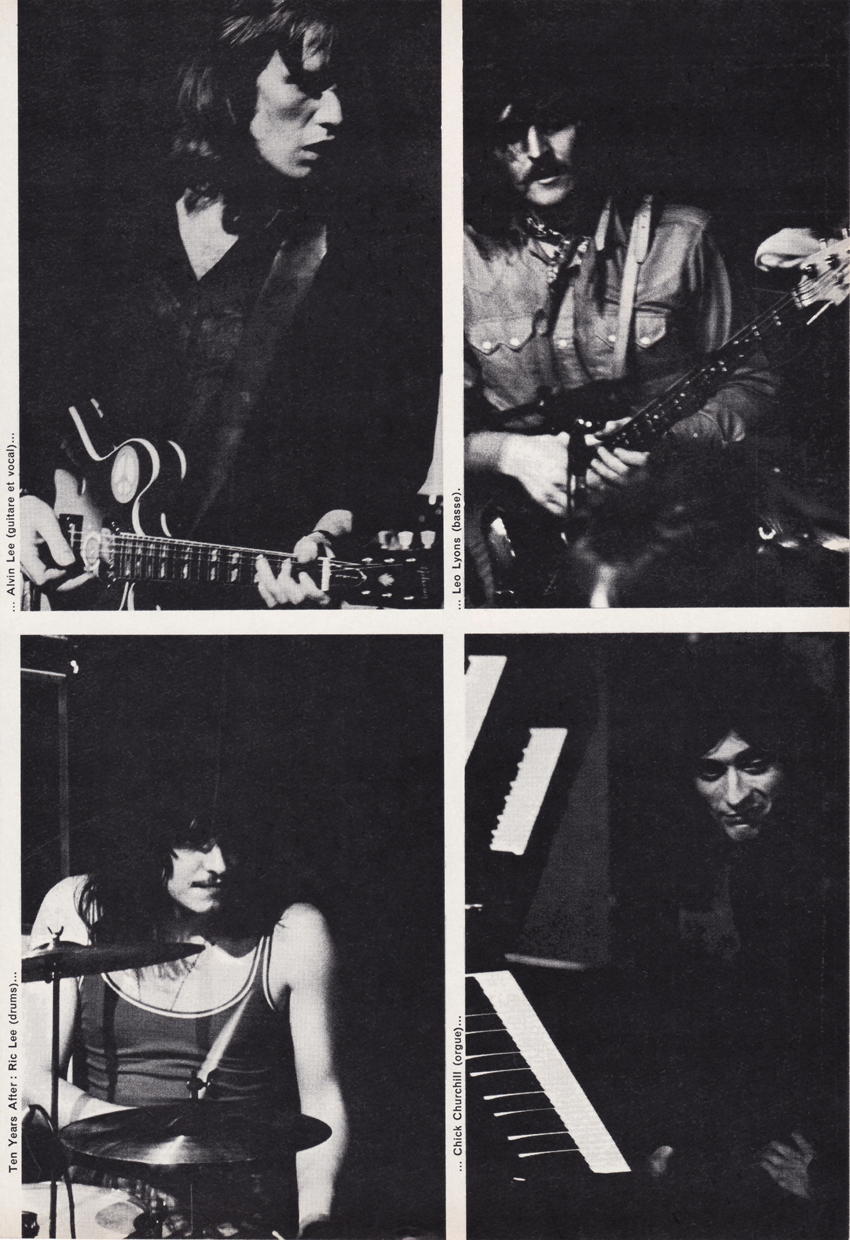
Page 47 -
Photos: Paris L'Olympia, 27 October 1970
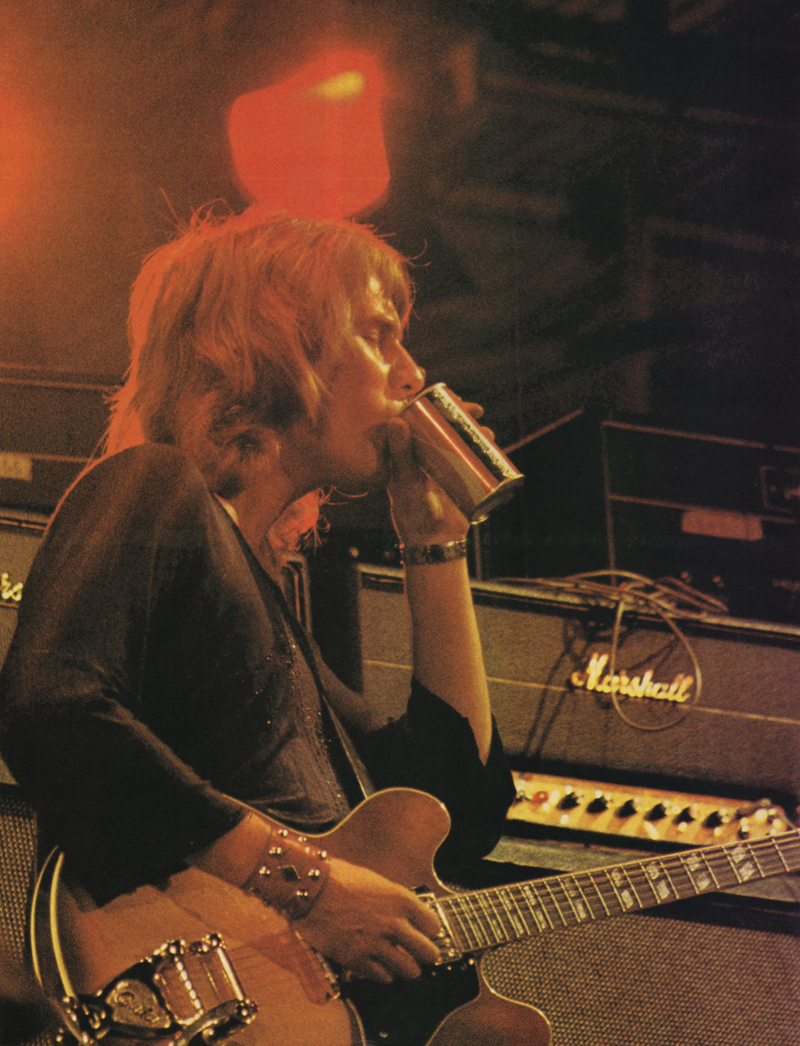
Page 48 -
Photo: Isle Of Wight Festival, 29 August 1970
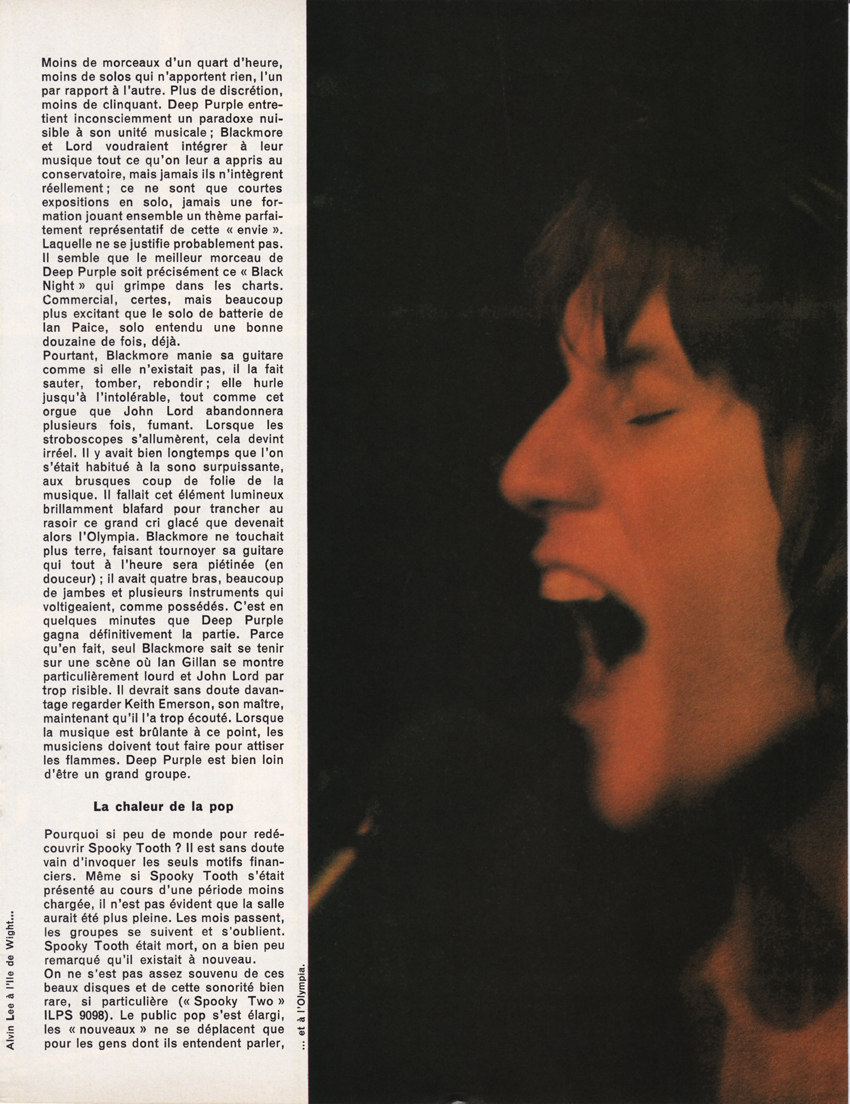
Page 49 -
Photo: Paris L'Olympia, 27 October 1970
Page 51
Page 52 - 58 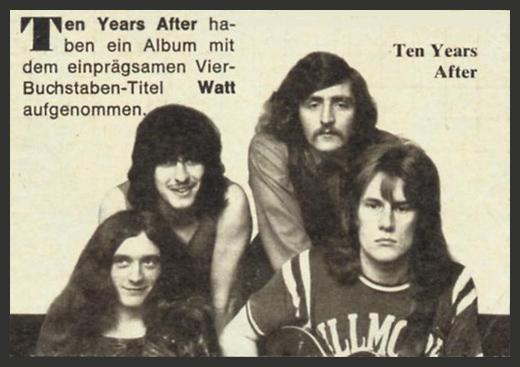
|
WATT - Release
Date 10 December 1970
Watt
by Ten Years After, shows how
much the group has matured during the last few months.
Alvin
Lee is still the star with his inventive guitar playing and
funky singing, but the other members get a chance to shine,
particularly CHICK CHURCHILL on piano, and organ. Included is
Sweet Sixteen, a ‘live’ recording from that historic Isle
of Wight concert—and it’s a knockout (Deram).
Tracks:
I’m Coming On; My Baby Left Me; Think About The Times; I Say
Yeah; The Band With No Name; Gonna Run: She Lies In The
Morning; Sweet Little Sixteen.
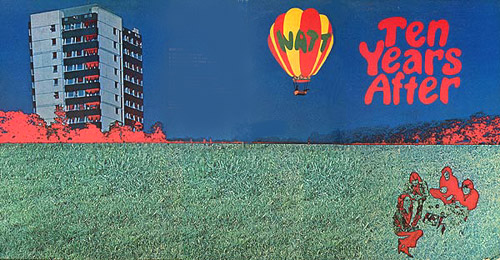
This review is from: Watt
(Audio CD)
In hindsight Ten Years After's breakthrough (their
star-making turn at Woodstock in 1969, and especially
when they featured prominently in the film of the
festival) was both the best and the worst that could
have happened. The best because it graduated them to a
real semblance of commercial success on their own terms
after two years' slogging (and an unforgettable live
album, "Undead," still the best set of their
career); the worst because they'd spend the next two
years trying to live up to it and running out of gas. A
decent remastering job still cannot overcome the point
that "Watt" sounds written and cut under sheer
exhaustion---which is probably how it was cut in the
first place. (It also finished their original recording
contract.)
After the last truly luminous exercise of their career
(the marvelous "Cricklewood Green"), here is a
band just about out of ideas. Which is saying something
for a band that didn't exactly have pocketfuls of ideas
above and beyond their distinctive enough marriage of
blues and bluesy jazz. ("Undead," their early
live set, is the best example of that marriage and
probably the best album of their career.) How drained
were they? The lyrics (never a TYA attribute in the
first place) are even more throwaway than in the past;
the butterfingered guitar runs sound extremely
repetitive (against each other and against a lot of
Alvin Lee's earlier exercises) and almost mechanically
executed; and, even allowing for bad recording, the
version of "Sweet Little Sixteen" that closes
the set, drawn from a 1970 concert, sounds anything but
the band whose rip-snorting Woodstock set made them
superstars in the first place.
If "Watt" was Ten Years After's way of saying
they were gassed, they couldn't have done it more
vividly. The lone exception, perhaps: "Gonna
Run," which graduates almost seamlessly from a
simplistic but paranoid-sounding stroll into an
exuberant, jazzy blues jam not dissimilar to what they
loved to unhorse pre-Woodstock---so exuberant, in fact,
that you'd be forgiven if you suspected Lee and the guys
were really yelling "Stop!" to the two-year
whirlwind that slammed them to this point. They took a
long break (and signed with a new label, Columbia) after
this album hit the racks. Then, they tried a mild
shakeup, adding a few folk and soft rock elements to an
attempt to streamline their style a little more overtly.
They got away with it for one album ("A Space in
Time," their first and best Columbia album),
learned the hard way it wasn't really them (they hinted
as much with "A Space in Time"'s closing track, the quick "Undead"-like "Uncle
Jam"), and faded away quietly enough by 1974, not
exactly the way you would have expected one of
Woodstock's biggest breakouts to go at the time of the
festival.
|
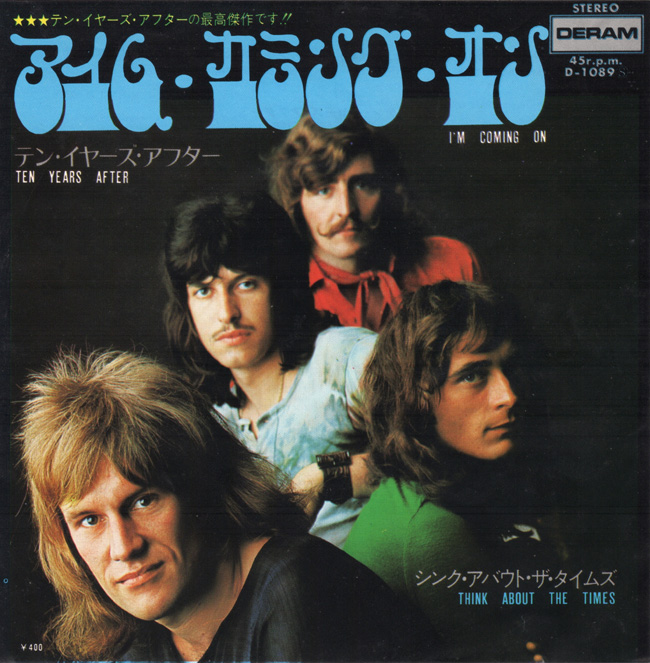
I'm
Coming On / Think About The Times - Single
published in Japan 1970
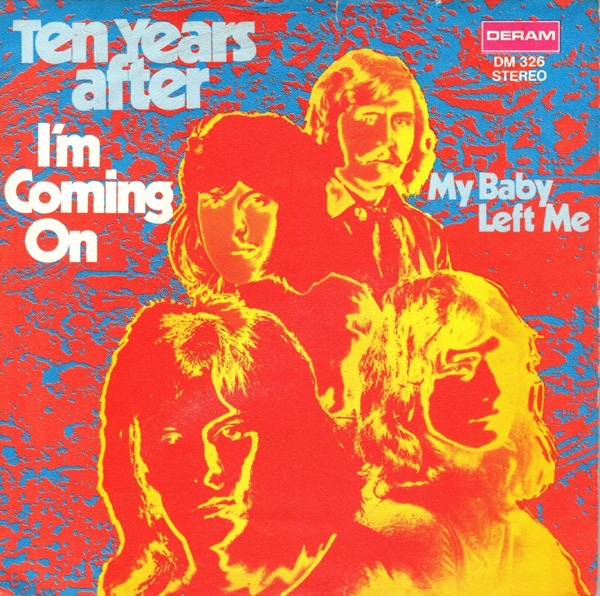
I'm Coming On / My
Baby Left Me - published in Germany
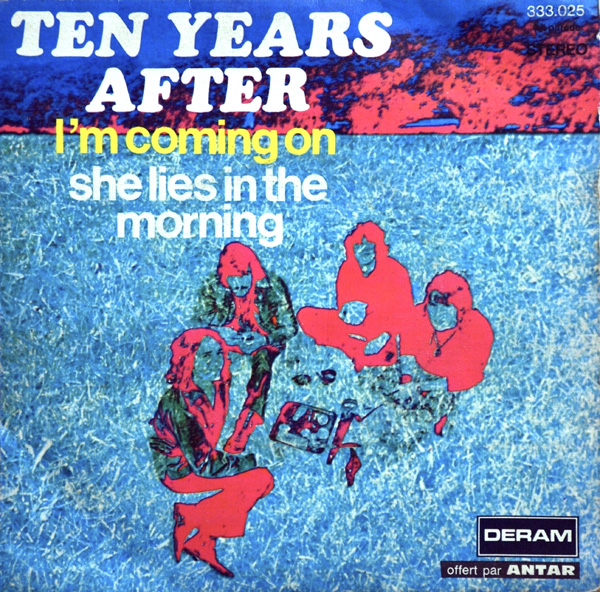
I'm Coming On / She
Lies In The Morning - published in France
From Melody Maker
- December 19,
1970

 Ten Years After: “Watt”
(Deram) Ten Years After: “Watt”
(Deram)
In the past most would agree that the figure of Alvin Lee
has dominated the group, as a guitar hero, rock idol, singer
and writer. But from the evidence of this solid,
unpretentious album of modern group wailing, Ten Years After
are now much more of a band.
It’s nice to hear Chick Churchill’s piano and organ coming
through strongly on the swinging jazz blow “Gonna Run,” and
adding meaningful chords to “Think About The Times.”
Leo Lyons and Ric Lee make a driving rhythm section and Ric
gets a nice “feel” going particularly on numbers like “She
Lies In The Morning.” Production is excellent and has only
sparing of use of gimmicks that became a little heavy handed
on one of their previous albums.
The significance of the Duane Eddy inspired “The Band With
No Name” followed by street noises is somewhat obscure—but
it sounds effective! Alvin sings in a painless style that
makes him a good band vocalist without being a new Neil
Young , and his guitar playing displays invention and good
taste without any of the excessive histrionics of which he
sometimes stands accused.
|
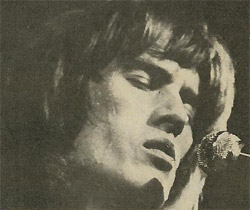 |
It’s fun to hear the “Sweet Little Sixteen” track a
“live” recording from the Isle Of Wight festival and the
first from that extraordinary event we have heard. The drums
stomp along. Alvin shouts with funky power and blows a mean
guitar….and the crowds cheer. When they write the history of
rock (if they haven’t already), Ten Years After could well
be exemplified as the archetypal crowd pleasing, open air
festival, guitar boogie shuffling rock band. And for proof
that they have even more to offer—give an ear to “watt” they
have been doing in the studio. |
|
Photo by Thom Lukas |
 |
|
|

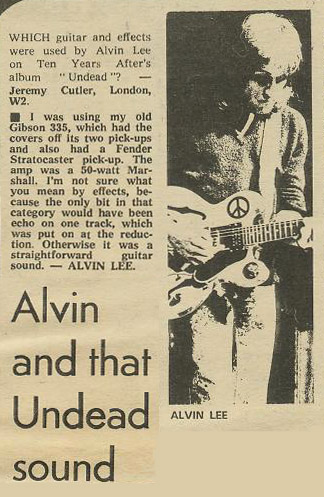
From December 26, 1970
|
|
Record Mirror – December 26, 1970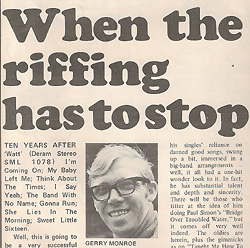
When The Riffing Has To Stop – By Garry
Monroe
Ten Years After “Watt” Album Review
Well, this is going to be a very
successful album – following on precisely from
“Cricklewood Green” with Alvin Lee’s guitar as the
dominant factor. “Watt” starts with Lee’s own “I’m Coming
On,” a fast number displaying Lee’s fast guitar-work.
That’s followed by “My Baby Left Me” a
slow blues, and not the Arthur Crudup number – again
written by Alvin Lee. The next two tracks, “Think About
The Times” and “I Say Yeah” are both taken at the same
tempo, a little more relaxed than the opening track, and
both based around a permanent riff. The opening track on
side two,
“The Band With No Name” is a little
different taken a little more lightly than the other, with
Lee on acoustic guitar. “Gonna Run” built around a
medium-paced riff, while “She Lies In The Morning,” the
long third number, changes tempo mid-way.
The final track is Chuck Berry’s “Sweet Little Sixteen” –
recorded live at the Isle Of Wight Festival August of this
year. Altogether, a certain chart entry and presumably, a
must for Ten Years After fans. But really, the riffs must
be
wearing a little thin by now, and as for the groups
version of “Sweet Little Sixteen,” well, I prefer Chuck
Berry.
|
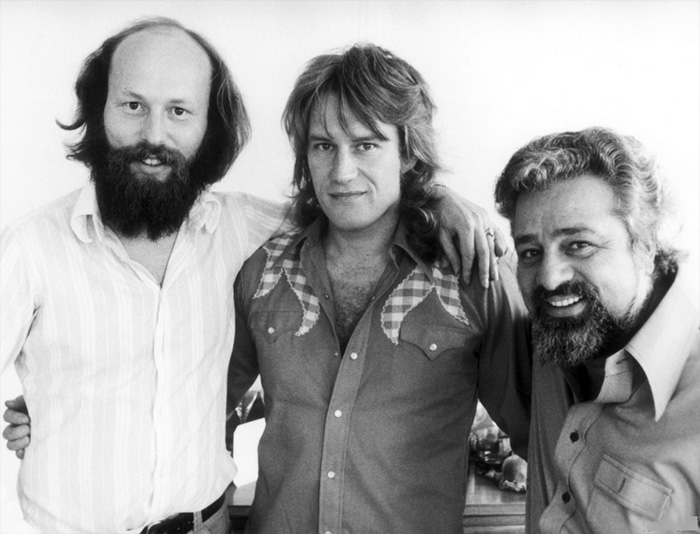
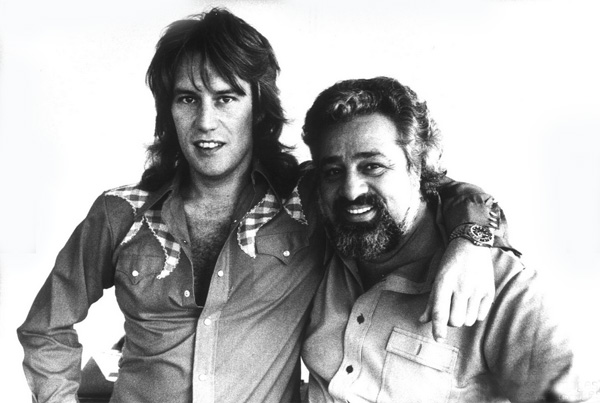
|
New Musical
Express
December
26, 1970

 |
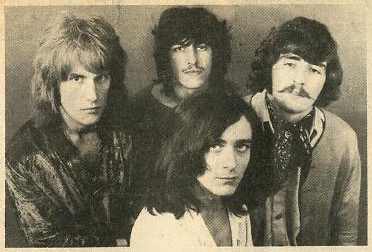 |
|
After
a break of several months since the last album, during which
time they managed a record-breaking American tour, a smash
appearance at the Isle Of Wight Festival, and—ye Gods!—even
a hit single, Ten Years After have popped up again with a
splendid effort designed to bring joy to their fans as they
gather round the log fire digesting the Christmas pud.
The
brave hero Alvin Lee is up front again, collecting the honours
as he races away on his electric steed (heavily disguised as a
guitar), but loveable Chick Churchill plays a more audible
part than of late, while Leo Lyons and Ric Lee consolidate
their respective positions of strength within the merry band.
In
no time at all, I expect to see the album cutting a dash up
the rungs of the ladder of fame, sometimes known as the chart,
and mighty will be the roar of the pennies clanking into the
coffers of the record company, and the group alike. But enough
of this little tattle, here is a track by track run down on
the goodies in store:
1.I’m
Coming On:
Not
to be confused with the TYA standard I’m Going Home, this
features Alvin building patterns on Leo’s repetitious bass
riff. Ric’s drumming compliments the bass on a number that
is mostly instrumental with a fast and exciting build up.
2.My
Baby Left Me:
Piano
chords introduce a slow blues with Alvin’s voice revealing
traces of Dylan. It suddenly switches to a boogie rhythm.
Alvin and Lee fusing their music together, then reverts to the
original mood before once again picking up the alternative
theme.
3.Think
About The Times:
Another
slow blues, Leo’s bass is prominent playing very clearly,
and leading the other instruments in support of the vocals.
The lead guitar solo midway is subdued with a lot fuzz on it.
4.
I Say Yeah:
A
long track, Alvin creates all manner of effects at times
sounding like the BBC Radiophonic Workshop, and Leo plays
superbly, proving his leadership in the field of bass players.
The excitement mounts, and the toes begin to tap.
5.
The Band With No Name:
Very
short and obviously a spoof, this sounds like the theme from
“A Handful Of Lire” or some other spaghetti Western.
6.Gonna
Run:
A
variation on the basic 12-bar that has been used by thousands
of bands for many, many years. The difference here is the way
in which TYA build the tempo gradually. Chick’s piano
becoming more prominent as the number progresses. There’s
the famous Alvin Lee-Leo Lyons combination of Leo running up
and down the scale, and Alvin relaxing into a jazz mood. The
drumming is skippy and fluent, and the piano takes a very good
solo, rolling and jumping about in fine form.
7.
She Lies In The Morning:
The
drums show the way on what begins as a medium-tempo rocker
that gets so fast it sounds as if the tape has been speeded
up. As suddenly as it increases in speed, the whole thing
slows almost to a crawl before the drums, bass and piano tempt
the lead guitar into a fit of wildness.
8.
Sweet Little Sixteen
Recorded
“live” at the Isle Of Wight Festival, it packs a hell of a
lot of power and gets right into a beautiful rock and roll
beat. The excitement generated by the crowd and the group
makes up for the poor recording quality. If you listen closely
you may even hear my piercing whistle at the end. Where are my
royalties, Alvin?
|
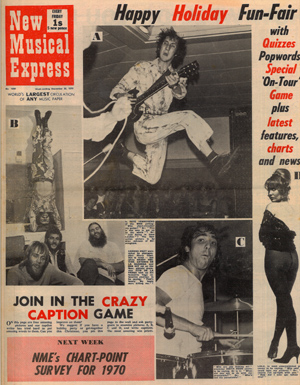

|
|
|