|
|
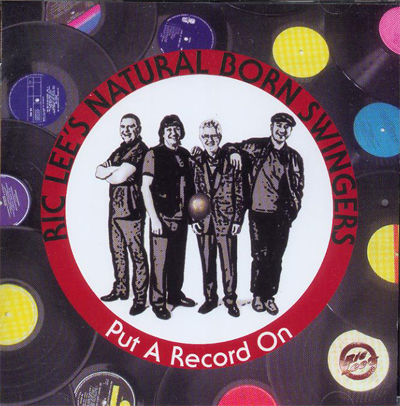
Ric Lee’s Natural Born
Swingers
|
CD Review – "Put A
Record On"
The Band:
Ric
Lee - Drums, Percussion and Vocals
Danny Handley –
Guitar/Vocals
Bob Hall –
Keyboards/Vocals
Scott Whitley – Bass/Vocals
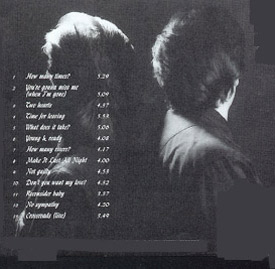
- I Want To
Know – 2:56
- Don’t Want
You Woman – 3:17
- Put A Record
On – 3:54
- The Hills Of
Afghanistan – 3:53
- Keep On
Singing The Blues – 3:58
- It’s Too Late
– 4:11
- I Don’t Play
Boogie – 5:04
- Bad Feeling
Blues – 4:27
- It Don’t Mean
A Thing To You – 3:38
- A Fool Like
Me – 3:27
- Passing On
Blues – 3:20
- Rock Your
Mama – 3:54
- I Can’t Get
My Ass In Gear – 3:50
|
 |
Liner Notes: The
Blues, music born around the turn of the 20th
century among poor black sharecroppers in the American
rural south, somehow resonated with British teenagers in
the 1960’s and became British blues, or blues-rock. One
of the foremost groups to play this “new” music was Ten
Years After, who became part of the British Blues
Invasion that took America by storm over the next
decade. Ten Years After appeared at the legendary
Woodstock Festival (1969) and had many hits in the
succeeding years. When Ric Lee, drummer with Ten Years
After, invited pianist and neighbour Bob Hall a founding
member of Savoy Brown, another legendary British Blues
Invasion band, to play at a local party, they little
realized what was in store. The partnership was a great
success and there was talk of forming a band to recreate
the exciting sounds of the former halcyon days. Through
a fortuitous connection, Ric and Bob met up with younger
generation Danny Handley (Vocals and Guitar) and Scott
Whitley (Bass and Vocals). The music ignited, and Ric
Lee’s Natural Born Swingers was conceived. The band’s
explosive blend of early Ten Years After swing and
shuffle favourites and original material, is stirring
fond memories among Ten Years After fans, blues fans,
and picking up many new friends among the younger, wider
public.
Special thanks
for their outstanding contributions to this debut album
go to guest artist:
Paul Jones (The
Manfreds and The Blues Band) on Harmonica
Kim Simmons
(Savoy Brown) Guitar
Virgil McMahon (Virgil and The
Accelerators) Guitar
Son Henry (Son Henry Band) Steel
Guitar
Steve Beighton (Paul Carrock) Brass.
Notes by Bob
Hall 2012
CD Review by Dave Willey
I Want To Know –
There are three songs on this cd that were originally on
the first Ten Years After
album. This is the first of them. It really serves no
purpose to compare the original version with this
rendition, as both are equal in performance. The only
difference is the pleasant discovery that Paul Jones,
who wrote the song, plays harmonic on it here.
A fast number, a
real toe-tapper and most of all memorable, on both
versions.
Don’t Want You
Woman – This is the second song from Ten Years After’s
debut album redone here. The acoustic guitar keeps a
firm rhythm going. Paul Jones covers the lead section
with his excellent harmonica work, which drives the song
along beautifully.
Put A Record On
– The pace and style changes from the first two songs.
You may have to listen to it more than once to really
appreciate this number. It will grow on you, and flow
with the first songs on this side.
The Hills of
Afghanistan – I was really unprepared for such a song on
this cd. But, it’s one of the best in this collection,
unique, un-preaching and speaking the truth. No one wins
a fight, a battle or a war. What are the powers that be
thinking about? I don’t really want to know.
Another surprise
on this song, is that this is the singing debut of
drummer Ric Lee. His soulful vocals provide the
heartfelt empathy / compassion needed to reflect the
humility that we all feel for these war ravaged people.
Keep On Singing
The Blues – A beer-barrel rocker, a Saturday night
roller. A story about accepting life and reality as it
is. The music is brilliantly done, strong with excellent
vocals. It’s got a Blues
Traveller sound and feel to it.
It’s Too Late –
I like this song, it reminds me of the old classic, “Six
Days On The Road”. The song also
has some unexpected chord changes going on, with great
keyboard work pushing it right along. The lead guitar
work is great, as it adds texture and isn’t overwhelming
as some players can be.
I Don’t Play
Boogie – The longest song on this debut collection.
You’ll never get tired of listening to it, when it comes
around on your player. Tasty, interesting and a lot of
good fun. Great playing
throughout, especially the piano being the highlight.
Smooth vocals, with a real countrified Rock-a-Billy
workout to be sure. It just makes you feel good!
Bad Feeling
Blues – One of my favourites, the playing and the vocals
are exceptional. It’s addictive,
smooth and satisfying.
It Don’t Mean A
Thing To You – A wonderful little rocker that’ll make
you sing and sing out loud. At home or driving your car
around town, you’ll be unable to sit still on this one. A lively
kick-ass tune – with a smart ending.
A Fool Like Me
– In a country bar, with the lights down low, on a
weekend with rain coming down – when this song comes on
the old juke-box – there’s suddenly a line forming at
the pay phone in the corner – it’s a cry in your beer
song, for fools like us.
Passing On Blues
– I don’t want to wake up in the morning and find myself
dead, give me time to count to five, just to make sure
that I’m really alive – and that I Survived the night
before….a song for Sunday morning after a wild night
with friends. Excess leads to the palace of wisdom they
say.
Rock Your Mama –
The third remake of a Ten Years After song on this cd.
As with the other two renditions it does no disservice
to the originals. In fact, it’s simply refreshing to
hear the old favourites reworked and given a brand new
life. In this case, the song holds the pace without any
lull, just a little different from the original, you’ll
enjoy both versions, I’m sure. The guitar and
vocals are extraordinary….and isn’t Ric right on the
money here….the entire band couldn’t be any
better…listen carefully for Paul’s subtle harmonica
work….I could listen to an hour of this song, it ends
too soon.
I Can’t Get My
Ass In Gear – If you listen to this song long enough,
you’re guaranteed to suffer a case of lethargy. If you
already suffer from a case of procrastination, a
severe lack of ambition or suffer from genetically
predisposed chronic case of low energy syndrome, this
song is for you. It could be your air-tight excuse,
for everything that you had no desire to do in the
first place. A fun song, that’ll stick in your head.
Think I’ll use this as a prelude to the “Rodeo Song”.
You can't sit
still when you listen to this song. It makes you want to
get up and move and dance. It will give you a boost of
energy that you didn't know you had.
In Conclusion:
Hello Ric and Band. What you guys wanted to get across
on this cd, hit the bull’s-eye the first time around.
The overall talent, passion and energy all came shining
through. I found myself listening to the entire group
effort and not concentrating on the individual
components presented here. It’s that good! I’m so used
to dissecting music in order to find what I really like
and the parts that don’t impress me much, that it feels
strange to listen to an entire cd without such
distractions. Your debut cd is a certified golden home
run, brilliantly done and with perfection in every area.
Performances, production, material and mutual admiration
of each others talents. I for one know that you worked
your collective asses off, because it sounds like it was
so damn easy to make. It doesn’t get any better than
this, can’t wait for the band’s second release!
by Dave Willey
|
|
From
Mansfield to Woodstock - and beyond!
A
fascinating address full of memories and
anecdotes related by Ric Lee, drummer and
founder member of Ten Years After.
January 23rd, 8pm.
Woodley Baptist Church Hall (opposite
Drumwright).
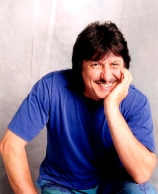
In 1967, four young musicians from
Nottinghamshire, England, Leo Lyons, Ric Lee,
Chick Churchill together with Alvin Lee, formed
Ten Years After and became one of the biggest
names and the most explosive quartets on the
world stage.
Their now legendary encore, “I’m Going Home”
performed at The Woodstock Music and Arts
Festival in August 1969, was captured on film
and exposed their jazz, blues, rock amalgam to a
large audience of movie-goers who were blown
away by the intensity of the band's performance
when the Academy Award winning documentary was
released. Their ten minute appearance in the
film is an acknowledged highlight and
established Ten Years After a place in rock
history. |
|
From 1968 to 1975 constant touring, playing
important musical events like The Newport Jazz
Festival, The Miami Pop Festival, The 1970 Isle
of Wight Festival, The Toronto Peace Festival
and huge venues like The Albert Hall, London,
Madison Square Garden,s NY. and The Budokan,
Tokyo, exposed the band's music to a Global
Audience. It is estimated that they performed to
in excess of 75,000 new fans a week. Almost four
million people a year, not counting those who
saw the band in the ‘Woodstock’ film Between
1967 and 1974, Ten Years After recorded and
released ten multimillion selling albums.
A UK tour is planned for early 2003, and Ric has
kindly found time in his hectic pre-tour
schedule to undertake this event for Drumwright,
of which he has been a strong supporter since
the company’s foundation six years ago.
As well as his extensive experience touring and
recording with Ten Years After and Chickenshack,
Ric has spent time recording and composing. He
is also a prominent drum teacher, having studied
himself with such luminaries as Gilbert Webster
(Guildhall School of Music and Drama), Robert
Hawes (Wren Orchestra) and Alan Dawson (one time
drummer with the legendary Dave Brubeck quartet).
You can experience a fascinating address, full
of memories and anecdotes related by Ric Lee,
drummer and founder member of Ten Years After,
one of the most successful groups to play at the
original Woodstock Festival in the USA in the
August of 1969.
Using rare photos and video clips from his own
collection, Ric charts the history of Ten Years
After. From humble beginnings, recording a demo
at the bottom of the stairs in a friend’s
house near Mansfield, Nottinghamshire, England,
to the heady days of the late 60’s and early
70’s. Appearing at Woodstock and later in the
film of the festival and touring in the company
of other rock legends such as Led Zeppelin,
Santana, Black Sabbath, The Who and many others.
The presentation will last around two hours,
including a question and answer session,
interval – and knowing Ric at least one
session on the kit.
|
|
|
An Evening with RIC LEE of Ten
Years After
Wednesday,
Sept 22nd 2010
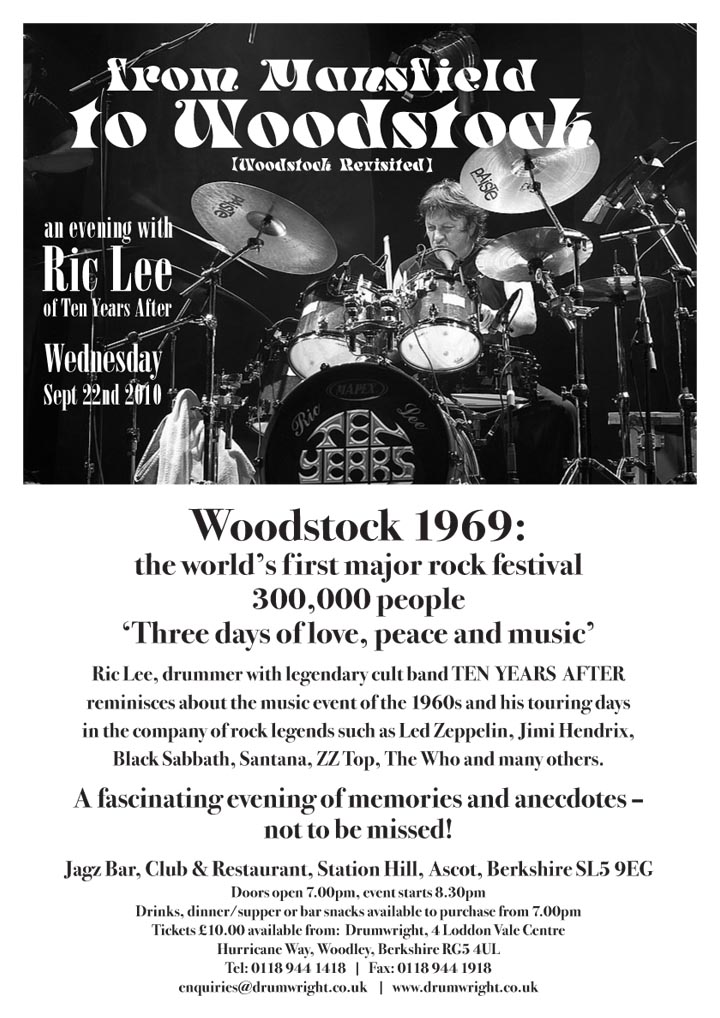
The
proceeds go to a Drumwright charity for the education of
children in India
Capacity is limited - so please book early!
|
|

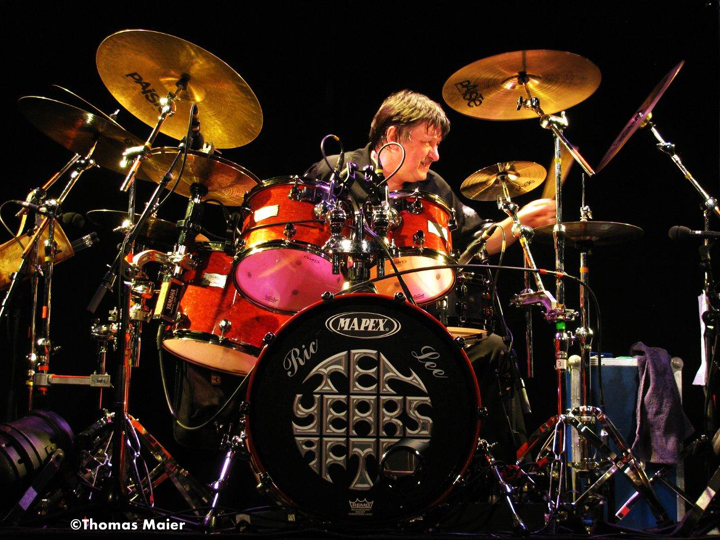
British
Drum Icon - RIC LEE
| IT’S not a bad career
high for a youngster who got into drumming using knitting needles
as sticks. Woodstock, mother of all festivals, where Ric Lee
and Ten Years After were one of the stand out acts. But don’t
think the near-mythical gathering in a farmer’s field near New
York defines the career of Mansfield’s most famous musical
export, with apologies to Alvin Stardust. Lee, still
pounding out Ten Years After classics with the ‘Now’ version,
boasting three quarters of the line up at Woodstock, was one of a
raft of drummers who inspired Spinal Tap, and also helped teach a
young drummer from Redditch a few things about triplets. |
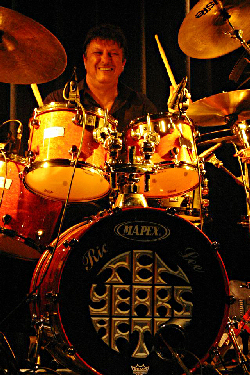 |
| Ric
Lee |
That his love and enthusiasm for
the music is still strong is testament to the enduring appeal of
Ten Years After, the jazz-influenced blues rockers. He plainly
still gets a buzz out of playing the music. It’s still a
challenge, especially with new tracks being written and the
arrival of Joe Gooch as front man to replace Alvin Lee (no
relation). It’s about 50 years since the young wannabe
drummer saved up his wages from a job delivering meat for the
local butcher to buy a snare drum and stand that he had “idolised”
for months – and that was it for a while. A young Lee, snare
drum and sticks.
“My oldest brother, Peter, had a
wind up gramophone and all these 78s, like “12th Street Rag”,
Guy Mitchell’s “Singing The Blues,” recalls Lee. “We wore
those records out. I used to tap along to them with knitting
needles. We also used to listen to Family Favourites and the Billy
Cotton Band Show on the radio at Sunday lunchtimes. “Mum
and dad said they couldn’t afford a drum kit so I got a job as a
delivery boy for the local butcher.” With the 10 shillings
(50p) a week he earned going into a fund for the much-prized snare
– “I can’t remember the make now, but I’ve got a feeling
it was an Olympic or Beverley with vellum skins” – Lee would
tap along to the music on the radio or the discs.
Seeking lessons from a local drum
teacher, the eager Lee was told “go and do piano for six months”.
“It was actually brilliant advice,” he remembers today. “He
also took me to several sessions and I learned to read music. It
was good discipline. I had to learn to read music quickly because
I had to turn the pages for him.” Cobbling together a
24inch gong drum for a bass, with an old hand painted Indian tom
tom and Charleston cymbals, Lee soon immersed himself in the
Mansfield music scene, often covering Cliff Richard and The
Shadows, Elvis and other top bands of the day. Inspired by
The Hollies’ Bobby Elliott, Lee sought further lessons and met
up with another local drummer called David Quickmire, at that
point occupying the drum stool in an up-and-coming band called The
Jaybirds, then a three-piece with virtuoso guitarist Alvin Lee and
bass player Leo Lyons, whose frenetic style masked a subtle touch.
Quickmire gave Lee an education in
drumming and drummers, from Joe Morello, Bill Eyden, Shelley
Manne, Buddy Rich and Art Blakey. “I also picked up on
Gene Krupa,” recalls Lee. “Dave didn’t want the gig with The
Jaybirds anymore. He wanted to get married and settle down.
Unbeknown to me he had taught me the techniques that would get me
through the audition.”
But after months of making a “phenomenal”
amount of cash (for that time) through gigs – “I had been
getting £15 a week with my first band The Mansfields.. At my day
job with the Inland Revenue (I only worked there for a year!) I
was only getting £7 10 shillings. When I joined The Jaybirds I
asked for £15 a week and they said “yes”. I didn’t realise
they weren’t making as much money as The Mansfields.
“A few months later Leo came up to me and asked me to go for a
split of the cash, not £15. He said that “when we make it, not
if” I would still be on £15 while they were coining it in. I
decided to take the split.”Soon
things were looking up for the band, but it was still a
topsy-turvy road. Winning a part in the London show “Saturday
Night, Sunday Morning”, saw them increase their earnings to £40
a week each and live like lords in swanky hotels. But then
the show ended after just a six-week run and for Lee, it led to a
hectic session schedule, taking over drumming duties from Clem
Cattini at Southern Music, music publishers and others. A
television appearance to bolster sales of tickets for the show led
to them being approached by the agent for the Ivy League and
things soon picked up for the band, now augmented by Chick
Churchill on keyboards. Then fate played its hand and Leo
managed to get the band, now called The Blues Yard, a slot at the
legendary Marquee Club. “Blues was just happening.
We had an interval slot on a Sunday supporting the Bonzo Dog
Doo-Dah Band and we got standing ovations. “I felt the
bass drum should work with the bass player and left hand with
Alvin’s licks. We played at Middle Earth in Convent Garden and I
was wrapping up my gear when two Brummies approached. One of them
asked me what the patterns were that I was doing with my left
hand, so I showed him. The two Brummies were John Bonham and
Robert Plant. Bonham converted my left hand patterns to the bass
drum, the famous Bonham triplet, although I think I had picked it
up from Art Blakey or Max Roach.”
|
Ginger Baker also
showed Lee a few tricks after a performance with the Graham Bond
Organisation. “He asked me if I had a pen, ripped up a fag
packet and wrote down what he had been playing.” Woodstock
came about for Ten Years After through London Records’ promotion
of their albums in America. “We were starting to
record tracks for what would become Stonedhenge and we got a
telegram that we could play Bill Graham’s Fillmore West if we
were ever in America.”
They duly did tour
America, meeting up with The Grateful Dead in Phoenix, jamming
with Jimi Hendrix and having blues royalty like BB King come and
see them in New York. The three-day musical extravaganza in
a farmer’s field near New York has acquired near mythical status
and Ten Years After was one of the acts of Woodstock. Their energy
and musical prowess won through despite technical troubles and
rain that affected the festival. But Lee, whose powerhouse
drumming propelled that performance, remembers Woodstock as a
stressful few hours, with the band hungry and bewildered by the
sheer scale of events. “Woodstock was fabulous,” he
recalls. “It was different to anything that came before, or
after. It was initially going to be a 50,000 people festival and
we weren’t going to do it because we weren’t getting paid
enough. “At that stage there were only about nine or ten
acts. I don’t think The Who, Hendrix, Jefferson Airplane had
agreed and the bill wasn’t that fantastic. It was a difficult
decision.” Joni Mitchell, that siren whose music
encapsulated the Woodstock era, was among the acts which declined
to perform at the festival, along with Free, The Moody Blues, Led
Zeppelin, Jethro Tull, the Jeff Beck Group and Frank Zappa.
Ten Years After, who
had only just begun to get a reputation in America, did manage to
slot the gig in during a hectic couple of days stateside, in front
of an estimated half a million people. Lee remembers: “I
think the figure has been inflated. I guess there were about
300,000 there, but it was still unlike anything we’d seen.
People just dumped their cars and walked. You couldn’t get
within six miles of the place. “We had flown in from
St Louis that morning and then driven for two hours. There were
helicopters for the acts and we went up this hill and were
standing there waiting for our helicopter when these four geezers
came up and got on in front of us. It was Crosby, Stills, Nash and
Young. “We hadn’t had anything to eat or drink. We were
told not to eat anything that wasn’t cooked or drink anything
that wasn’t sealed because of food poisoning and hepatitis.
“When I look at the film now I realise how dodgy the sound must
have been. After a storm passed through it became very cold. I had
only got a tank top and jeans on and there are pictures of my
first wife sewing different materials on to the tank top to keep
me warm.” The band went on at 10pm on the last day. The
storm had delayed proceedings and the atmospherics were terrible.
“We started Good Morning Little Schoolgirl four times. It was a
dreadful start in front of 500,000 people. However, we
finished the set and managed to find a state trooper on a horse,
and a car complete with driver to take us out of the site. We got
back to base camp at about 1am, asked for something to eat but the
restaurant was closed. Luckily, there was a diner nearby and
I think we ate everything they had.”
Getting back to New
York later than expected, the group found their rooms had been let.
They found alternative places to sleep before their New York gig
and set off for Baltimore the next day. A truly whirlwind tour,
with emotional highs and lows. “If we hadn’t have done
Woodstock, we wouldn’t have had a career like we have,” admits
Lee. “But in a sense it was just another gig. The enormity of it
was that it was the first and last of its kind.” Ten Years
After played the Isle of Wight Festival in 1970 in front of
600,000, although: “It didn’t have the atmosphere of
Woodstock.”
At the height of their
career Ten Years After released 11 studio and live albums,
including the critically-acclaimed Cricklewood Green containing
the UK Top Five single “Love Like A Man”. But the cracks
were beginning to show. Alvin Lee and Leo Lyons weren’t seeing
eye to eye and the drummer was often the middle man. “I was like
the bloke in Spinal Tap, which I’m sure was based on me. I was
the buffer between the two. That’s what I ended up being, on
stage and off.” During the recording of A Space In Time,
Lee had been ill and the band recorded what was to become one of
their biggest tracks without him. He returned to the studio
and the band asked him to dub the drums on to the track. In
those days there were no click tracks, consequently the timing
shifted throughout the track, but Lee enjoyed the challenge and
believes it adds to the track’s feel. “I’d Love To Change
The World” became TYA’s biggest hit in the USA.
The wheels could have
come off the Ten Years After bus when Alvin Lee finally split for
a solo career. By this time Ric had got involved in music
publishing and then joined Stan Webb’s Chicken Shack before a
brief reformation of Ten Years After for the Marquee’s 25th
anniversary. Lee, who managed the band for an additional couple of
European dates, said: “We also did Reading as “special guests”,
which was nice. We went our separate ways again until 1988 when I
got a phone call from Alvin again seeing if we could do some
European festivals. It was good to get back together again.”
A new album, “About Time”, recorded in Memphis, Tennessee was
released in 1989, but Alvin Lee left the band to go solo in 1991.
Another reformation of TYA took place in 1995 and the band toured
South and North America. The reformation lasted until 1999 when a
row erupted between Alvin Lee and Leo. Lee then went across
Europe with Kim Simmonds’ Savoy Brown and during the
tour realised “there was a hell of a lot of demand for Ten
Years After”. Enter Ten Years After Now, rebranded but still
pounding out the classics and newer material. He added: “We
found two guitar players of our age and then Joe Gooch, who was a
lot younger. We knew instantly that Joe was the right man for the
band. In the first year with him we did more rehearsals than we’d
ever done before. We also recorded a new album, “Now”, which
sold phenomenally well.” That album was followed by a “live”
double CD “Roadworks” in 2005 and a DVD and new studio
album will be released in early 2008. And as for the
drumming? “You get an inbuilt sense of time. You
have got to develop that internal crotchet. Leo doesn’t play
bass like many others who anchor the time. Guitarists tend to
pull. It’s a great challenge.
“I think it is most
important to play what the music requires. There are times when
Joe is soloing and I stay off the double kick pedals, others when
I really go for it. You’ve got to listen to and feel what’s
required for the music that’s going on around you. “When
Chick is soloing, for instance, I try to emphasise and be
sympathetic to what he is playing. There’s lot of stuff that I
can play but doesn’t really need to be in Ten Years After. It’s
about exercising taste in what you choose to play, thinking about
the audience, and working closely with your fellow musicians.”
Interview by Mark
Forster
|
|
|
|
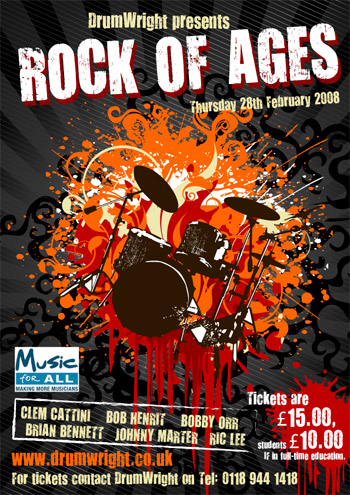
28
February 2008
Ric Lee,
Chick Churchill and Joe Gooch at "ROCK OF AGES"
in Reading, UK
The line-up at the Rock
of Ages Charity will be Chick Churchill on
keyboards, Joe Gooch on guitar & vocals
and Ric Lee on drums (of course) of Ten Years
After and a friend of the band, Mark Pullen on
Bass. Unfortunately, due a prior engagement
Leo Lyons, original bass player of Ten Years After will not be able to perform at the event.
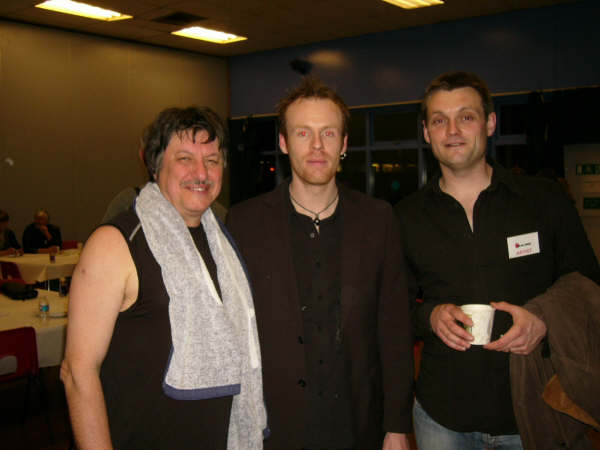
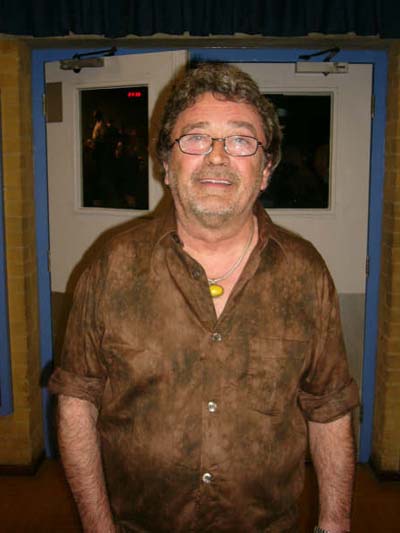
Ric Lee, Joe
Gooch, Mark Pullen and Chick Churchill
From Lionel
Webb:
Brigitte,Dave
Hi......... Trust you are both well, I went to the
Rock of Ages gig last Thursday, a concert held to
help fund Music for All, a charity to
encourage people to participate in music. The
venue, a sports hall in Reading, was pretty
much full with a mixed of ages from children to
the over 60'S I will send on a programe listing
the musicians performing as I know this is of
interest. I plus son Duncan were there to hear Ric,
Chic & Joe. They kicked off with King of the
Blues, after an on stage interview with Ric, the
event was sponsored by a drum company, in which he
talked about Woodstock, playing on the same bill,
and meeting Buddy Rich as well as what was
happening now.the second piece was The Hobbit, I
have of course been fortunate to hear this several
times but I would say this was the best yet, well
there was an audience of drummers and would be
drummers, the guys together with standin bassist
Mark Pullen,finished with Goin Home of course,the
seated crowd loved it and I would say they made a
good few new fans on the night.
I managed to have a few words with the guys
afterwards, Ric of course wanted to know how it
sounded, I said great but I just know he could
have told me of loads of things that weren't as he
would like, he's such a perfectionist. I managed
to get a couple of photo's, which I attach (fingers
crossed), let me know if they dont appear.
Love and peace to you both.....Lionel
Many thanks to Lionel Webb for the photos and report
|
PRESS
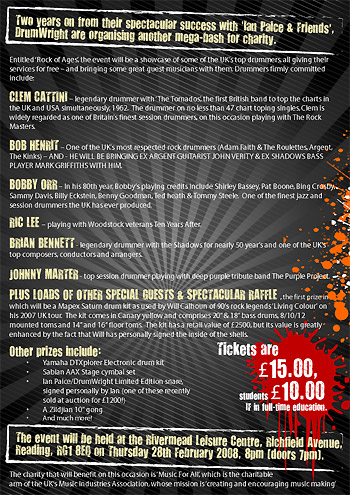
RELEASE 28TH JANUARY 2008
TOP
DRUMMERS FOR CHARITY GIG
On
28th February Reading’s Rivermead
Centre will rock to the beat of some of the UKs
greatest drummers, all of whom have given their
services absolutely free for charity.
The
event is called ‘Rock of Ages’ and has been
organised by DrumWright Managing Director Chris
Wright, who is one of the driving forces behind
the new charity Music For All. Chris explains:
‘Music
For All` is a charity which has the simple
aim of getting more people –from every age group
– to play music.
Rock of Ages aims to bring together some of
the most successful drummers in the UK for a
one-off fund raising event to raise funds to help
today’s aspiring musicians to take up an
instrument.”
The
careers of some of these drummers span more than
six decades.
They include:
BRIAN
BENNETT –
legendary drummer with The Shadows for nearly 50
years – and one of Britain’s top conductors,
arrangers and composers, playing with fellow
Shadow Mark Griffith (bass).
CLEM
CATTINI –
drummer with ‘Johnny Kidd and the Pirates’ and
‘The Tornados’, the first British band to top
the charts in the UK and USA simultaneously in
1962. He was the drummer on no less than 47
chart topping singles (including Love Affair’s
‘Everlasting Love’, Tom Jones ‘The Green
Green Grass Of Home’, Jeff Becks
‘Hi Ho Silver Lining’ and many of the
Kinks hits).
He is widely regarded as one of Britain’s
finest session drummers.
He will be accompanied by ‘The Rock
Masters’, featuring
one-time member of ‘The Springfields’ Mike
Hurst, who went on to play in ‘The Methods’
with Jimmy Paige, Albert Lee and Tony Ashton
before becoming one of the UK’s top record
producers (over 50 chart singles and 25 Platinum
albums, including Manfred Mann, Cat Stevens, PP
Arnold, The Move and Showaddywaddy); Colin Farley
(bass), best known as a member of Cutting Crew and
co-writer of their 70’s hit ‘I Died In Your
Arms Tonight’; and one of Britain’s top
guitarists, Ray Fenwick (Spencer Davis, Ian Gillan).
BOB
HENRIT – One
of the UK’s most respected rock drummers (Adam
Faith & The Roulettes, Argent, The Kinks)
–and – he will be bringing ex- Argent
guitarist John Verity and ex-Matthew Southern
Comfort and Shadows bass player Mark Griffith with
him.
Their performance will include Argent’s classic
70’s hit ‘Hold Your Head Up’.
RIC
LEE
– drummer with Woodstock veterans Ten
Years After - will be appearing at the
concert.
The line-up at the
Rock of Ages Charity will be Chick Churchill on
keyboards, Joe Gooch on guitar & vocals and
Ric Lee on drums (of course) of Ten Years After
and a friend of the band, Mark Pullen on
Bass. Unfortunately, due a prior engagement
Leo Lyons, original bass player of Ten Years
After will not be able to perform at the
event.
BOBBY
ORR – In his
80th year, Bobby’s playing credits include
Shirley Bassey, Pat Boone, Bing Crosby, Sammy
Davis, Billy Eckstein, Benny Goodman, Ted heath
& Tommy Steele. One of the finest jazz
and session drummers the UK has ever produced, and
Bobby will be performing with a big band of 15 –
19 year olds from the Berkshire Maestros.
NIGEL
SHIPWAY – one of
the UK’s top percussion players – a man with a
CV that reads like a Who’s Who of the UK music
scene.
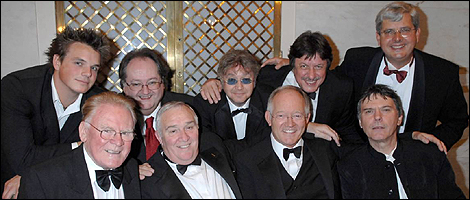
Back
Row: (left to right) Ian Wright (son of Chris
Wright and Operations Manager at DrumWright)’
Nigel Shipway, Ian Paice, Ric Lee, Chris Wright.
Front row: Bobby Orr, Clem Cattini, Brian
Bennett, Bob Henrit
at the MIA’s annual awards ceremony at
The Savoy in October, at which Chris Wright made a
presentation to Brian Bennett in recognition of
his outstanding services to music over fifty years.
(Photo Credit to OK Magazine).
|
|
|
Ten Questions With Ric Lee
Question 1.
Would you tell us who some of your major musical
influences were, and then what makes someone like
yourself want to beat the hell out of a perfectly good
drum kit for a living?
Answer 1.
What really got me started in music were mainly the
jazz players, such as:
1. Buddy Rich (of course) 2. Art Blakey, 3. Shelly
Manne 4. Joe Morallo
In Rock it was: 1. Mitch Mitchell, 2. Clive Bunker,
and 3. Ginger Baker.
More recently: 1. Chad Smith, 2. Dennis Chamber, 3.
Vinnie Colaiuta, 4. Rene Creemers, 5. Greg Bissonnette,
6. Simon Phillips and many more.
My eldest (older) brother Peter, wanted to be a
drummer and he tapped all around the house. Apparently,
it rubbed off on me because I became obsessed with the
instrument.
Question 2.
During the height of Ten Years After success in the
late 1960's and early 1970's and during the vast
number of tours the band did, which opening bands
really gave you guys a good run for your money?
Answer 2.
No opening bands that I can think of, but there were a
few headliners that sure did, such as Janis Joplin and
Big Brother, The Jimi Hendrix Experience, and
Fleetwood Mac, with the original line up of, Peter
Green, Mick Fleetwood, John McVie and Jeremy Spencer.
Question 3.
Considering that Ten Years After originated in
England, was the band's decisions based on a monarchy
system or on a democratic vote?
Answer 3.
In the beginning, Leo managed the band and the
material was chosen by Alvin and Leo together. Then
when we started recording, Alvin became the "songwriter".
Then, Chris Wright took over management of the band
but still operated through Leo, as he made suggestions
to Leo, who then fed them to us, they got our feedback
and then decisions were ultimately made. For the real
in depth answers to this question you'll have to wait
for my book to come out. The subject matter is just
too complicated and diverse to give a short yes or no
answer here.
Question 4.
In your honest opinion, did you really think that Ten
Years After would achieve the great success that it
did?
Answer 4.
Yes, in fact when I first saw Alvin, I knew straight
away that he had a phenomenal talent as a guitarist
and when he and Leo first asked me to join the band I
was determined to hang in there as I really believed
one day we would become big, if there was any justice
in the world.
We had some tough times and some narrow squeaks but we
kept going and finally came through.
Question 5.
I've seen Kim Simmonds perform many times. What was it
like to be playing drums for Savoy Brown?
Answer 5.
It was an honour and a joy. We had a pretty hectic
schedule on the European tour, but I thoroughly
enjoyed it. It was great playing with Kim and
Nathaniel Peterson (Nate) who later was with "Twin
Dragons". Even thought the sets were sometimes
gruelling, one and a half to two hours long at times,
which I hadn't done for quite a while.
Question 6.
What is the real story behind the name of the 1970 Ten
Years After album called "Cricklewood Green"
?
Answer 6.
Sorry, you'll just have to wait to read the sleeve
notes on the new re-mastered album when it comes out
later this year or early next.
Question 7.
What is your remembrance of the Woodstock Festival and
the late 1960's and early 1970's ?
Answer 7.
"Woodstock was a one-off (one of a kind)
phenomenon. It was terrific and I'll always remember
it. To have 300,00 (500,000) plus people in one place
with no violence was incredible. The camaraderie of
all those there was unbelievable. Bear in mind we were
there for one day only as we were in the middle of a
long tour. In contrast, the Isle Of Wight Festival in
1970 turned rather nasty and the love and peace era
was definitely at an end.
One of the things I'm doing at present is a series of
lectures titled "Woodstock Revisited"
sub titled "From Mansfield to Woodstock - Ten
Years After - A History" and I cover all these
subjects. A two hour, one man, audio visual
presentation with a bit of drumming thrown in, it's
going over a storm here in the UK. I'd like to bring
it to the States. Any suggestions?
Question 8.
What is your take (opinion) on the songs played live
on the Ten Years After set-list, and also did you want
to do more and different tunes and material?
Answer 8.
"I always thought the Ten Years After sets were a
little short and would have been happy to play longer.
I also thought that in certain venues we could have
done an acoustic spot similar to the ones we used to
do at the Marquee Club in the early days. We grouped
round the mic centre stage. Alvin sat and played an
acoustic guitar, Chick played "steam" piano
(which is an ordinary non-electric piano), Leo was on
an upright string bass and I had just my snare drum
and played with brushes. We did two or three tunes,
one of which was "Don't Want You Woman", I
think. I suggested to Alvin we do that again when we
played the Hammersmith Odeon concert in the late
1980's, but we didn't. A short time later, everyone
followed Eric Clapton'a lead and did "Unplugged"
concerts for VH1…MTV. What can I say?
Question 9.
About your Ten Years After diary (book), when will it
be published? And also, what years and topics will it
cover?
Answer 9.
I'm working to publish my book. It's more of a story
than a diary, covering from the time I started playing
with bands, through joining Alvin and Leo, Woodstock,
the albums, tours, the business set ups (arrangements)
and downs and loads more.
Question 10.
In your opinion Ric, will Ten Years After ever tour or
record again with Alvin Lee?
Answer 10.
As I see it at present, no. But as Leo says, "Never
say never".
Ric Lee 7 / 15 / 02
|
|
|
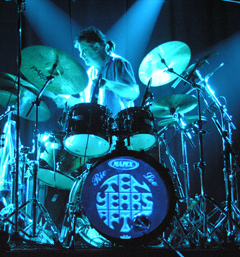
Ric Lee 2005
Ten Years After's one and only drummer is
not getting older he's getting better all the
time.
Taking his old favorite and signature drum solo
"HOBBIT" and kicking dynamic new life into the
old crowd pleasing favorite for Ten Years After then and
Ten Years After "NOW"
He
continues to strive for perfection. Hear it, and see Ric in action performing it live and meet him in
person on tour "NOW"
|
|
TEN YEARS AFTER: THIRTY-TWO
YEARS LATER
By GERRY GALIPAULT
(Feb. 3, 2002)
It dawned on Ric
Lee one day while shopping in a record store in Germany
two years ago: Ten Years After is sorely misrepresented
on compact disc.
The drummer for the British blues-rock quartet
immediately sought to right a wrong.
"I got in touch with EMI, because I realized there
were only like two of our records out (on CD)," Lee
said recently. "The rest of it had been sort of
deleted. I went to EMI and said, 'What's going on? This
is our history that's going down the tubes here. Can't
we put some stuff together?'
"There were licensing things all over the place to
smaller labels and there was little quality control over
it. Nobody really cared about it. And there were
different pricing levels. It was harming the catalog,
really."
EMI agreed and decided to revamp Ten Years After's
classic albums from the early 1970s. First up in this
year's reissue campaign, however, is a previously
unavailable album, "Live at the Fillmore East"
(Chrysalis/EMD), initially released last summer in
Britain and issued stateside on Jan. 8.
Recorded less than a year after the group's seminal
performance at Woodstock in 1969 and just before the
release of its heralded "Cricklewood Green"
LP, "Live at the Fillmore East" captures Lee,
guitarist-vocalist Alvin Lee (no relation), bassist Leo
Lyons and keyboardist Chick Churchill at the top of
their game. The 12-track, two-CD set, replete with
psychedelic jams and nostalgic nods to such rock
standards as "Good Morning Little Schoolgirl"
and "Roll Over Beethoven," was recorded by
engineer Eddie Kramer, best known for his work with Jimi
Hendrix and for building Hendrix's Electric Ladyland
studio in New York.
"If you listen to the Fillmore album and think of
it in the context of (Alvin) and me playing off each
other," Lee said, "it's more apparent on that
album than anywhere else. Which is why I like the album
so much. We really did kind of spark each other.
"And the sound quality is fabulous. I'm knocked out
with it. Eddie said at the time that it was the best
drum sound I ever had. For Eddie to get it under the
conditions he was in - it was pretty hairy - makes it
even more amazing.
"I was talking to him about it. He said he got all
the gear covered up with tarp and sheets because as soon
as the band started playing, dust came piling out of the
ceiling. He was right under the stage. He didn't want to
risk anything getting into the phasers or whatever. He
was working under a sheet with a lamp."
Lee has fond memories of Bill Graham's cozy 3,564-seat
theater at Second Avenue and Sixth Street in New York
City.
"Alvin says he remembered the jamming, which I do,
too," Lee said. "But unfortunately when you
got the chance to play, you were either too stoned or
too drunk, so you wandered off to the hotel. He
remembers jamming with Janis Joplin, and Bill Graham had
set it up for us to jam. Loads of people showed up.
Janis always had a bottle of Southern Comfort with her,
and she was swigging that. She gave one to Alvin, which
he thought was a sweet wine. He drank it, and he was
never that big of a drinker, but he collapsed basically.
The next thing, he woke up at about 6 or 7 in the
morning, and the whole theater was deserted and he had
to walk back to the hotel on his own."
During that three-day run at the Fillmore in February
1970, Ten Years After headlined with John Hammond,
Zephyr (fronted by Tommy Bolin) and Doug Kershaw. Few
bands in those days, though, dared to share a stage with
Ten Years After, known for working its audiences into a
frenzy.
"We used to go on with the idea that nobody could
follow us," Lee said. "That's how we basically
built up our whole thing. Blood, Sweat & Tears had
us taken off a tour around about the same time because
they couldn't follow us; we had done like three dates of
what was going to be a 15-date tour with them and they
said 'We want this band off the tour.' The same with
Country Joe and The Fish. We played the Fillmore with
them, and they said they would never follow us again. We
used to drain the audience. 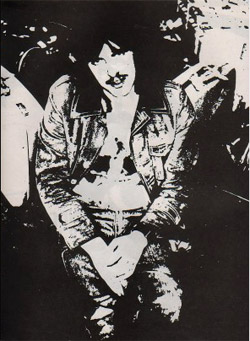 As you can hear on the album,
those were wild shows." As you can hear on the album,
those were wild shows."
Back then, endless touring and burgeoning FM radio were
the only avenues for a band like Ten Years After. The
group spent much of the early 1970s on the road, racking
up 28 tours of America alone.
Touring was a necessary evil, Lee says, but it may have
been the band's undoing.
"In a lot of ways, I think that's what caused a lot
of the cracks," he said. "When you're in that
mode, traveling every day, it can make you go cuckoo.
Initially, we were traveling by car in America; you'd do
an East Coast tour and then a Midwest section and then
the West Coast. Then you'd do a Texas and Southern
section. In the early days, we went into markets to try
to break us out, like New York and Boston. Those we
would do by car or station wagon; we used to fly the
gear in. Then we got to flying later.
"I used to enjoy the early days, that Fillmore
period. For instance, we used to do the Boston Tea
Party, which we would do for three nights. You got time
to know people and got to the know the towns. I used to
love to play golf, otherwise you'd be hanging around
bored stiff or getting stoned. I liked to get out and do
something.
"But that's the way you built a band in those days.
We didn't tend to make singles. One of the conditions at
the beginning of the deal with Decca (in the U.K.) was
that we wouldn't do a single first and then follow it
with an album, which was the normal modus operandi. We
insisted that it be an album deal, otherwise we were
going to look elsewhere. We didn't want to be one-hit
wonders, a flash in the pan."
Their albums sold well, fueled by such FM hits as
"Love Like a Man," "Baby Won't You Let Me
Rock 'N Roll You" and "Choo Choo Mama."
Their lone U.S. Top 40 hit, "I'd Love to Change the
World," is a mainstay at classic rock radio.
"I was talking with Alvin the other day, and he's
quite right," Lee said, "we consider ourselves
musicians rather than pop stars. Woodstock was a good
and bad thing for us. We got saddled with 'I'm Going
Home,' as though that was the only thing we could do. On
that Fillmore show, things like 'Spoonful' and 'Help Me
Baby,' showed how we used to jump and change the shows a
lot in those days. We'd jam a lot. After Woodstock, that
tended to go out the window completely and we started
doing formulated performances."
Today, Lee and Lyons form two-thirds of the rock trio
LLC. Signed to New York-based Blue Storm Music, they're
working on a new album. Alvin Lee continues to tour with
his Alvin Lee Band, mostly at European festivals.
Churchill also has his own band and, like Alvin Lee,
lives in Spain.
Lee would love to see a Ten Years After reunion, but
he's not banking on it: For whatever reason, Alvin Lee
and Lyons aren't on speaking terms.
"I think the rift is too big," he said.
"Alvin and Leo have known each other for so long;
it's like a marriage that's gone wrong. It doesn't look
reconciliable to me. We'll see - never say never."
The sun may have set on Ten Years After, but Lee says
it's been a good life.
"I can't complain," he said. "The albums
are still out there; the fans are still around. I live
in the countryside (of England); I have two wonderful
children - a 9-year-old and a 6-year-old. Can't get any
better than that."
|
|
Released
in 2001
Ric Lee re-mastered for
quality sound
TEN YEARS AFTER
LIVE AT
THE FILLMORE EAST 1970
- Double CD Box Set -
click here to order
|
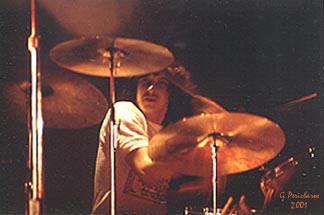
Photo by George Pericharos
|
RIC
LEE'S SOLO PROJECTS:
|
SAVOY
BROWN live in Harelbeke, Belgium – Saturday
April 15th, 2000
Kim
Simmonds (guitars, harmonica, vocals)
Nathaniel
Peterson Jr (bass, vocals)
Ric
Lee (from Ten Years After – drums)
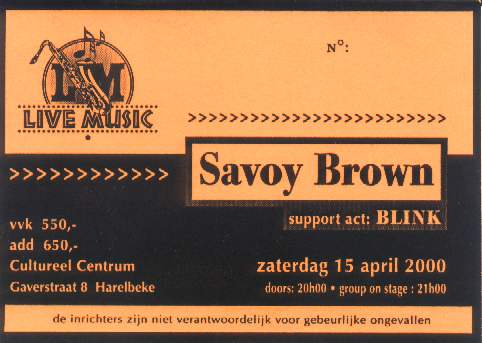
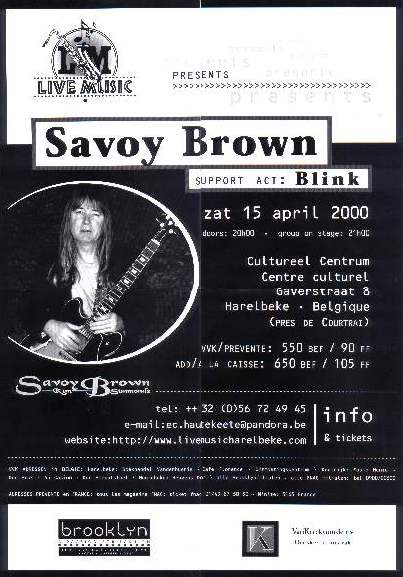
the REVIEW !
Savoy
Brown fans in general, and readers of Shades Of
Savoy Brown in particular, already know that Kim
Simmonds is a First League guitar player and
band leader. Those who had the pleasure to meet
him, know how nice a human being he also is. Two
months ago, when I first learned of Savoy
Brown’s planned performance in Harelbeke,
Belgium, I asked Kim if he would agree to sign
my huge collection of Savoy Brown vinyls and
CDs. Not only did he agree, but the way he
treated us (yours truly and a friend of mine who
introduced Savoy Brown's music to me 32 years
ago), was beyond all expectations. Not only
could we attend the soundcheck, but Kim and the
guys later invited us in their private room
backstage. No need to go into details here,
suffice to say that
Kim stopped eating his soup in order to
carefully unpack my LPs and sign them one by one,
making comments on their excellent condition and
giving his artistic opinion on some of them ! He
also signed some CDs and singles, and we talked
about various things (you know how a fan feels
when he meets his idol and gets to talk to him
during 15 minutes – it’s like being in
heaven). I then asked Nathaniel to sign my copy
of The Blues Keep Me Holding On, which he did
with great kindness. We then left the room, but
at this point, Kim asked Nathaniel – “did
you sign Raoul’s CD ?") . Another proof
of Kim’s nice attitude towards the fans.
Back
in the hall, and the opening act (a Belgian band
called Blink) entertained us with 60 minutes of
pure 50s rock and roll (Gene Vincent style).
At
approximately 10.30 pm, Savoy Brown took the
stage, generating a warm applause when the
promoter introduced them. They started with TOO
MUCH OF A GOOD THING (from Bring It Home) with
Nathaniel on lead vocals. Next was A HARD WAY TO
GO (from Raw Sienna) with lead vocals by Kim –
unusual as songs from the Chris Youlden area
fits Nathaniel’s natural voice better. Then
came a long instrumental intro to a slow blues
number, that I recognized as being LITTLE RED
ROOSTER (from The Blues Keep Me Hanging On) as
soon as Nathaniel began to sing. Is it still
necessary to say how good a blues singer
Nathaniel is ? Back to Kim on lead vocals, with
FIFTEEN MILES TO GO (from Live And Kickin’)
with an excellent crowd reaction. Nathaniel gets
back to his best “Chris Youlden” voice next
(and that is a compliment), with a splendid
version of I’M TIRED (from A Step Further).
Time for Kim to switch guitars now, and
announcing a slide instrumental, which happened
to be BLIND ALLEY (from his solo CD Solitaire).
A friend of mine begged me before the show, to
ask Kim to play MR BROWN’S BOOGIE (from Bring
It Home), which is his favorite number from
recent years. I didn’t have to, as this was
the song they played next (Nathaniel on lead
vocals). The rule of alternating rockers and
slow numbers was again respected, as they next
stepped into STAY WHILE THE NIGHT IS YOUNG (from
Raw Sienna). Another excellent Nathaniel vocal
performance. MISSISSIPPI STEAMBOAT (from The
Blues Keep Me Holding On) came next, with
another fine vocal by Kim. We then all stepped
aboard the TRAIN TO NOWHERE (from Blue Matter),
another Chris Youlden era song sung by
Nathaniel. Then came a very long medley; first
with Nathaniel on lead vocals for WANG DANG
DOODLE (from Street Corner Talking). Well in
fact one can nearly qualify this as double lead
vocals, as Kim added a strong second vocal
harmony on this one. The song was elongated to
include a long drum solo by Ric Lee, which was
appreciated by the audience. There was also a
jazzy mood during some of the instrumental parts
of this performance, which reminded me of the
jazzy moments of the Lookin’ In album. Next in
the medley came SAVOY BROWN BOOGIE (from A Step
Further). Not a very long version unusually, and
soon the tempo was slowed down for CAN'T GET
NEXT TO YOU (from Street Corner Talkin') and
then up again for another slice of SAVOY BROWN
BOOGIE. Kim then announced that it was over, and
said thank you and goodbye. But we all knew they
would come back, and less than one minute later
they were back onstage for the encore. The intro
to TELL MAMA caused a vivid audience reaction,
and Kim sang the lead vocals for this one,
Nathaniel adding the harmony. A long version of
LITTLE WHEEL was the last song they played, and
they then left the stage for good.
An
excellent performance is the exact description
for the evening, but I can't help but feel that
the show was shorter than usual. Well 115
minutes is by no means short, but the last time
I saw the band (in 1996) , they played for 160
minutes. But there was no opening act in 1996,
and with the band taking the stage at 10. 30 pm,
one can easily understand why the concert didn't
last as long as usual.
Unusual
also is the fact they didn't talk much between
the songs; they only introduced a couple of
songs and the rest was done without the
in-between-songs chat.
As to
Ric Lee, well the least I can say is that he
fits into the band's sound perfectly ! I just
hope that he stays with Savoy Brown after the
current European tour. But considering that the
original Ten Years After have now reunited and
regularly performs, it could be wishful thinking.
Another
unusual thing ? Well,
they didn't play Louisiana Blues ! And
that is MOST unusual, as Kim said many times
that it is one of his all time favorite songs
that he likes to hear and to play. Maybe they
planned to play it as the second encore, but as
they didn't come back on stage for that,
obviously they couldn't play it....
Thanks
again to Kim, Nathaniel and Ric for an excellent
evening of excellent music.
|
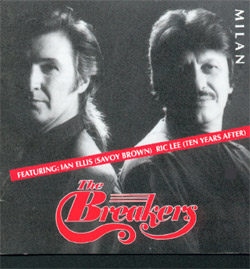
RIC LEE'S BREAKERS
Ric was (still is) the fine
drummer in mythical band Ten Years After. As the band
remains inactive during long periods of time (as Alvin
Lee also develops his own solo career), Ric keeps
himself busy with his own band, Ric Lee's Breakers.
In February 1995, Paul Samson (from
heavy metal band Samson) joins them:
- Paul
Samson (guitar, vocals)
- Ian
Ellis (bass)
- Ric
Lee (drums)
-
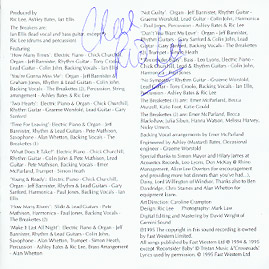
They toured promoting the album Milan
(recorded by Ric and Ian, with Tony Crooks on vocals and
featuring special appearances by Chick Churchill and Leo
Lyons, both from Ten Years After). Their tours usually
saw great guests jamming with them, such as Chris
Farlowe or Dick Heckstall-Smith.
Around August 1996, Paul Samson
leaves the band, as the band split because Ten Years
After started playing gigs again.
| Ian
Ellis Bass |
|
|
 |
|
Bass
guitar
|
•
|
|
Harmonicas
|
•
|
|
BG
vocals
|
•
|
|
|
|
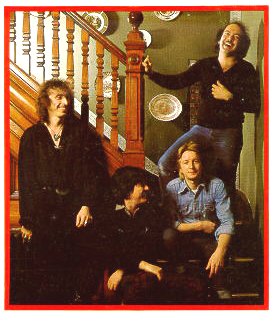
| Ian
Ellis is a superb Scottish
bassist and vocalist with an
enviable pedigree. During
his career he has played
with the Alex Harvey Band,
Savoy Brown, Steve Hackett,
Pete Townsend and the late
Paul Samson, to name but a
few. His solid, driving
bass-lines perfectly
compliment Ken Ward's
thundering drums. Born in
Scotland, [D.O.B. classified]
Ian now resides in South
London. |
|
 |
|
Ian's
Bio-Disco
|
| Bands |
Clouds,
Alex Harvey, Savoy
Brown Blues Band,
Southside, Steve
Hackett, Ric Lee's
Breakers, Mick
Clarke Band, Cream'd,
Tyla Gang II
|
|
|
|
|
|
|
|
RIC LEE with
Stan Webb's Chicken Shack (1979-1981)
In
May 1980 Stan put together yet another
version of Chicken Shack. The only
survivor from Banbury was Paul Butler,
joining them on bass was Alan Scott and ex-
TYA drummer Ric Lee. Alan Scott was soon to
be replaced by Andy Pyle who was ex-Juicy
Lucy, Savoy Brown, Blodwyn Pig, Colosseum
II, Kinks, Keef Hartley Band amongst others!
The
Roadies Concerto line up
Stan
and this line-up, augmented by Tony Ashton
back on keyboards recorded the live Roadies
Concerto album (released April
1981)which featured a more bluesy sound.
|
ROADIE'S CONCERTO
|
|
1.
2.
3.
4.
5.
6.
7.
8.
9.
|
Tell Me
Why I Sing The Blues
Back Door Man
Black Night
So Far Back
End (Prisoner)
Poor Boy
Shake Your Moneymaker
Hideaway
|
|
Tony Ashton
Paul Butler
Ric Lee
Allan Scott
Stan Webb
Producer:
|
Keyboards
Guitar, Vocals
Drums
Bass
Vocals, Guitar
Bazza, Stan Webb
|
|
|
The Incredible Kidda Band - March Music
- Biography 1979 by Ric Lee
-
Note:
Ric Lee became manager of the Kidda Band for a short time in
the 1980s.
The
Kidda Band consists of Alan Hammonds (Lead
vocal and songwriter), his brother Kidder who
lends his nickname to the band (Second vocals/keyboards),
John Rollason (guitar/vocals) and his brother
Les (bass), Dave ‘Legs’Lister (guitar/vocals)
and Paul Gardner (drums). All of the band lives
in Nuneaton except Paul who hails from Rugby.
Alan
(23) was originally a dustman and has the dubious
honour of being one time boyfriend of the local police
chief. At a recent gig he started a riot and offended
women’s’ libbers in the audience by stating his
preference for ‘feminine’ women. The group’s
songwriter, he ‘starts with a title’ usually to do
with a personal experience and ‘the rest of the song
follows from there’. His musical influences are The
Rolling Stones and Marc Bolan.
Kidder (21) must have been the youngest coal miner
in the country, but now prefers to try his hand at
gold mining rather than working down a pit. He is most
famous for having won the Cadburys Chocolate
Competition for painting at school for these
consecutive years! His musical influences are ELO
and Eric Clapton.
Les
(21) was on the dole for so long at one period that he
started to receive invites to the office parties. This
terminated quickly when he started accepting the
invites!! His musical influences are Slade and
the Alex Harvey Band.
Dave
(23) was the smallest juggernaut driver in England and
spent the early part of his life as a pendant on his
mother’s charm bracelet. Influences are Brian
Robertson of Thin Lizzy and Diana Ross.
Paul
(23) was a local council worker for the Health
Department and spent many years ‘up to his neck in it…’
in the sewers of Rugby. His influences are Cozy
Powell and Status Quo.
John
(23), the Kidda Bands’ answer to Robert
Redford, is probably the most volatile and dynamic
guitarist to arrive on the music scene since
‘supersonic’ Syd Little.
|
|
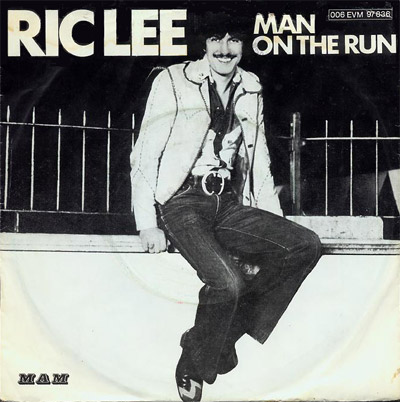
Rare
45-Record
Side
A: Man On The Run (Jones) - Side B: Free
Fall (Jones)
produced
by Ric Lee and John Jones
1976
M.A.M Records Ltd.
|
|
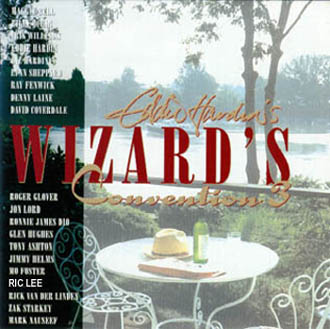
Eddie
Hardin's
Wizard's
Convention 1976
Extended CD Issue 1994
Drums: RIC LEE
on the song "Until Tomorrow"
Electric Guitar: Ray Fenwick
Bass Guitar: Mo Foster |
|
|
|
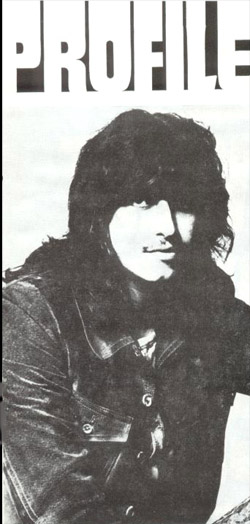
RIC LEE PROFILE
Beat
Instrumental December 1971
Although
we have a Player of the Month column for December, we
felt that Ten Years After drummer, Ric Lee, deserved
special mention, so we decided to Profile him.
Lee
is the perpetual student of drumming and is examining in
great detail all the different aspects and rhythms of
his counterparts around the world. He is currently
immersed in studies of the Afro-Cuban rhythms and feels
that Santana are falling down because of their lack of
exploration and that they have been overtaken by Osibisa.
Lee
has also been developing his own techniques of
Afro-Cuban drumming and feels that any white man could
play this type of music. “If you saturated yourself
enough in the environment, you’d have to adapt to its
influences eventually,” he said.
|
Lee was brought up on the strains of the big bands and Gene
Krupa, Buddy Rich, Louis Bellson and Duke
Ellington. He considers that Krupa, is probably
his greatest influence, although his admiration
for Rich runs very high. “Krupa raised the
complete status of the drummer by developing the
solo routine and bringing the whole concept of
the drummer to the fore. Before Krupa the
drummer just sat there and tapped out the
rhythms.” Lee says, it’s the job of the
drummer to kick the band along, and to have the
necessary dynamics. He must also, however, be
able to play all different styles of music at a
moment’s notice. He names Buddy Rich as one of
the finest exponents of dynamics, and drumming.
Rich, he says, would be able to play in a
20-piece orchestra just as easily as he could in
a four piece group.
One
of Lee’s greatest ambitions is to play in a
big band, and to help him along in getting the
feel of a larger band he is trying to persuade
the other members of Ten Years After to aid him
during his drum solos by doubling up on a
variety of percussive instruments.
Lee
first became aware of modern blues, as
interpreted by Ten Years After, with Big Bill
Broonzy, and other 12-bar blues artists. However,
he got bored with them quite quickly as they
lacked variation. He now says he prefers to play
his own blues.
Blues
are important to Lee. Depending on his mood he
says he can affect all the other members of the
band, and their playing. “If you’re feeling
bad you can sometimes really get good blues,”
he said. “I suppose it’s the same with any
other drummer, though,” he added. He
says he is now developing a new drum solo as he
feels the present one, which has caused
audiences on both sides of the Atlantic to stand
on their feet, and shriek with excitement, has
reached its limit.
|
|
|
“I first of all work to a
framework of key ideas, and start with the basic
rhythms. When something acceptable gets going I
build it up with some jazz, and blues influences.
Then I put a bridge in between the two for
contrast. About this time the technique starts
creeping in.
I
always do the same pattern solo but it never is
exactly the same solo, if you know what I mean.
I hope the new one is as good as the other one
turned out to be,” he said.
Lee
is, at present, using a Gretsch drum kit
comprising a 24´´ x 14´´ bass, 14´´ x 6 ½
wood shell concert-type snare (he said he
prefers the wood shell from the more popular
rock metal snare), a 12´´ x 9´´ tom-tom, two
16´´ x 16´´ floor tom-toms, a 19´´ heavy
ride Avedis Zildjian cymbal, two 16´´ thick
crash cymbals and two 15´´ hi-hats.
He
has, however, two other drum kits. He uses a
Ludwig for rehearsals and another Gretsch in the
studios. Every one of his drums is miked-up
through the PA, because he says he can get a
really balanced sound that way.
Note:
The first drum solo that Ric mentioned was
"Shantung Cabbage".
The new drum solo that Ric was working on
is called "Hobbit"
|
|
|
|
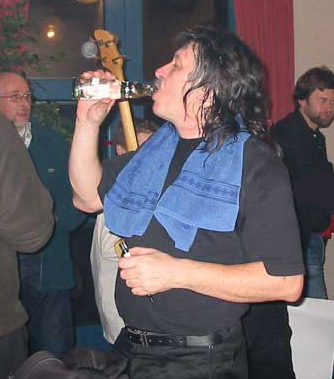
CHEERS EVERYBODY!
|